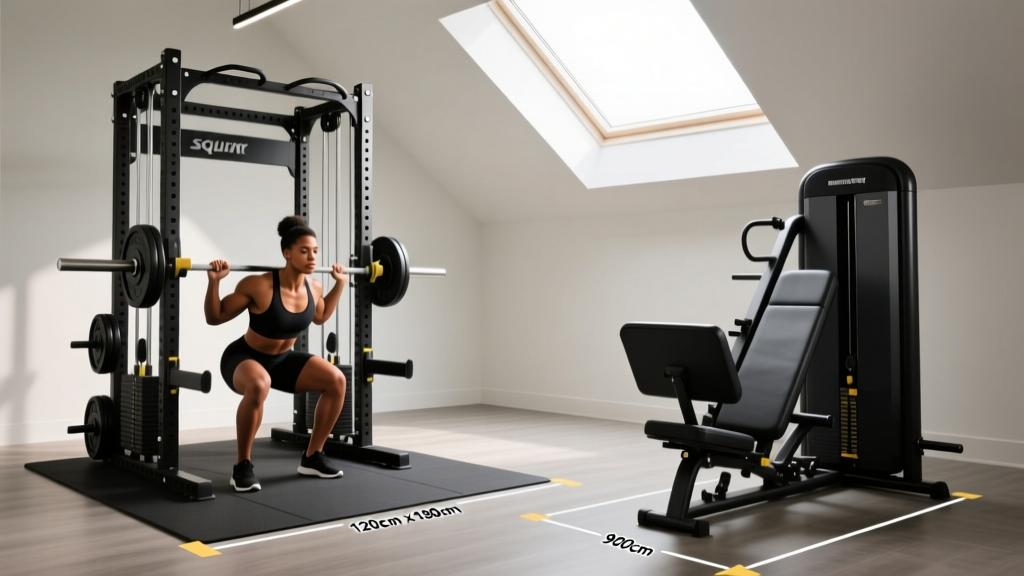
Squat Rack & Lying Down Leg Press Machine: Space Layout Guide
Optimize your gym layout with our guide to integrating a squat rack and lying down leg press machine. Exact dimensions, 2026 models, and floor plans.

The Ultimate Leg Day Dilemma: Heavy Iron in Tight Quarters
Building a comprehensive lower-body training zone requires addressing two distinct movement patterns: axial loading (squats) and horizontal/shear loading (leg presses). For serious lifters, the gold standard setup involves a heavy-duty squat rack or power cage paired with a dedicated lying down leg press machine. However, integrating these two massive pieces of equipment into a home garage, basement, or boutique commercial facility presents a severe spatial challenge.
Unlike 45-degree angled sleds that eat up vertical space, a true lying down leg press machine demands a massive horizontal footprint. When you combine this with the operational clearance required for a 7-foot Olympic barbell inside a power cage, poor layout design can result in dangerous choke points, restricted range of motion, and inefficient plate-loading workflows. In this 2026 layout guide, we break down the exact measurements, optimal floor plans, and equipment selections required to seamlessly merge these two leg-training titans.
📐 The 2026 Garage Gym Standard: According to facility design principles outlined by the National Strength and Conditioning Association (NSCA), a minimum of 36 inches of unobstructed walkway must be maintained between the operational zones of any two fixed-resistance machines to ensure safe user transit and emergency egress.Footprint Analysis: Vertical Cages vs. Horizontal Presses
To design an effective layout, we must first contrast the spatial constraints of both machines. The squat rack is primarily constrained by width and height. A standard Olympic barbell is 86 inches long. To load and unload plates safely, you need a minimum of 12 inches of clearance on each sleeve, pushing your absolute minimum width requirement to 110 inches (just over 9 feet).
Conversely, the lying down leg press machine is constrained by length and loading clearance. Because the user is completely supine, ceiling height is irrelevant for the machine itself. However, the carriage track and the user's body extend far beyond the base frame. Furthermore, loading 45-pound bumper plates (which have a 17.5-inch diameter) on low-lying horizontal pegs requires significant lateral floor space.
Equipment Dimension & Clearance Matrix
| Equipment Type | Base Footprint (W x L) | Operational Zone Required | Primary Spatial Constraint |
|---|---|---|---|
| Standard Power Cage (4x3) | 49" x 49" | 110" W x 84" D | Barbell width & ceiling height (90"+) |
| Folding Squat Rack | 4" x 43" (Folded) | 110" W x 60" D | Wall structural integrity & depth |
| Lying Down Leg Press | 34" x 83" | 70" W x 115" L | Total length & lateral plate loading |
Optimal Layout Configurations for 2026
When merging these two stations, you cannot simply place them side-by-side. The loading pathways will intersect, creating a hazardous environment. Here are the two most effective layout configurations for integrating a squat rack and a lying down leg press machine.
Configuration A: The L-Shape Corner Anchor
This is the most efficient layout for a standard 2-car garage (typically 20x20 feet). Place the power cage in the rear-left corner, facing inward. Position the lying down leg press machine along the adjacent right wall, with the user's head pointing toward the center of the room.
- The Workflow: You load the squat rack from the center of the room. When moving to the leg press, you walk diagonally to the adjacent wall. The loading pegs of the leg press face the open garage door, allowing you to roll plates directly onto the pegs without navigating around the squat cage.
- Space Saved: By utilizing two perpendicular walls, you eliminate the 'dead space' that occurs when machines are placed parallel to one another, preserving a massive 10x10 foot open turf area in the center for sled work or mobility.
Configuration B: The Parallel Corridor (Commercial Setup)
If you are designing a narrow basement or a commercial studio, the parallel corridor is your best option. Both machines are placed against the same long wall, separated by a 48-inch plate storage rack.
⚠️ Warning: The Choke Point Failure ModeNever place the open end of a lying down leg press machine directly facing the loading sleeves of a squat rack. If a lifter is executing heavy squats and needs to dump the bar backward, or if plates slide off the sleeve, the transit path to the leg press becomes a severe impact hazard. Always stagger the operational depths.
Equipment Selection for Space-Constrained Lifters
To execute these layouts, you need equipment that respects spatial boundaries without compromising structural integrity. Here are the top-performing models for 2026 that balance heavy-duty capacity with intelligent footprints.
1. The Squat Rack: Titan T-3 Series Folding Power Rack
If your layout demands flexibility, the Titan T-3 Folding Rack (priced around $699) is unparalleled. When folded, it protrudes only 4 inches from the wall. This allows you to push the lying down leg press machine closer to the squat zone on days you aren't squatting, effectively creating a modular gym floor. Ensure you bolt it into structural studs or a reinforced concrete wall using 3/8-inch lag bolts.
2. The Cage Alternative: Rogue SML-2C Squat Monster
For those who refuse to compromise on stability, the Rogue SML-2C (approx. $1,850) features a 30x30-inch footprint with 11-gauge steel. By utilizing Rogue's fold-up spotter arms and a wall-mounted pull-up bar, you eliminate the need for bulky rear uprights, shaving 18 inches off the depth requirement and giving the adjacent leg press machine more breathing room.
3. The Lying Down Leg Press: Body-Solid GLPH1100
The Body-Solid GLPH1100 (approx. $1,199) remains the industry benchmark for horizontal supine leg presses. Its dual-linear bearing system ensures smooth tracking, but its true value for layout design is its low-profile carriage. Unlike older models that required massive overhead clearance for the safety catches, the GLPH1100 keeps the weight stack and carriage low to the ground, allowing you to install overhead lighting or storage racks directly above the machine.
Safety, Flow, and Environmental Controls
Integrating heavy machinery requires more than just measuring tape; it demands environmental preparation. The American Council on Exercise (ACE) emphasizes that equipment placement must account for acoustic vibration and floor deflection, especially in residential spaces.
Flooring Specifications
Do not use interlocking foam tiles. The point-load of a lying down leg press machine fully loaded with 800 pounds, combined with the dropped weights from a squat rack, will compress and tear foam. The Solution: Install 3/4-inch (19mm) vulcanized rubber stall mats over a sealed concrete subfloor. For the squat rack zone, add a 2-inch high-density EVA foam layer beneath the rubber to absorb kinetic energy and protect your foundation from micro-fractures.
Plate Storage Integration
The biggest layout killer is scattered weight plates. To maintain the operational zones outlined in our matrix, utilize vertical A-frame plate trees positioned exactly between the squat rack and the leg press. This creates a centralized 'loading hub' that minimizes the distance a lifter must carry heavy plates, reducing lower-back fatigue before the working set even begins.
Frequently Asked Questions (FAQ)
Can I use a 45-degree leg press instead to save space?
While a 45-degree sled (like the Powertec or Body-Solid ProClub) reduces the horizontal length requirement, it introduces a massive vertical constraint. You will need a minimum ceiling height of 10 feet to accommodate the top of the guide rods and the user's head at full extension. If your space has low ceilings (under 96 inches), the lying down leg press machine is actually the superior spatial choice.
How much weight capacity do I really need for the leg press?
For advanced lifters, the lying down leg press allows for immense overload due to the lack of spinal compression. It is common for athletes to push 1,000+ pounds. Ensure the machine you select has a minimum 1,000 lb capacity and features dual safety stoppers to prevent the carriage from tracking past the user's lockout point.
Is it safe to put a power cage on an upper floor?
Generally, no. A loaded power cage and a lying down leg press machine can easily exceed 1,500 pounds of static weight, not including the dynamic force of dropped reps. Unless your floor is reinforced with commercial-grade steel joists, keep this specific layout on a ground-level concrete slab.
More gear to consider
All reviews
Setting Up a Rogue Leg Press Machine vs Hack Squat

Squat Rack vs Hammer Strength Leg Press Machine Space Layouts

Leg Extension & Curl Guide: Beyond How to Use Leg Press Machine

Glute Training Trends 2026: Hip Thrusts vs Seated Leg Press Machine