
Hack Squat vs Leg Press Install & Leg Press Machine Feet Placement
Compare hack squat vs leg press installations. Learn spatial requirements, calibration, and optimal leg press machine feet placement for max gains.

The Heavy Metal Dilemma: Choosing Your Primary Leg Builder
As of 2026, commercial gym build-outs and elite home gym installations face a critical spatial and financial decision: do you allocate floor space and budget to a Hack Squat, a Linear Leg Press, or both? While both machines are foundational for lower body hypertrophy, their installation requirements, biomechanical outputs, and user setups differ vastly. This comprehensive walkthrough bridges the gap between physical facility installation and biomechanical user setup, ensuring your equipment is not only bolted down correctly but optimized for human performance.
Whether you are installing the Matrix Fitness Magnum Hack Squat (retailing around $4,800) or the Hammer Strength Linear Leg Press (approximately $5,900), understanding the nuances of structural load, carriage alignment, and user positioning is non-negotiable for safety and longevity.
Spatial Footprint and Floor Load Requirements
Before unboxing, you must verify your facility's structural integrity. These machines generate immense dynamic downward force. A user loading 1,000 lbs on a 45-degree sled creates a dynamic impact force exceeding 1,500 lbs during eccentric deceleration.
| Specification | Matrix Magnum Hack Squat | Hammer Strength Linear Leg Press |
|---|---|---|
| Footprint (L x W) | 86" x 53" (218cm x 135cm) | 83" x 62" (211cm x 157cm) |
| Machine Weight | 650 lbs (295 kg) | 890 lbs (404 kg) |
| Max User + Load Capacity | 1,000 lbs (454 kg) | 1,200 lbs (544 kg) |
| Required Concrete PSI | 3,500 PSI minimum | 4,000 PSI minimum |
Step-by-Step Installation & Calibration Walkthrough
Proper installation prevents carriage stuttering, uneven bearing wear, and catastrophic failure modes. Follow this exact sequence for linear-bearing-based leg equipment.
Step 1: Base Frame Leveling and Anchoring
- Positioning: Move the main frame into place, leaving a minimum 24-inch clearance on all sides for plate loading and emergency egress.
- Shimming: Use a 48-inch machinist spirit level across the base rails. If the floor is uneven, insert stainless steel shims under the base pads. Do not rely on the anchor bolts to pull the frame down to an uneven floor; this will warp the linear guide rods.
- Drilling: Mark the anchor holes. Use a hammer drill with a 1/2-inch carbide masonry bit to drill 3.5 inches deep into the concrete.
- Anchoring: Insert 1/2-inch x 3.75-inch zinc-plated wedge anchors. Torque to 60 ft-lbs using a calibrated torque wrench. This specific torque ensures the wedge expands fully without snapping the bolt head.
Step 2: Carriage Alignment and Bearing Lubrication
The most common failure mode in hack squats and linear leg presses is carriage binding. This occurs when the linear bearings are misaligned or improperly lubricated.
- Lubrication: Avoid standard WD-40 or petroleum-based greases, which attract chalk and dust, creating an abrasive paste. Use a PTFE-based (Teflon) dry-film lubricant or a specialized white lithium grease designed for linear motion systems.
- Alignment Check: Load the carriage with exactly 45 lbs on each side to test balance. Push the sled through the full range of motion. If you feel a 'grinding' sensation at the midpoint, the guide rods are under torsional stress. Loosen the carriage mounting bolts by a quarter-turn, cycle the sled, and retighten.
Biomechanics in Practice: Hack Squat vs. Leg Press
Once installed, understanding the biomechanical differences dictates how your members or clients will use the equipment. According to the ACE Fitness Exercise Library, spinal compression and shear forces are the primary differentiators between these two movements.
"The hack squat fixes the torso angle, significantly reducing the shear force on the lumbar spine compared to free barbell squats, while still demanding high core stabilization. The leg press, conversely, completely unloads the axial skeleton, making it the superior choice for athletes managing spinal injuries or those requiring isolated quadriceps overload without systemic central nervous system fatigue."
Mastering Leg Press Machine Feet Placement
While the hack squat restricts foot positioning due to the fixed shoulder pad geometry and balance requirements, the leg press offers a massive canvas for manipulation. Understanding leg press machine feet placement is critical for targeting specific muscle bellies and managing joint stress. By altering the moment arm, users can shift the primary load from the knee extensors to the hip extensors.
Below is the definitive guide to foot positioning on a standard 45-degree linear leg press, synthesized from kinesiology data and verified by ExRx.net's biomechanical databases.
| Foot Placement | Primary Movers | Joint Stress Focus | Best Application |
|---|---|---|---|
| High & Wide | Gluteus Maximus, Adductor Magnus | Hip Flexion/Extension | Glute hypertrophy, powerlifting lockout strength |
| Low & Narrow | Vastus Lateralis, Rectus Femoris | Knee Flexion (High Shear) | Quad sweep, bodybuilding detail work |
| Center (Shoulder-Width) | Balanced Quad/Glute/Hamstring | Distributed evenly | General mass building, athletic conditioning |
| Toes on Bottom Edge | Gastrocnemius, Soleus | Ankle Plantarflexion | Heavy calf raises without spinal loading |
Edge Cases and Safety Limits in Foot Placement
When utilizing the low and narrow leg press machine feet placement, the knee travels significantly past the toes, increasing patellofemoral compressive forces. While this is highly effective for vastus medialis oblique (VMO) development, it is contraindicated for users with a history of patellar tendinopathy or meniscus tears. Instruct users to stop the eccentric descent the exact millisecond their lumbar spine begins to round (the 'butt wink' threshold), which typically occurs when the knees reach 90 to 110 degrees of flexion in this specific stance.
💡 Pro Setup Tip: For users utilizing the 'High & Wide' stance to target the glutes, ensure they actively push through their heels. Placing a 2.5 lb plate under their heels on the sled platform can artificially increase ankle dorsiflexion, allowing for a deeper hip hinge without the calves restricting the range of motion.Maintenance and Failure Mode Troubleshooting
Even with perfect installation, heavy leg equipment requires rigorous maintenance protocols to survive a high-traffic commercial environment in 2026.
Troubleshooting Carriage Stutter
If the sled stutters or 'skips' during the concentric phase, inspect the linear bearings. Over time, microscopic metal shavings from the guide rods mix with sweat and chalk, forming a cement-like sludge inside the bearing housing. The fix: Remove the carriage, use a degreaser to flush the bearings, and re-pack them with marine-grade PTFE grease. If the inner race is pitted, replace the bearings immediately (typically 1-inch or 1.5-inch inner diameter flanged bearings, costing roughly $45 each from industrial suppliers like McMaster-Carr).
Preventing Sled Drift on Asymmetrical Loading
Users frequently load uneven plates (e.g., three 45s on the left, two 45s and a 25 on the right). On a 45-degree leg press, this asymmetrical center of mass creates a torsional twist on the carriage. Over months, this will warp the guide rods. Install physical weight-load stickers on the machine horns explicitly stating: "Load Symmetrically. Uneven loading voids warranty and risks carriage binding."
Final Verdict for Facility Builders
If your budget and floor space only allow for one machine, the Linear Leg Press wins on versatility due to the vast array of leg press machine feet placement options, allowing users to target everything from calves to glutes while completely unloading the spine. However, for pure athletic transfer and functional core integration, the Hack Squat remains an irreplaceable tool. For elite facilities, installing both—properly anchored into 4,000 PSI concrete and maintained with PTFE lubricants—provides the ultimate lower-body development ecosystem.
More gear to consider
All reviews
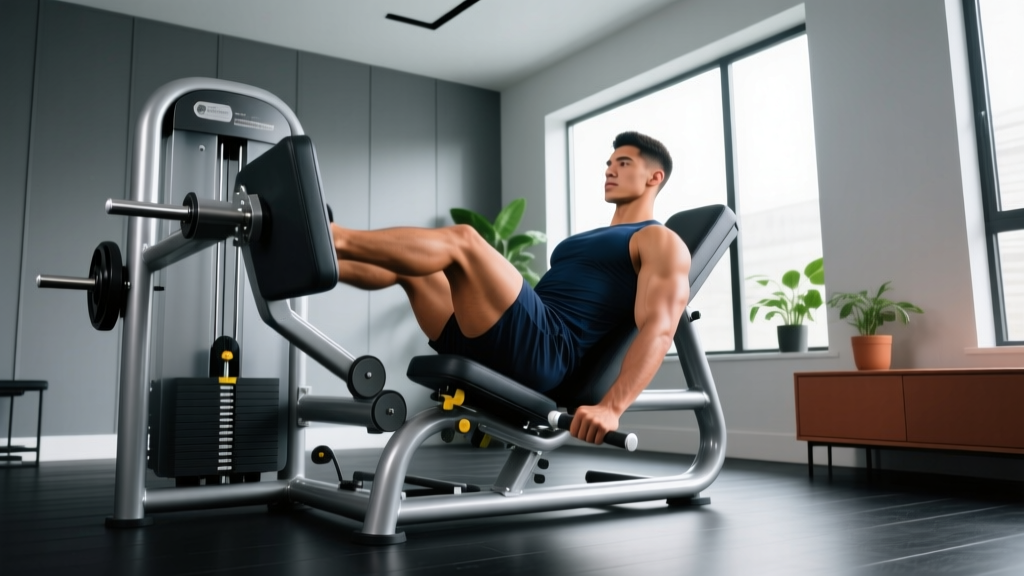
Beyond the Leg Press Machine Gym Image: Sled Guide
Glute Equipment Guide: Leg Press Machine Form in 2026

Space Layouts: Squat Racks & Different Kinds of Leg Press Machines

Fixing Calf Stalls: Standing vs Seated Gym Equipment for Leg Workout

Leg Press Machine Workout Guide: Horizontal vs 45-Degree
