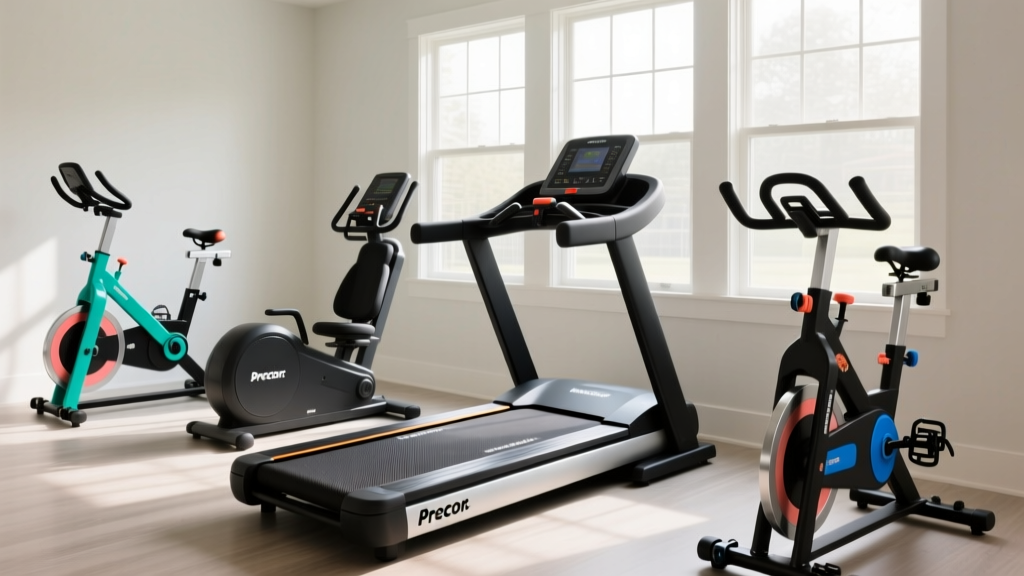
Home Gym Layouts: Bike Types and Your Precor Treadmill Serial Number
Optimize home gym layouts by comparing upright, recumbent, and spin bike footprints, plus how to use your Precor treadmill serial number for service clearances.

The Spatial Reality of Home Cardio Zones
Designing a high-performance home gym in 2026 requires more than just purchasing top-tier equipment; it demands a rigorous approach to spatial geometry and service logistics. When integrating multiple cardio modalities into a single room, the margin for error shrinks dramatically. A miscalculated footprint doesn't just make a room feel cramped—it can void warranties, block emergency egress, and prevent routine maintenance. According to facility design guidelines published by the American College of Sports Medicine (ACSM), proper equipment spacing is critical not only for user safety and biomechanical clearance but also for adequate ventilation and technician access.
This guide dissects the spatial requirements of the three primary stationary bike types—upright, recumbent, and spin—while addressing the often-overlooked logistical hurdle of housing a premium treadmill in the same footprint. Specifically, we will cover why locating your Precor treadmill serial number is a non-negotiable first step in finalizing your room's CAD layout or floor plan.
Decoding Stationary Bike Types for Tight Spaces
Stationary bikes are frequently marketed as 'space-saving' cardio alternatives, but this is a gross oversimplification. The spatial impact of a bike depends entirely on its chassis geometry, pedal stroke radius, and the user's biomechanical needs during high-intensity intervals.
Upright Bikes: The Vertical Compromise
Upright bikes mimic traditional road cycling geometry but with a slightly more relaxed seat tube angle. They are ideal for users seeking a moderate cardiovascular workout without the aggressive forward lean of a spin bike.
- Model Benchmark: Sole Fitness B94 (2026 Edition)
- Physical Footprint: 43 inches L x 22 inches W
- Operational Clearance: Requires 15 inches of lateral clearance on both sides to account for the user's elbow swing and pedal rotation.
- Layout Strategy: Upright bikes can be tucked into corners at a 45-degree angle. Because the console height rarely exceeds 55 inches, they can be placed beneath standard basement bulkheads or sloped ceilings.
Recumbent Bikes: The Horizontal Space Hogs
Recumbent bikes offer unparalleled lumbar support and are essential for rehabilitation or users with limited mobility. However, their extended wheelbase makes them the most spatially demanding bikes on the market.
- Model Benchmark: Schwinn 270 Recumbent
- Physical Footprint: 64 inches L x 28 inches W
- Operational Clearance: Requires 20 inches of lateral clearance for pedal rotation and a minimum of 30 inches of frontal clearance for the user to mount and dismount safely without shin strikes.
- Layout Strategy: Never place a recumbent bike in a high-traffic walkway. The low profile (seat height is typically 18-20 inches) makes it a tripping hazard if positioned behind a doorway swing. Anchor them against a primary wall with a dedicated wall-mounted fan for cooling.
Spin and Indoor Cycles: The Dynamic Radius
Indoor cycles are built for out-of-saddle riding, sprinting, and aggressive lateral movement. While their physical footprint is small, their dynamic footprint is massive.
- Model Benchmark: Keiser M3i Magnetic Spin Bike
- Physical Footprint: 45 inches L x 26 inches W
- Operational Clearance: Demands a 360-degree 'halo' of at least 24 inches. When a rider stands and shifts their weight side-to-side during a climb, their knees and elbows extend far beyond the handlebars.
- Layout Strategy: Group spin bikes in the center of the room or facing a mirror wall, ensuring no shelving, dumbbells, or sharp furniture edges exist within the 24-inch lateral halo.
2026 Cardio Footprint & Clearance Matrix
| Machine Type | Model Example | Base Footprint (LxW) | Required Service Clearance | Avg 2026 Price |
|---|---|---|---|---|
| Upright Bike | Sole B94 | 43' x 22' | 15' Lateral | $1,299 |
| Recumbent Bike | Schwinn 270 | 64' x 28' | 30' Frontal | $899 |
| Spin Bike | Keiser M3i | 45' x 26' | 24' 360-Degree | $2,295 |
| Premium Treadmill | Precor TRM 731 | 80' x 34' | 36' Rear / 24' Lateral | $7,495 |
The Treadmill Variable: Clearances and the Precor Treadmill Serial Number
When your home gym layout includes both stationary bikes and a high-end treadmill, the treadmill dictates the room's anchor points. Premium treadmills, particularly commercial-grade models adapted for luxury home use, require strict adherence to manufacturer clearance guidelines to maintain warranty validity and ensure serviceability.
If you are integrating a Precor model (such as the TRM 731 or TRM 635) into your layout, you must locate your Precor treadmill serial number before finalizing the floor plan. This 10-to-15 digit alphanumeric code—typically found on a decal near the lower front frame, the power inlet, or the underside of the motor hood—is the key to unlocking the exact CAD schematics for your specific machine.
Why the Serial Number Dictates Your Layout
- Model-Specific Service Clearances: Precor's commercial and high-end residential treadmills require specific rear and lateral clearances for motor hood removal, belt tensioning, and inverter board replacement. Entering your exact Precor treadmill serial number into the Precor support and warranty portal provides the precise service clearance requirements for your build year. Boxing the machine into an alcove without verifying these metrics can result in a technician having to dismantle the machine in the driveway to replace a drive motor.
- Incline Height Calculations: The TRM 731 features a 15% incline capability. When fully elevated, the front deck rises significantly. The serial number allows you to pull the exact elevation specs, ensuring your ceiling height (especially in basements with HVAC ductwork) accommodates the tallest user plus the maximum deck incline.
- Electrical Circuit Verification: Different build years and regional variations of Precor treadmills have distinct amperage draw profiles. The serial number confirms whether your dedicated circuit needs to be 15A or 20A, preventing breaker trips when the treadmill and an upright bike's magnetic resistance system are used simultaneously.
Electrical and Environmental Layout Frameworks
Space optimization is not just about physical dimensions; it is about managing the invisible infrastructure of your gym. According to safety standards outlined by the National Strength and Conditioning Association (NSCA), environmental controls and electrical safety are paramount in multi-equipment spaces.
Strategic Outlet Placement
Never route power cords across the operational clearance zone of a recumbent or spin bike. A loose power cable in the pedal-strike radius is a severe laceration and tripping hazard. When mapping your layout:
- Install floor outlets or recessed wall outlets directly behind the planned treadmill location.
- For upright and spin bikes, utilize ceiling-mounted retractable cord reels or route cables through baseboard channels to keep the 24-inch lateral halo completely free of obstructions.
Airflow and Thermal Management
Treadmills generate massive amounts of heat and particulate dust from belt friction. Recumbent bikes, due to the user's seated, low-to-the-ground position, are highly susceptible to stagnant air pockets. Position your primary HVAC return vents away from the rear of the treadmill to prevent the motor from ingesting belt dust, and ensure oscillating fans are mounted on walls at a 45-degree downward angle to cover the low-profile recumbent zone.
Real-World Edge Cases and Failure Modes
Even with meticulous planning, home gym layouts often fail due to overlooked edge cases. Here are three common spatial failure modes to avoid:
1. The Door Swing Interference
Interior doors typically swing 32 to 36 inches into a room. Placing an upright bike or the rear of a treadmill within this arc will eventually result in the door handle smashing into the bike's console or the treadmill's elevation motor housing. Always use a heavy-duty wall-mounted door stop or replace standard hinges with 180-degree pivot hinges.
2. Baseboard Pedal Strikes
Spin bikes and upright bikes feature crank arms that extend laterally. If the machine is placed flush against a wall, the user's heel or the pedal spindle will gouge the drywall or baseboard during the 6 o'clock pedal position. Maintain a strict 12-inch buffer from any wall for the crank-side of the bike.
3. Flooring Transition Trip Hazards
Placing heavy cardio equipment on thick interlocking rubber mats that meet bare hardwood or carpet creates a 1/2-inch lip. This lip is a catastrophic trip hazard when dismounting a recumbent bike or stepping off a moving treadmill. Use beveled transition strips or ensure the rubber matting is flush-mounted into a recessed subfloor.
Finalizing Your Cardio Zone
Optimizing a home gym for multiple cardio modalities requires a shift in perspective from 'fitting things in a room' to 'engineering a functional training environment.' By understanding the distinct spatial demands of upright, recumbent, and spin bikes, and by leveraging critical data points like your Precor treadmill serial number to verify service clearances, you can build a layout that is safe, serviceable, and built for the long haul.
More gear to consider
All reviews
Beyond the F80 Treadmill Manual: Top Under Desk Treadmills 2026

Elliptical vs Treadmill: Fixing Treadmill Funny Noises & Wear

How to Fix a Treadmill: Maintenance & Feature Comparison
Walking Pads vs Treadmills vs Stationary Bikes: 2026 Upright, Recumbent & Spin Guide
Beyond the Treadmill Image: Head-to-Head Stair Climber Comparison
