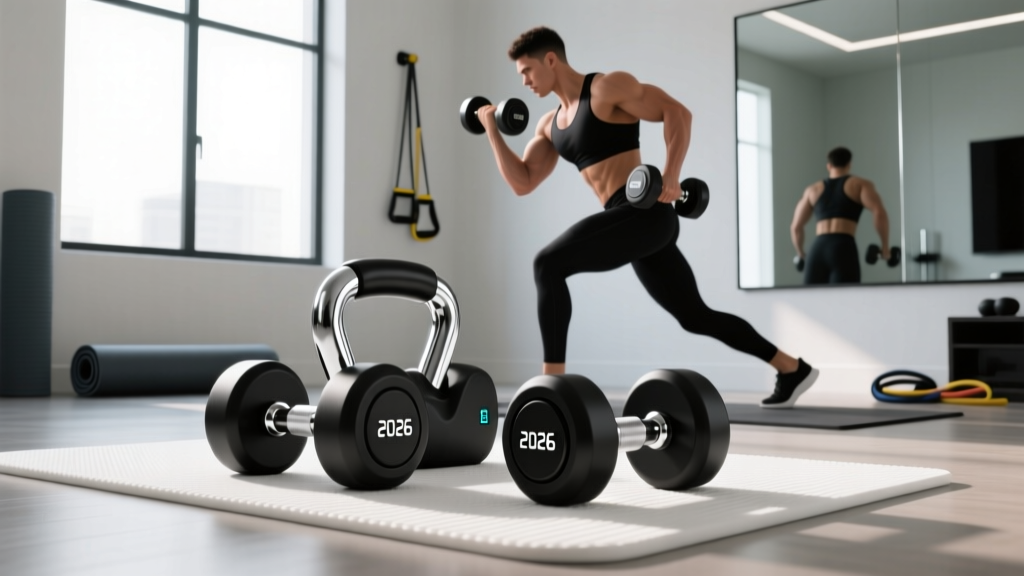
What Is a Good Starting Dumbbell Weight for Neoprene Home Sets?
Discover what is a good starting dumbbell weight for beginners. Our step-by-step guide covers choosing the best neoprene coated dumbbells for home use.

Introduction: Navigating the Home Dumbbell Aisle
Building a home gym in 2026 is one of the most effective investments you can make for your long-term health. According to the Centers for Disease Control and Prevention (CDC), adults need at least two days of muscle-strengthening activity per week to maintain optimal metabolic and bone health. When beginners start shopping for free weights, they are immediately confronted with a dizzying array of materials: cast iron, urethane, rubber, and neoprene. For home use—especially in shared living spaces or apartments—neoprene coated dumbbells are the undisputed champion due to their floor-friendly, noise-dampening properties.
However, the most common question we receive at FitGearPulse is: What is a good starting dumbbell weight? The answer is not a single number, but rather a strategic matrix based on your current biomechanical baseline and the specific movement patterns you plan to train. This step-by-step guide will help you test your baseline, understand the material science of neoprene, and build a cost-effective starter set without wasting money on weights you will outgrow in three weeks.
Step 1: Establish Your Baseline (The Household Test)
Before you spend a single dollar, you need to determine your 10-repetition maximum (10RM) for basic movement patterns. Your 10RM is the maximum weight you can lift for 10 repetitions with perfect form, where the 11th repetition would be impossible. If you do not have access to a gym to test this, you can use the 'Household Test'.
- Find a sturdy backpack: Load it with common household items. A standard gallon jug of water weighs exactly 8.34 lbs. A standard hardcover textbook weighs roughly 3 to 4 lbs.
- Test the Push (Overhead Press): Hold the backpack or a loaded tote bag in one hand. Press it overhead. If you can easily do 15 reps, your starting weight needs to be heavier than the bag.
- Test the Pull (Dumbbell Row): Hinge at the hips and pull the weight to your ribcage. The back muscles are significantly larger than the shoulders, so your starting weight here will naturally be higher.
- Test the Legs (Goblet Squat): Hold the weight vertically against your chest and squat. Your lower body can handle the most load.
By mapping out your approximate 10RM for these three planes of motion, you eliminate the guesswork from your purchasing decision.
Step 2: Decode the Matrix: What Is a Good Starting Dumbbell Weight?
Once you have a rough idea of your strength levels, use the matrix below to select your starting neoprene dumbbell weights. This data is synthesized from beginner programming standards outlined by the American Council on Exercise (ACE).
| Movement Pattern | Exercise Example | Beginner Women (Starting Weight) | Beginner Men (Starting Weight) |
|---|---|---|---|
| Upper Body Push | Overhead Press, Chest Press | 5 lbs to 10 lbs | 10 lbs to 15 lbs |
| Upper Body Pull | Single-Arm Row, Bicep Curl | 8 lbs to 15 lbs | 15 lbs to 25 lbs |
| Lower Body / Core | Goblet Squat, Romanian Deadlift | 15 lbs to 25 lbs | 25 lbs to 40 lbs |
Pro Tip: Never buy just one pair of dumbbells. Because your lower body is roughly 40-60% stronger than your upper body pushing muscles, a single 15 lb pair will be too heavy for your shoulders but too light for your squats. You need a tiered approach.
Step 3: The Material Science of Neoprene (What You Must Know)
Neoprene is a synthetic rubber (scientifically known as polychloroprene). It is created by coating a solid cast-iron core in a thick layer of this polymer. Here is why it is the best choice for home use, along with a few hidden drawbacks you must watch out for.
The Advantages
- Floor Protection: Unlike bare cast iron, neoprene will not dent hardwood floors or crack ceramic tiles if dropped from waist height.
- Acoustic Dampening: The rubberized coating absorbs the kinetic energy of the weight hitting the floor, drastically reducing noise for apartment dwellers.
- Tacky Grip: Neoprene provides a slightly tacky surface that prevents slipping when your hands get sweaty.
The Hidden Drawback: Handle Diameter and Grip Fatigue
Here is an industry secret that most generic buying guides ignore: neoprene coating adds significant bulk to the handle. A standard Olympic barbell or bare steel dumbbell has a handle diameter of about 28mm to 32mm. Because manufacturers must dip the entire iron core into liquid neoprene, the handles on neoprene dumbbells often swell to 35mm or even 40mm in diameter, especially on heavier weights (25 lbs and above).
⚠️ Expert Warning on Grip Fatigue: If you have smaller hands, a thick 40mm neoprene handle will cause your forearms to burn out before your target muscles (like your lats during a row) reach failure. When shopping, look for brands like Yes4All or CAP Barbell that feature 'contoured' or 'ergonomic' handles, where the neoprene is thinned out specifically in the grip zone to keep the diameter closer to 32mm.Step 4: The 'Rule of Three' Purchasing Strategy
Do not buy a 10-pair neoprene rack. It is a waste of money and takes up too much space. Furthermore, as of early 2026, shipping costs have stabilized, bringing neoprene dumbbell prices back to the highly affordable $1.80 to $2.80 per pound range. Instead of a massive rack, use the 'Rule of Three' to build your starter kit. Buy exactly three pairs: a Light, a Medium, and a Heavy.
Sample $150 Beginner Shopping Cart
- The Light Pair (8 lbs or 10 lbs): Used for lateral raises, tricep extensions, and overhead presses. Estimated Cost: $25 - $35.
- The Medium Pair (15 lbs or 20 lbs): Used for bicep curls, chest presses, and single-arm rows. Estimated Cost: $45 - $55.
- The Heavy Pair (30 lbs or 35 lbs): Used exclusively for goblet squats, lunges, and Romanian deadlifts. Estimated Cost: $75 - $90.
By purchasing these three specific pairs, you cover every major muscle group in the human body with appropriate resistance, keeping your total investment under $180.
Step 5: Progression and the 2-for-2 Rule
Once you have your neoprene set, how do you know when it is time to buy heavier weights? The National Strength and Conditioning Association (NSCA) recommends the 2-for-2 Rule for safe, progressive overload.
"If you can complete two extra repetitions on your final set of an exercise, with perfect form, for two consecutive workouts, it is time to increase the resistance by 5% to 10%."
For example, if your goal is 3 sets of 10 reps with your 15 lb neoprene dumbbells, and you manage to hit 12 reps on the final set during both your Monday and Thursday workouts, you have officially outgrown the 15 lb pair for that specific exercise. It is time to order the next tier up (e.g., 20 lbs).
Neoprene Care and Longevity
To ensure your neoprene coating does not degrade, peel, or emit a foul odor, you must manage salt and UV exposure. Human sweat is highly saline. Over time, salt crystals embed themselves in the microscopic pores of the polychloroprene, drying it out and causing it to flake. Never use bleach or harsh chemical degreasers on neoprene. Simply wipe the handles down with a microfiber cloth dampened with plain water and a single drop of mild dish soap after every session. Keep them out of direct sunlight, as UV rays break down the synthetic rubber bonds rapidly.
Frequently Asked Questions
Are neoprene dumbbells toxic?
No. Modern neoprene dumbbells manufactured by reputable brands are non-toxic and free of the harsh off-gassing odors associated with cheap, recycled PVC rubber. They are perfectly safe for indoor home use, even in poorly ventilated rooms.
Can I use neoprene dumbbells for heavy powerlifting?
No. Neoprene is designed for light to moderate hypertrophy and general fitness. If you are progressing to advanced strength training (lifting 50+ lbs per hand), you should transition to bare steel or urethane hex dumbbells, which offer thinner handles for better grip mechanics and greater durability under extreme loads.
Is a good starting dumbbell weight different for seniors?
Yes. For older adults focusing on joint stability and bone density, a good starting dumbbell weight is typically 2 lbs to 5 lbs for upper body movements. The focus should be on slow, controlled eccentrics (the lowering phase of the lift) rather than moving heavy loads.
More gear to consider
All reviews
Dumbbell Pullovers for Lats: EZ Curl Bar vs Straight Bar

Lat Workouts With Dumbbells: 2026 Adjustable Gear Review & Fixes

Squat Stand vs Power Rack: Dumbbell Deadlift to Upright Row Setup

Bumper vs Iron Plates & Chest Exercises with Dumbbells Only
Kettlebell Layouts: Cast Iron vs Competition & The Pullover Dumbbell