Globe Dumbbells & Barbell Collars: Clamp Types & Safety Compared
Compare barbell collar types (spring, Proloc, clamp) and fixed globe dumbbells for gym safety. Discover exact failure modes and 2026 pricing data.

The Free Weight Safety Dichotomy: Fixed vs. Modular Loads
When outfitting a commercial facility or a high-end home gym in 2026, equipment directors and serious lifters face a fundamental safety dichotomy. Free weight safety generally falls into two categories: the structural integrity of fixed-weight implements and the clamping security of modular barbell systems. While traditional globe dumbbells rely entirely on metallurgical welds and cast-iron cohesion to keep their loads secure, modular barbells depend entirely on the friction and mechanical advantage of barbell collars and clamps to prevent catastrophic plate shifts.
Understanding the exact failure modes, material fatigue thresholds, and biomechanical interactions of both equipment categories is critical for preventing gym injuries. In this head-to-head comparison, we establish the safety baseline of fixed globe dumbbells before conducting a deep-dive technical analysis of modern barbell collar types, complete with 2026 market pricing and engineering limitations.
The Fixed-Weight Baseline: Globe Dumbbells Safety Profile
Traditional globe dumbbells, characterized by their spherical cast-iron heads and solid steel handles, represent the gold standard of fixed-weight implements in powerlifting and strongman gyms. Unlike urethane-encased hex dumbbells that disperse impact across flat planes, globe dumbbells concentrate drop forces directly through the handle-to-head junction.
Metallurgy and Failure Modes
The primary safety concern with globe dumbbells is not load shifting—as the weight is permanently fixed—but rather rotational torque and weld shearing. Premium manufacturers like York Barbell and Troy Barbell utilize deep-penetration MIG welding or friction welding to bond the solid steel handle to the cast-iron sphere. However, when a 120lb+ globe dumbbell is dropped from overhead onto a hard rubber mat, the rotational inertia can exceed 450 Nm of torque at the weld point.
- Chrome Flaking: Repeated knurling friction and sweat exposure can cause cheap chrome plating on the handles to oxidize and flake, creating a laceration hazard and degrading grip security.
- Weld Micro-Fractures: Unlike hex dumbbells, the spherical shape of globe dumbbells causes them to roll unpredictably upon impact, transferring lateral sheer forces to the handle junction. Over 3-5 years of heavy commercial use, this leads to micro-fractures in the weld bead.
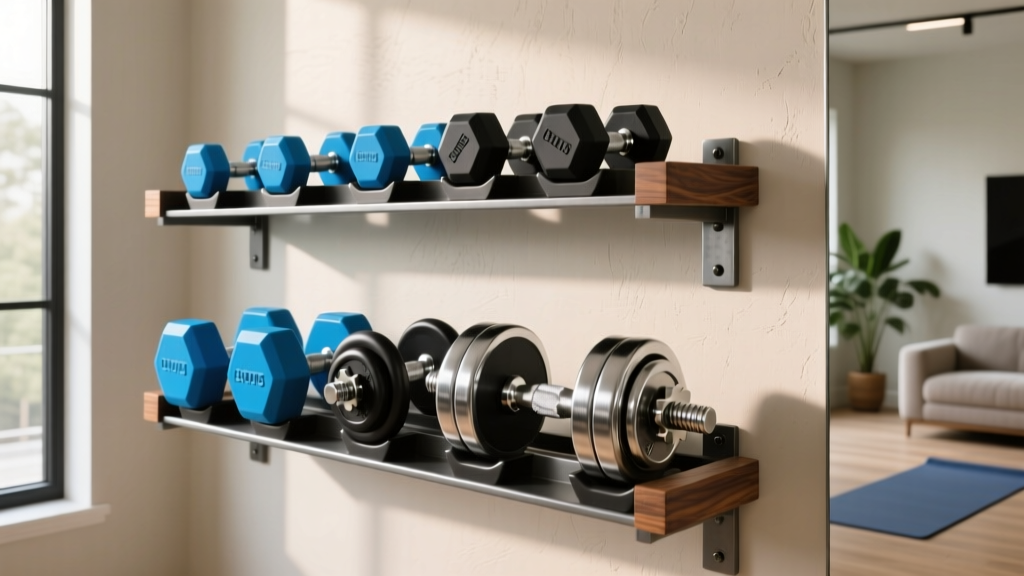
- The Rolling Hazard: Because they roll, globe dumbbells require specialized storage racks with contoured saddles. Storing them on flat shelving is a severe OSHA and gym-safety violation due to the crush hazard they pose when bumped.
Because fixed implements like globe dumbbells eliminate the variable of plate shift, they allow lifters to push to absolute muscular failure without the cognitive load of worrying about loose hardware. This makes their structural integrity the sole point of failure.
Barbell Collar & Clamp Types: Head-to-Head Engineering Analysis
Unlike globe dumbbells, a loaded barbell is a dynamic, oscillating system. If the collars fail, the plates shift, altering the center of mass and resulting in catastrophic joint injuries or missed lifts. According to BarBend's comprehensive collar testing, the market is dominated by four primary clamping mechanisms, each with distinct engineering trade-offs.
1. Spring Collars (The Economy Baseline)
Constructed from zinc-plated or stainless steel wire, spring collars rely on torsion spring tension to grip the barbell sleeve. While they are inexpensive (averaging $12 to $18 per pair in 2026), they are fundamentally flawed for heavy or dynamic loading.
- Clamping Force: Typically generates 120–150 lbs of radial inward force when new.
- Failure Mode: Metal fatigue. After approximately 1,500 compression cycles, the steel loses its temper, reducing clamping force by up to 30%. Furthermore, they struggle to grip 29mm powerlifting bars securely due to the larger circumference.
2. Polymer Clamp Collars (The Commercial Standard)
Brands like Proloc and Lock-Jaw dominate commercial gyms. These utilize a high-tensile polymer body with a reinforced nylon or fiberglass core and a cam-lever locking mechanism.
- Clamping Force: Exceeds 350 lbs of radial force, easily securing bumper plates during heavy deadlifts.
- Pricing: $28 to $38 per pair.
- Failure Mode: The polymer locking tab is susceptible to shear stress if the collar is dropped directly onto the concrete from a height of 6+ feet. In freezing garage gyms (below 40°F), the polymer becomes brittle and can snap upon impact.
3. CNC Aluminum Screw Clamps (The Premium Tier)
Exemplified by the Rogue Fitness barbell collar lineup, these clamps use a threaded aluminum ring and a Delrin acetal resin insert to grip the bar sleeve without scratching the zinc or chrome finish.
- Clamping Force: Virtually infinite, limited only by the user's hand strength when tightening the screw mechanism.
- Pricing: $60 to $75 per pair.
- Failure Mode: Thread galling. If chalk dust or iron oxide infiltrates the aluminum threads and is not cleaned with a wire brush, the threads will strip, rendering the clamp useless. They also add 20–30 seconds to loading times, which is detrimental in high-volume group classes.
4. Competition Lever/Cam Collars (The IWF Standard)
Used in Olympic weightlifting, these heavy-duty collars (often weighing exactly 2.5kg each to count toward the total bar weight) utilize a mechanical cam-action lever. Eleiko's competition collar specifications demonstrate how precision-machined steel cams bite into the barbell sleeve.
- Clamping Force: Over 500 lbs of locking pressure, designed to withstand the extreme bar whip and lateral G-forces of a 150kg+ clean and jerk.
- Pricing: $110 to $160+ per pair.
- Failure Mode: Cam wear. Over years of use, the steel cam teeth can round off, reducing the bite depth on the bar sleeve and allowing micro-movements during the catch phase of a snatch.
During Olympic lifts, a 28mm barbell experiences severe lateral oscillation (bar whip). If a collar lacks lateral rigidity, the plates will 'walk' outward by 1-2mm per rep. Over a set of 5 heavy cleans, this shifts the barbell's center of gravity, forcing the lifter's stabilizer muscles to overcompensate and increasing the risk of a wrist or shoulder impingement.
Head-to-Head Comparison Matrix
| Collar Type | Model Example | Avg Price (2026) | Radial Clamping Force | Primary Failure Mode |
|---|---|---|---|---|
| Spring Clip | HG 2-Inch Spring | $14 / pair | ~130 lbs | Metal fatigue / loss of temper |
| Polymer Clamp | Proloc 110g | $32 / pair | ~350 lbs | Locking tab shear from drops |
| Aluminum Screw | Rogue 2.0 Locking | $65 / pair | User-dependent | Thread galling from chalk/rust |
| Competition Cam | Eleiko Training Collar | $135 / pair | 500+ lbs | Cam tooth rounding over time |
Strategic Purchasing Framework: Matching Equipment to the Environment
Choosing between fixed-weight investments and modular clamping systems requires analyzing your specific training modalities. If your facility focuses on hypertrophy and general fitness, the structural predictability of globe dumbbells paired with a high-volume rack is optimal, as it removes the setup friction of threading plates and securing collars. However, for strength and power athletes, modular barbells are non-negotiable.
Decision Guide by Lifting Style
- For Olympic Weightlifting: You must invest in Competition Cam Collars (Eleiko or Werksan). The lateral G-forces generated during the jerk dip and drive will easily overcome the friction of polymer clamps, leading to plate shift.
- For Powerlifting (Squat/Bench/Deadlift): CNC Aluminum Screw Clamps or heavy-duty Polymer Clamps are ideal. Powerlifting bars (29mm) are stiffer and do not oscillate laterally, meaning extreme cam-bite is unnecessary, but high radial friction is required to secure heavy iron plates during slow, grinding reps.
- For CrossFit / High-Intensity Functional Training: Polymer Clamp Collars (Proloc/Lock-Jaw) are the undisputed winners. They offer the best balance of secure clamping force and rapid deployment, allowing athletes to transition between barbell complexes and dumbbell movements in under 3 seconds.
Final Verdict on Gym Safety
Whether you are inspecting the MIG welds on a set of 100lb globe dumbbells or testing the polymer tension on a new batch of barbell clamps, free weight safety is an exercise in applied physics. Never assume that hardware is infallible. Implement a quarterly equipment audit in your facility: retire spring collars after 12 months of commercial use, inspect globe dumbbell welds for hairline fractures using a bright LED backlight, and keep a wire brush on hand to maintain the threads on your aluminum screw clamps. By respecting the mechanical limits of your equipment, you ensure that the only point of failure in your gym is the lifter's muscular endurance.
More gear to consider
All reviews
The Dumbbells Acronym & Bumper vs Iron Plate Maintenance
EZ Curl Bar vs Straight Bar and the Incline Dumbbell Squeeze Press

Rubber Hex vs Urethane: Best Deltoid Raise Dumbbell Value

Power Rack vs Squat Stand: Woman's Dumbbell Chest Press Setup
Rack Setup Guide: Squat Stands vs Power Racks for Dumbbell OHP