Front Lunges with Dumbbells: A Beginner's Guide to Neoprene Weights
Learn how to perform front lunges with dumbbells safely. Our beginner guide covers step-by-step form and why neoprene weights are ideal for home gyms.

Mastering the Basics: Front Lunges with Dumbbells for Home Workouts
Building a functional, aesthetic, and strong lower body doesn't require a commercial gym membership or thousands of dollars in equipment. In 2026, the home fitness landscape is dominated by smart, space-saving gear, and the humble neoprene-coated dumbbell remains the undisputed champion of the beginner home gym. When paired with foundational movements like front lunges with dumbbells, you unlock a highly effective, unilateral exercise that targets the quadriceps, glutes, and hamstrings while challenging your core stability.
According to the Centers for Disease Control and Prevention (CDC), adults should engage in muscle-strengthening activities of moderate or greater intensity that involve all major muscle groups on two or more days a week. Lunges perfectly fulfill this requirement. This step-by-step guide will walk you through the exact biomechanics of the front lunge, while also explaining why neoprene dumbbells are the smartest equipment investment for your living room or garage floor.
Why Neoprene Dumbbells Are the Best Choice for Home Lunges
Before we break down the movement, we need to talk about the tool. Neoprene dumbbells feature a solid cast-iron core encased in a synthetic rubber (neoprene) coating. For beginners performing dynamic movements like front lunges with dumbbells, this specific material offers distinct advantages over bare iron or hard plastics.
💡 Expert Insight: The Grip Factor
When performing lunges, your hands will be under tension for 45 to 60 seconds per set. Neoprene provides a soft, slightly tacky surface that reduces grip fatigue compared to aggressive knurling on bare metal, allowing you to focus entirely on your lower-body form without your forearms giving out prematurely.
Material Comparison for Home Gyms (2026 Market Data)
| Material | Noise Level | Floor Protection | Grip Quality | Avg. Cost per lb (2026) |
|---|---|---|---|---|
| Neoprene Coated | Very Low | Excellent | Good (Tacky) | $1.50 - $2.20 |
| Hex Rubber | Low | Very Good | Fair | $1.80 - $2.50 |
| Urethane | Low | Excellent | Fair | $4.00 - $6.00+ |
| Cast Iron (Bare) | High | Poor (Damages floors) | Excellent (Knurled) | $1.00 - $1.50 |
Top 2026 Recommendations for Beginners: The Yes4All Neoprene Coated Dumbbell Set (approx. $35 for a 15lb pair) and the CAP Barbell Neoprene Hex Dumbbells (approx. $28 for a 10lb pair) offer the best balance of durability, hex-shaped anti-roll design, and affordability for home use.
Step-by-Step Guide: Performing Front Lunges with Dumbbells
Proper form is non-negotiable. The Cleveland Clinic notes that the quadriceps are heavily activated during lunges, but poor knee tracking can shift dangerous shear forces onto the patellar tendon. Follow these steps to ensure maximum muscle recruitment and joint safety.
Step 1: The Setup and Stance
- Foot Placement: Stand with your feet hip-width apart. Crucial Mistake: Do not stand with your feet in a straight line (like walking on a tightrope). This destroys your lateral balance.
- The Hold: Grab your neoprene dumbbells and let them hang straight down by your sides, palms facing your thighs (neutral grip).
- The Brace: Pull your shoulder blades down and back. Engage your core as if you are about to be punched in the stomach. Keep your chest proud and eyes fixed on a point straight ahead.
Step 2: The Stride and Descent
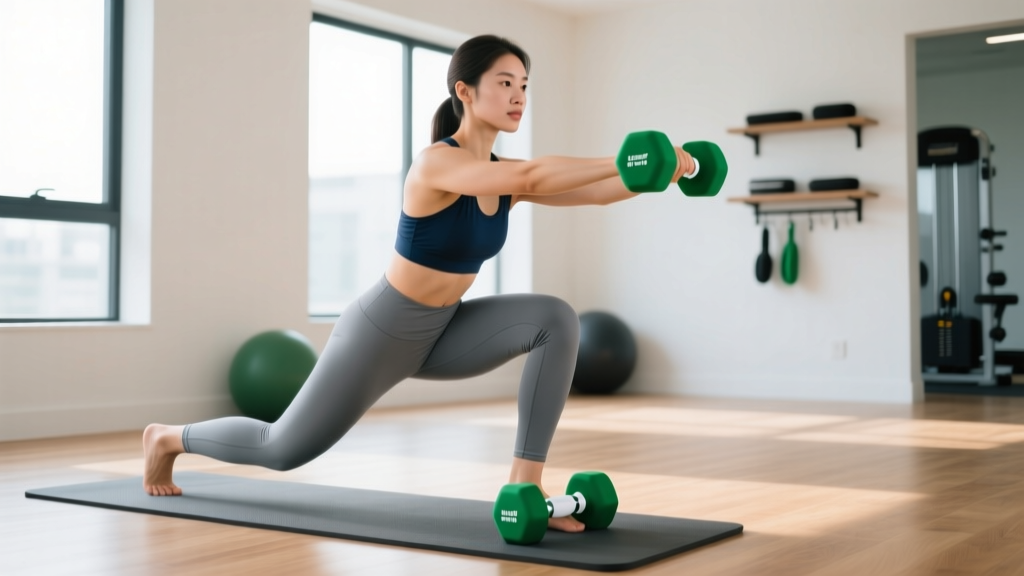
- Step Forward: Take a controlled, generous step forward with your right leg. Your stride should be long enough that when you drop down, your front knee does not travel excessively past your toes.
- Heel Strike: Land firmly on your front heel first, then roll onto the flat of your foot. Keep your back toes planted with the heel lifted.
- Drop the Hips: Lower your body straight down toward the floor. Imagine you are riding an elevator, not walking down stairs.
- Target Depth: Descend until your back knee is about one inch from the floor. Both your front and back knees should be bent at roughly 90-degree angles.
Step 3: The Drive
- Push Through the Heel: Drive forcefully through the heel and mid-foot of your front leg. Do not push off your back toe; the back leg is merely a kickstand for balance.
- Return to Start: Bring your front foot back to the starting position, resetting your hip-width stance before initiating the next rep (alternating legs) or continuing on the same side.
⚠️ Warning: Knee Valgus (The Knee Cave)
As you push back up, watch your front knee. If it collapses inward toward your big toe (valgus), you are placing extreme stress on the MCL and ACL. Actively push your knee outward so it tracks directly over your second and third toes throughout the entire movement.
Common Beginner Mistakes and Troubleshooting
Even with the American Council on Exercise (ACE) exercise guidelines, beginners often develop bad habits when fatigue sets in. Here is how to fix the most common front lunge errors:
| Mistake | Why It Happens | The Fix |
|---|---|---|
| Short Stride Length | Causes the front heel to lift off the ground and pushes the knee too far forward, increasing joint stress. | Take a slightly longer step. Focus on a vertical shin angle on the front leg at the bottom of the movement. |
| Excessive Torso Lean | Weak core or tight hip flexors cause you to hinge forward, turning the lunge into a weird squat/good-morning hybrid. | Keep your chest up. Squeeze your glutes and brace your abs before you step forward. |
| Rushing the Tempo | Using momentum to bounce out of the bottom position, removing tension from the muscles. | Use a 2-1-1 tempo: 2 seconds down, 1-second pause at the bottom, 1 second explosive drive up. |
Programming Front Lunges into Your Beginner Routine
How many reps should you do? As a beginner using neoprene dumbbells, your goal is neuromuscular adaptation—teaching your brain and muscles to work together efficiently.
- Beginner Baseline: 3 sets of 8-10 reps per leg.
- Rest Periods: 60 to 90 seconds between sets.
- Weight Selection: Start with 5 lb to 10 lb neoprene dumbbells. If you cannot complete 8 reps with perfect form, drop the weight. If you can easily do 12 reps, it is time to buy the next size up (e.g., moving from 10 lbs to 15 lbs).
Equipment Care: Prolonging the Life of Neoprene
Neoprene is incredibly durable indoors, but it has one major vulnerability: UV degradation and heat. If you store your dumbbells in a sunroom, near a radiator, or outside on a patio, the UV rays and heat will break down the synthetic rubber. Over time, the coating will become sticky, peel, or crack, exposing the iron core to rust.
Maintenance Tip: After your workout, wipe down the neoprene handles with a damp cloth to remove sweat and acidic skin oils, which can also degrade the coating over years of use. Store them on a small indoor rack or mat away from direct sunlight.
Frequently Asked Questions (FAQ)
Can I do front lunges on carpet with neoprene dumbbells?
Yes, but carpet can compress unevenly, affecting your balance. If you are working out on thick carpet, wear flat-soled shoes (like Converse or minimalist training shoes) rather than squishy running shoes to ensure a stable base when you plant your front heel.
Should I alternate legs or do all reps on one side first?
Both methods work, but they serve different purposes. Alternating legs gives each side a micro-rest, allowing you to maintain better form as a beginner. Doing all reps on one side first (unilateral sets) increases localized muscle fatigue and cardiovascular demand. Beginners should start by alternating.
My front heel keeps lifting. What do I do?
This is almost always caused by taking too short of a step or having poor ankle dorsiflexion mobility. Lengthen your stride so your shin is relatively vertical at the bottom of the lunge, and spend 5 minutes doing ankle mobility stretches before your workout.
Final Thoughts
Front lunges with dumbbells are a cornerstone of lower-body development. By investing in a high-quality set of hex-shaped neoprene dumbbells, you protect your home floors, reduce noise, and secure a comfortable grip that lets you focus purely on the mind-muscle connection. Master the stride, control the descent, and drive through the heel, and you will build resilient, powerful legs right from the comfort of your home.
More gear to consider
All reviews
Prone Dumbbell Row Safety: Maintaining Loadable Dumbbells

Home Gym Setup: Neoprene Dumbbells & Dumbbell Twist Curl Form
How Heavy Are The Dumbbells You Lift TV Show? Kettlebell Value Guide

Adjustable Dumbbell Setup & Review: Dumbbell Row Muscles Worked
Marshalls Dumbbells vs Urethane: Space & Layout Guide