Foam Roller Density Guide & Wall Mounted Yoga Mat Rack Storage
Master foam roller density and size selection for optimal recovery, plus learn how to organize gear using a space-saving wall mounted yoga mat rack.

The 2026 Home Recovery Blueprint: Selecting and Storing Your Gear
Building a functional home recovery zone requires more than just buying the most expensive equipment; it demands an understanding of biomechanics, material science, and spatial organization. For beginners stepping into the world of self-myofascial release (SMR), the sheer variety of foam rollers on the market can be paralyzing. Furthermore, once you acquire these bulky cylindrical tools alongside your yoga mats, floor clutter quickly becomes an issue. This step-by-step guide will walk you through the exact science of foam roller density and size selection, and conclude with a brilliant storage hack utilizing a wall mounted yoga mat rack to keep your space pristine and functional.
Step 1: Decoding Foam Roller Density (Material & Firmness)
The effectiveness of a foam roller is dictated by its density, which determines how deeply it penetrates the fascia and muscle tissue. According to research published by the National Institutes of Health (NIH), applying the correct amount of pressure is vital for increasing range of motion without causing protective muscle guarding. In 2026, the market is dominated by three primary material densities:
1. Low-Density (Soft) EVA Foam
- Density Metric: ~30 to 40 kg/m³
- Best For: Rehabilitation, elderly users, or individuals with extreme pain sensitivity and conditions like fibromyalgia.
- The Reality: These provide a gentle, broad massage. However, they suffer from rapid hysteresis (permanent deformation) and will likely lose their shape within 3 to 4 months of daily use.
- Price Range: $12 – $20
2. Medium-Density (Standard) EVA Foam
- Density Metric: ~50 to 60 kg/m³
- Best For: Beginners, general fitness enthusiasts, and pre-workout warm-ups.
- The Reality: This is the 'Goldilocks' zone for most people. It offers enough firmness to stimulate blood flow and break up mild adhesions without triggering the nervous system's pain response. Expect a lifespan of 8 to 12 months before the core begins to soften.
- Price Range: $18 – $30
3. High-Density EPP (Expanded Polypropylene)
- Density Metric: ~85 to 100+ kg/m³
- Best For: Athletes, deep-tissue work, and heavy daily use.
- The Reality: EPP is a closed-cell foam that is virtually indestructible under human body weight. It does not suffer from the hysteresis that plagues EVA foam. While it can be painfully intense for beginners, it is the most cost-effective long-term investment.
- Price Range: $25 – $45
Step 2: Size and Dimension Matrix
Density is only half the equation; the physical dimensions of the roller dictate its utility. The standard diameter for most rollers is 5.5 to 6 inches, which provides the necessary clearance for your spine and limbs to move over the apex of the cylinder. Here is how to select the right length for your specific needs:
| Length | Primary Use Case | Ideal User Profile |
|---|---|---|
| 36-Inch | Full T-spine extension, latissimus dorsi sweeps, Pilates alignment. | Yoga practitioners, physical therapy patients, dedicated home gyms. |
| 24-Inch | Quadriceps, IT band (with caution), general back, and glutes. | The versatile standard; best single-purchase option for beginners. |
| 18-Inch | Calves, hamstrings, targeted glute work, travel. | Frequent travelers, runners, those with limited floor space. |
| 12-Inch (4" Dia) | Pinpoint trigger points (TFL, pec minor, subscapularis). | Advanced users needing localized, deep-tissue precision. |
Step 3: Reclaiming Space with a Wall Mounted Yoga Mat Rack
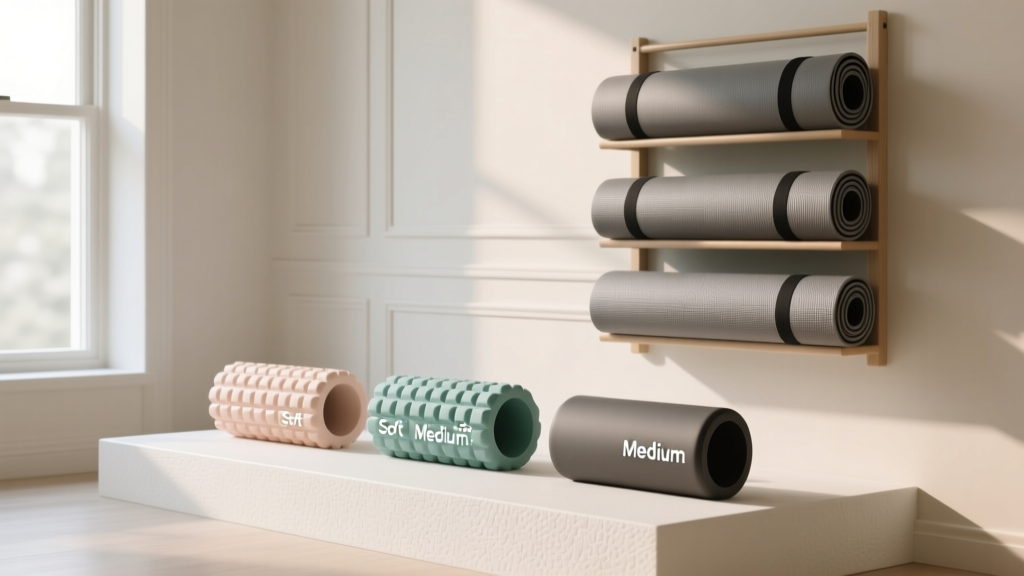
Once you have selected your ideal foam rollers and yoga mats, the immediate problem is storage. Bulky recovery tools clutter floors, collect dust, and create tripping hazards. This is where a wall mounted yoga mat rack transitions from a simple accessory to a vital organizational hub. While traditionally designed for hanging rolled cork or PU yoga mats via their straps, the multi-prong architecture of a wall mounted yoga mat rack is perfectly suited for storing foam rollers.
The Storage Hack: How to Rack Your Rollers
Most premium wall mounted yoga mat rack models feature 3 to 5 wooden or metal prongs extending 10 to 14 inches from the wall. Here is how to utilize them for your recovery gear:
- The Hollow-Core Slide: If you purchase a hollow-core vibrating foam roller or a PVC-core EVA roller, you can slide the roller directly onto the prongs of the rack, hiding the hardware inside the roller itself.
- The Horizontal Rest: For solid EPP or standard EVA rollers, simply rest them horizontally across two or three adjacent prongs. A 36-inch roller will sit securely across a 3-prong rack, while 18-inch rollers can be stacked vertically between the prongs.
- Mat & Roller Alternation: Use the top prongs for your yoga mats (hanging by the strap) and the lower prongs to cradle your 24-inch and 18-inch foam rollers, creating a unified 'Recovery Station'.
Installation & Weight Capacity Guidelines
Foam rollers are surprisingly dense. A 36-inch high-density EPP roller can weigh upwards of 4 to 6 lbs, and when combined with heavy 5mm cork yoga mats, the dynamic load on your wall hardware increases significantly—especially when pulling items off the prongs.
Pro-Tip for 2026 Home Gyms: Never use standard plastic drywall anchors for a wall mounted yoga mat rack if you plan to store foam rollers on it. The lateral torque applied when yanking a heavy roller off a wooden peg will rip plastic anchors straight out of the drywall. Always drill into wooden studs using 2.5-inch wood screws, or use heavy-duty toggle bolts (snap toggles) rated for at least 50 lbs of shear force per bolt.Step 4: Matching Density to Your Routine (Decision Framework)
To ensure you are getting the most out of your SMR practice, the American Council on Exercise (ACE) recommends aligning your roller density with the specific goal of your workout session:
- Pre-Workout (Warm-up): Use a Medium-Density roller. Perform fast, rhythmic rolls (1-2 seconds per sweep) to stimulate the nervous system and increase local blood flow without depressing muscle power output.
- Post-Workout (Recovery): Use a High-Density (EPP) roller. Perform slow, sustained holds (30-60 seconds) directly on adhesions or 'knots' to encourage the Golgi tendon organ to trigger autogenic inhibition, forcing the muscle to relax.
- Rest Day / Mobility: Use a Low-Density or soft roller for gentle lymphatic drainage and broad sweeping motions to reduce delayed onset muscle soreness (DOMS).
Step 5: Maintenance and Hygiene Protocols
Foam rollers and the prongs of your wall mounted yoga mat rack are breeding grounds for bacteria and fungi, especially in humid environments or garage gyms. EVA foam is porous and absorbs sweat, while EPP is closed-cell and easily wiped down.
The Weekly Cleaning Routine:
- Mix a solution of 70% isopropyl alcohol and water in a spray bottle. (Avoid bleach or quaternary ammonium compounds, as these will break down the chemical bonds in EVA foam over time, accelerating hysteresis).
- Lightly mist the roller and immediately wipe it down with a microfiber cloth. Do not let the liquid pool on the surface.
- Wipe down the prongs of your wall mounted yoga mat rack with a damp cloth and a mild wood-safe soap to prevent the transfer of oils and dead skin from your mats and rollers to the rack hardware.
Frequently Asked Questions
Can I use a 4-inch diameter roller for my back?
No. A 4-inch diameter does not provide enough clearance for your spinous processes (the bony projections on your vertebrae). Using a 4-inch roller on the thoracic spine can cause hyperextension and joint irritation. Stick to 5.5 or 6-inch diameters for all spinal work.
Will a wall mounted yoga mat rack hold a 36-inch roller?
Yes, provided the rack is at least 24 inches wide and features a minimum of three prongs. The 36-inch roller will simply overhang the edges slightly, which is perfectly safe as long as the rack is anchored into wall studs.
How often should I replace my EVA foam roller?
If you are rolling 4 to 5 times a week, expect to replace a medium-density EVA roller every 9 to 12 months. If it develops a permanent flat spot or loses its rebound, it is no longer providing adequate pressure and must be replaced. Upgrading to EPP eliminates this recurring cost.
More gear to consider
All reviews
Setup Guide: Speed, Weighted & Beaded Ropes on a Burgundy Yoga Mat
Resistance Band Sets: Levels, Types & Yoga vs Exercise Mat Pairings
Foam Roller Density vs. Yoga Mat Point Therapy: Head-to-Head

Jump Rope Types & Melissa Wood Health Yoga Mat: Mistakes & Fixes

Beyond the Yoga Mat Towel: 2026 Block & Strap Guide