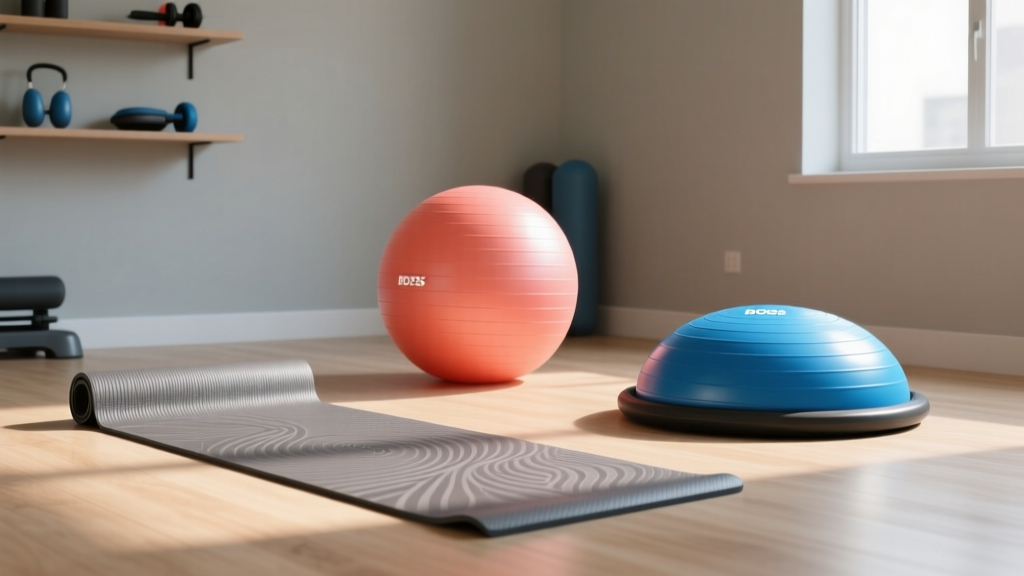
Home Gym Layouts: Exercise Ball Sizing & How Much Is a Yoga Mat
Master your home gym layout with our exercise ball size guide. Learn spatial clearance needs, anti-burst ratings, and how much is a yoga mat for your space.

The Spatial Geometry of the Modern Home Gym
As urban living spaces shrink and home fitness routines become more sophisticated in 2026, the days of simply tossing a stability ball into the corner of a spare bedroom are over. Designing a functional home gym requires a meticulous approach to spatial geometry, volumetric clearance, and budget allocation. When you are mapping out a multi-use living area, every piece of equipment must justify its physical footprint. The stability ball remains a cornerstone of functional training, but its large, awkward volume presents unique layout challenges. Furthermore, understanding the foundational layer beneath your equipment is critical for both joint health and spatial storage. In this comprehensive guide, we will break down the exact biomechanical sizing for exercise balls, analyze their spatial clearance requirements, and answer a crucial budgeting question for your floor zone: how much is a yoga mat that actually fits your spatial and ergonomic needs?
Exercise Ball Size Guide: Biomechanics vs. Room Clearance
Choosing the right exercise ball size is traditionally based on user height and the resulting hip-to-knee angle. According to Mayo Clinic's guidelines on core stability, your hips and knees should form a 90-degree angle when seated on the ball with your feet flat on the floor. However, from a space optimization perspective, you must also calculate the 'Active Strike Zone'—the minimum clearance required to perform rotational movements, stability ball pikes, or hamstring curls without striking walls, baseboard heaters, or furniture.
The Active Strike Zone is calculated by taking the ball's diameter and adding a minimum of 36 inches of clearance on all sides. Below is the definitive sizing matrix that bridges human ergonomics with architectural constraints.
| User Height | Ball Diameter | Seated Hip Angle | Active Strike Zone (Footprint) | Ideal Room Allocation |
|---|---|---|---|---|
| Under 5'1' | 45 cm (18') | 90 Degrees | 6.5 ft x 6.5 ft (42 sq ft) | Small Bedroom / Office Nook |
| 5'1' to 5'8' | 55 cm (22') | 90 Degrees | 7.5 ft x 7.5 ft (56 sq ft) | Standard Guest Room |
| 5'9' to 6'2' | 65 cm (26') | 90 Degrees | 8.5 ft x 8.5 ft (72 sq ft) | Living Room / Garage Zone |
| 6'3' to 6'7' | 75 cm (30') | 90 Degrees | 9.5 ft x 9.5 ft (90 sq ft) | Dedicated Gym Space |
| 6'8' and taller | 85 cm (34') | 90 Degrees | 10.5 ft x 10.5 ft (110 sq ft) | Open Concept / Basement |
Anti-Burst Ratings and Environmental Failure Modes
When buying an exercise ball, material integrity is just as important as size. The market is flooded with cheap PVC balls that pose a severe laceration and impact risk if they rupture under load. You must exclusively purchase balls rated with an Anti-Burst (or Slow-Deflate) honeycomb matrix. High-quality models, such as the TheraBand Stability Ball or the Vive Fitness Anti-Burst series, are static-tested to withstand between 500 lbs and 2,200 lbs of downward force.
From a spatial layout perspective, environmental failure modes dictate where you can safely store and use your ball. Direct UV exposure from south-facing windows degrades PVC and TPE compounds over 6 to 12 months, leading to micro-tears and catastrophic deflation. Furthermore, placing your Active Strike Zone near forced-air baseboard heaters or sharp-cornered mid-century modern furniture increases the risk of puncture. Always map your ball's storage location away from direct sunlight and heat sources, utilizing vertical wall-mounted ball hammocks (which require only 2 square feet of wall space) rather than leaving them in high-traffic walkways where accidental punctures from pet claws or dropped keys occur.
Floor Space Budgeting: How Much Is a Yoga Mat?
Once you have established the volumetric clearance for your stability ball, you must address the foundational layer beneath it. Using a stability ball directly on hardwood or laminate flooring creates a slip hazard and damages the floor's finish. This brings us to a critical intersection of budget and spatial design: how much is a yoga mat that provides adequate joint protection while remaining compatible with your storage constraints?
The cost of a yoga mat in 2026 ranges from $15 to over $160, but the price is directly tied to the material density, thickness, and ultimately, its rolled storage footprint. If you are optimizing a small apartment, a mat that rolls to a 6-inch diameter cylinder will not fit in standard 4.5-inch under-bed storage bins, forcing you to allocate valuable vertical closet space.
Material Cost vs. Spatial Storage Breakdown
- PVC (Polyvinyl Chloride): $15 – $25. Typically 3mm to 4mm thick. Rolls to a tight 3.5-inch cylinder. Highly space-efficient for under-bed storage, but offers poor shock absorption for heavy dumbbell drops or high-impact stability ball jumps. Degrades quickly with heavy sweat exposure.
- TPE (Thermoplastic Elastomer): $35 – $65. Typically 5mm to 6mm thick. Rolls to a 5-inch cylinder. The best middle-ground for budget and joint support. However, the 5-inch rolled diameter requires dedicated shelving or a vertical wall-hanging strap.
- Natural Rubber (e.g., JadeYoga Harmony): $70 – $95. Typically 4mm to 5mm thick. Heavy (up to 5 lbs) and rolls to a 4.5-inch cylinder. Offers superior grip for stability ball planks but requires a climate-controlled space to prevent dry-rotting.
- Cork / Polyurethane Blends (e.g., Liforme, YOLO): $110 – $160. Typically 5mm thick. Rolls to a 5.5-inch cylinder. Premium pricing reflects the antimicrobial cork surface and exceptional grip, but the thick, stiff nature of these mats makes them difficult to store in tight, multi-use living spaces.
When evaluating how much is a yoga mat for your specific home gym layout, do not just look at the retail price. Factor in the 'spatial tax.' If buying a $120 premium cork mat forces you to purchase a $40 vertical wall-mounted mat rack because it won't fit in your storage ottoman, your true spatial cost is $160. For most micro-gyms, a high-density 5mm TPE mat ($45 average) paired with a simple canvas wall sling offers the highest ergonomic and spatial ROI.
The 40-Square-Foot Micro-Gym Layout Framework
To seamlessly integrate a stability ball, a yoga mat, and functional movement into a constrained space, follow this 40-square-foot layout framework endorsed by ExRx.net's kinesiological breakdown of functional movement zones.
- The Anchor Point (0-2 ft zone): Position your doorway pull-up bar or suspension trainer anchor at the edge of the room. This is your vertical axis.
- The Foundation Layer (2-8 ft zone): Unroll your TPE or Natural Rubber mat perpendicular to the anchor point. This 24-inch by 68-inch strip is your primary contact zone for floor work, planks, and stretching.
- The Active Strike Zone (8-14 ft zone): Place your correctly sized exercise ball at the far end of the mat. Ensure the 36-inch clearance radius around the ball is free of coffee tables, floor lamps, and heating vents.
- Vertical Storage Integration: Install a heavy-duty canvas ball hammock on the adjacent wall, 4 feet off the ground. When the workout is over, the ball is suspended, freeing up the 9-square-foot floor footprint it normally occupies, instantly returning the room to its primary living function.
Expert Sourcing and Ergonomic Standards
Designing a home gym is not just about buying equipment; it is about curating an environment that promotes consistency and prevents injury. According to the CDC's physical activity environment recommendations, removing physical barriers and friction points in your workout space significantly increases long-term adherence to fitness routines. By accurately sizing your exercise ball to your biomechanics and your room's architecture, and by understanding the true spatial and financial costs of your foundational yoga mat, you create a seamless, frictionless training environment. Whether you are working with a 60-square-foot studio apartment or a dedicated 200-square-foot garage gym, respecting the spatial geometry of your gear is the ultimate key to sustainable home fitness in 2026 and beyond.
More gear to consider
All reviews
Beyond the Alo Yoga Yoga Mat: Battle Rope Length & Thickness
Yoga Block & Strap Guide: Caring for Your Hello Kitty Yoga Mat

Speed vs Weighted Jump Ropes on an Oversized Yoga Mat

Expert Exercise Ball Size Guide & Best Way to Clean Yoga Mat Gear
Why Are Yoga Mats So Expensive? Head-to-Head Mat vs Foam Roller Guide