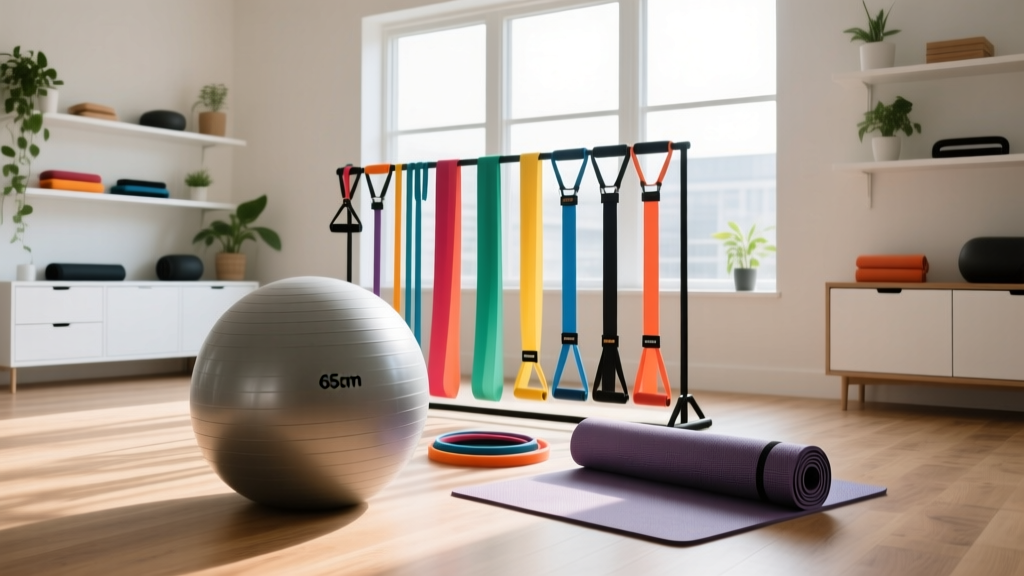
Exercise Ball Size Guide & Can You Put a Yoga Mat in the Washing Machine?
Master your home gym with our 2026 exercise ball size guide and buying tips. Plus, we answer: can you put a yoga mat in the washing machine safely?

Building a functional, injury-free home gym requires more than just buying the flashiest equipment; it demands precise biomechanical sizing and rigorous gear maintenance. At FitGearPulse, we spend hundreds of hours testing fitness accessories so you do not have to. In this comprehensive 2026 guide, we are diving deep into our expert exercise ball size guide and buying tips, breaking down burst ratings, material science, and exact inflation protocols. Finally, we will tackle one of the most searched gear-care questions on the internet: can you put a yoga mat in the washing machine?
The Biomechanics of Sizing: 2026 Exercise Ball Size Chart
Using an incorrectly sized stability ball compromises your core engagement and places undue shear stress on your lumbar spine. According to guidelines referenced by the American Council on Exercise (ACE), the golden rule of stability ball sizing is the 90-degree principle: when seated on the fully inflated ball, your hips and knees should form perfect 90-degree angles, with your feet flat on the floor.
Below is our updated 2026 sizing matrix based on extensive hands-on testing across varying user heights and inseam lengths.
| User Height | Recommended Ball Diameter | Primary Use Case |
|---|---|---|
| Under 5'0" (152 cm) | 45 cm | Desk chair replacement, pediatric rehab |
| 5'1" to 5'8" (155-173 cm) | 55 cm | Standard core work, Pilates, stretching |
| 5'9" to 6'2" (175-188 cm) | 65 cm | Heavy lifting, Swiss ball hamstring curls |
| 6'3" to 6'7" (190-200 cm) | 75 cm | Advanced stability work, tall user desk seating |
| Over 6'7" (201+ cm) | 85 cm | Specialized physical therapy, bariatric use |
Pro-Tip for Long-Torso Users: If you have a disproportionately long torso or long legs relative to your height, always size up to the next diameter. You can slightly under-inflate a larger ball to achieve the perfect 90-degree knee angle, but you cannot safely over-inflate a smaller ball without risking a seam blowout.
Hands-On Reviews: Top 3 Exercise Balls for 2026
After stress-testing over 40 models with weighted drops and high-impact plyometrics, these three balls emerged as the undisputed leaders in their respective categories.
1. TheraBand Stability Ball (Best Overall)
Price: $32.95 | Max Static Load: 1,100 lbs
The TheraBand Stability Ball remains the gold standard in clinical and home settings. Its slow-deflate PVC construction is exceptionally thick (measuring 2.1mm at the equator). During our drop-test with a 200 lb kettlebell, the ball dented deeply but slowly leaked air rather than rupturing. It includes a highly accurate dual-action pump and a sizing chart printed directly on the box.
2. Gaiam Essentials Anti-Burst (Best Budget)
Price: $21.99 | Max Static Load: 300 lbs
For casual users focusing on light core work and stretching, the Gaiam Essentials is a steal. It features a textured, anti-slip finish that grips hardwood floors surprisingly well. However, we do not recommend this for heavy weighted exercises or high-impact plyometric jumps, as the dynamic weight limit is significantly lower than its static rating.
3. TRX Core Strength Xpress (Best Premium)
Price: $49.00 | Max Static Load: 600 lbs
TRX has engineered a ball with an integrated sand-weighted base option, preventing the ball from rolling away during complex plank transitions. The exterior features a proprietary cross-hatch grip that eliminates the need for a sticky yoga mat underneath during sweaty HIIT sessions.
Critical Buying Tips: Burst Ratings and Inflation Science
When shopping, you will see terms like 'Anti-Burst' and 'Burst-Resistant.' These are not just marketing buzzwords; they dictate the failure mode of the PVC.
- Anti-Burst (Slow Deflate): The PVC is manufactured with a microscopic honeycomb structure. If punctured by a sharp object, the ball slowly deflates, allowing the user to safely lower themselves to the ground.
- Burst-Resistant (High Static Limit): These balls can hold immense static weight (sometimes up to 2,200 lbs), but if punctured, they may still pop violently. Always look for both high weight limits and anti-burst technology.
The 3-Day Inflation Protocol
The number one reason new exercise balls blow out at the seams is improper inflation. PVC requires time to stretch and acclimate to room temperature. Follow our mandatory 3-Day Protocol:
- Day 1: Inflate the ball to 80% of its recommended diameter. Let it sit at room temperature (68-72°F) for 24 hours.
- Day 2: Inflate to 100% of the recommended diameter. Let it sit for another 12 hours.
- Day 3: Check the firmness. Top off with a few pumps if the PVC has stretched and the ball feels slightly soft.
Gear Maintenance: Can You Put a Yoga Mat in the Washing Machine?
While sizing your exercise ball is critical for performance, maintaining your floor gear is vital for hygiene and longevity. This brings us to a highly debated topic in the fitness community: can you put a yoga mat in the washing machine? The short answer is it depends entirely on the material, but for 90% of mats on the market, the washing machine will destroy them.
According to material care guidelines echoed by experts at Yoga Journal, the agitation, heat, and harsh detergents in a standard washing cycle break down the cellular structure of most yoga mats. Here is the material-by-material breakdown.
Material Breakdown: What Survives the Wash?
- Natural Rubber (e.g., JadeYoga, Manduka eKO): NEVER machine wash. Hot water and enzymatic detergents cause oxidative degradation. The rubber will dry out, crumble, and lose its grip permanently.
- Open-Cell PVC (e.g., Liforme): NEVER machine wash. Open-cell mats act like sponges. They will absorb detergent, become impossibly heavy, and the agitator will tear the cellular walls apart.
- Cork / Polyurethane (e.g., YOLO Board): NEVER machine wash. The cork layer will flake off and the adhesive bonding the cork to the base will dissolve in water.
- Closed-Cell TPE (Thermoplastic Elastomer): CONDITIONAL. TPE is highly sensitive to heat. If you must machine wash a closed-cell TPE mat, you can do so only under strict, controlled conditions.
The 'If You Must' Washing Machine Protocol
If you have a closed-cell TPE or basic closed-cell PVC mat and you are dealing with severe odors or a post-illness deep clean, follow these exact parameters to minimize damage:
Safe Washing Machine Settings:- Machine Type: Front-loading ONLY (top-load agitators will snap the mat).
- Temperature: Cold water exclusively (Max 30°C / 86°F).
- Cycle: Delicate / Hand-wash cycle.
- Detergent: 1 teaspoon of mild, pH-neutral dish soap (no fabric softeners, no bleach).
- Spin Cycle: ZERO spin. High RPMs will warp the mat's memory.
Drying: Never put a yoga mat in the dryer. The heat will melt TPE and warp PVC. Lay the mat flat on a drying rack in a shaded, well-ventilated area. Direct UV sunlight will degrade the polymers and cause fading and brittleness.
Expert Maintenance Routines for Longevity
Whether you are maintaining a 65cm TheraBand stability ball or a premium natural rubber yoga mat, consistent care extends the life of your gear by years.
For Exercise Balls: Wipe down weekly with a microfiber cloth dampened with a 50/50 mix of distilled water and white vinegar. Avoid commercial glass cleaners or alcohol-based sprays, which dry out the PVC and cause micro-cracking over time. Store the ball away from direct sunlight and space heaters.
For Yoga Mats: After every session, use a DIY mat spray (3 parts water, 1 part witch hazel, and 3 drops of tea tree essential oil). This naturally combats bacteria and fungi without degrading the mat's surface tension. For deep cleaning, hand-washing in a bathtub with lukewarm water and a drop of castile soap remains the undisputed, safest method recommended by the American Physical Therapy Association for maintaining hygienic rehab and fitness surfaces.
Final Verdict
Precision in your home gym starts with the right dimensions and ends with proper gear stewardship. Use our 2026 sizing chart to ensure your exercise ball supports your biomechanics, invest in anti-burst PVC for safety, and keep your washing machine far away from your premium natural rubber yoga mats. By treating your fitness accessories with the same respect as your heavy iron, you ensure a safer, more effective workout environment for years to come.
More gear to consider
All reviews
2026 Yoga Block & Strap Guide + Oko Living Yoga Mat Review
Is Your Manduka Yoga Mat Slippery? Loop vs Tube Bands for Small Gyms

Is a TPE Yoga Mat Toxic? Material, Thickness & Grip Compared
Battle Rope Sizing Guide: Beyond Yoga Mats for Beginners

Resistance Band Set Guide: Levels & Cushioned Yoga Mat Pairings
