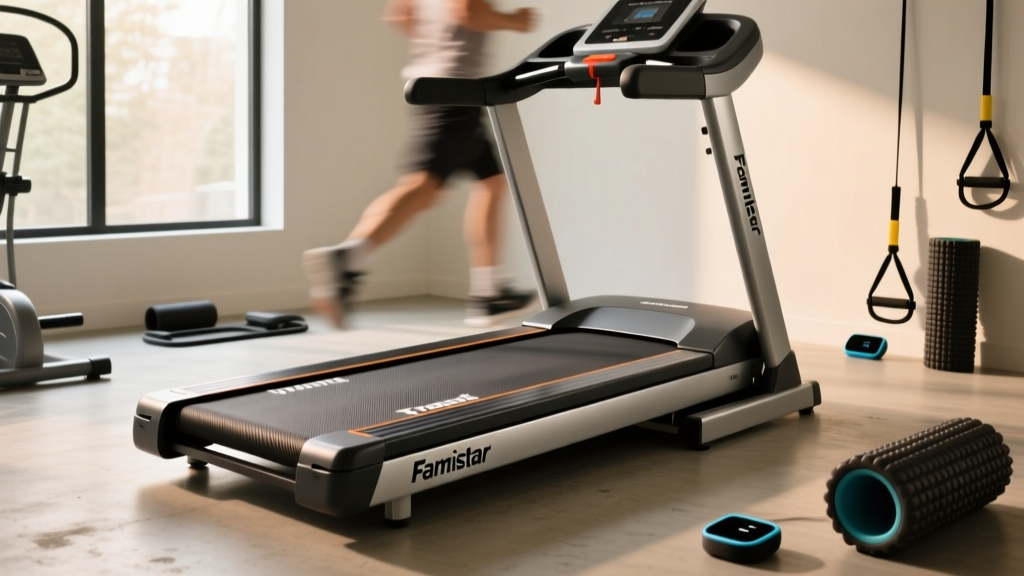
2026 Market Trends: Famistar Treadmill Belt Maintenance Guide
Discover 2026 market trends in home fitness care. Learn exact lubrication protocols, friction metrics, and maintenance steps for your Famistar treadmill belt.

The 2026 Direct-to-Consumer Treadmill Market Shift
The home fitness equipment landscape in 2026 has been fundamentally reshaped by the rise of direct-to-consumer, budget-friendly brands. Among these, the Famistar treadmill line has captured significant market share in the sub-$800 folding segment. Models like the Famistar F800 and F950 offer consumers accessible entry points into daily cardiovascular training without the $3,000+ premium attached to commercial-grade units. However, a deeper market analysis reveals a hidden metric that budget buyers frequently overlook: the Total Cost of Ownership (TCO).
While commercial treadmills from brands like Life Fitness or Precor utilize heavy-duty components designed to withstand 12+ hours of daily gym abuse, budget-friendly home units rely on tighter manufacturing tolerances and lighter materials. According to comprehensive data from RunRepeat's treadmill statistics and lifespan reports, the average lifespan of a budget home treadmill drops from an expected 7 years to under 3 years when routine maintenance is neglected. The primary culprit? Belt-deck friction. Understanding the specific maintenance architecture of your Famistar treadmill is no longer just a chore; it is a critical financial strategy to protect your hardware investment.
Belt Architecture: Budget PVC vs. Commercial Polyurethane
To properly maintain a Famistar treadmill, one must first understand the materials in play. Most Famistar models utilize a 1-ply Polyvinyl Chloride (PVC) belt running over a medium-density fiberboard (MDF) deck coated with a phenolic resin. This differs vastly from the 2-ply polyurethane belts found on commercial machines.
| Feature | Famistar (1-Ply PVC) | Commercial (2-Ply Poly) |
|---|---|---|
| Friction Coefficient (Dry) | 0.45 - 0.60 | 0.20 - 0.30 |
| Friction Coefficient (Lubricated) | 0.10 - 0.15 | 0.05 - 0.08 |
| Required Lubricant | 100% Silicone Liquid | Silicone or Wax-based |
| Lubrication Interval | Every 130 miles / 3 months | Every 500+ miles / 6 months |
| Average Replacement Cost | $45 - $75 | $150 - $300+ |
Because 1-ply PVC generates significantly more heat and friction when dry, the thermal load transfers directly to the Famistar's 1.5 HP continuous-duty drive motor. This makes strict adherence to lubrication schedules non-negotiable for this specific tier of equipment.
The Chemistry of Lubrication: 2026 Nano-Silicone Trends
A dangerous trend in the DIY fitness repair space is the misuse of generic aerosol lubricants. Never use WD-40, petroleum distillates, or lithium grease on a Famistar treadmill belt. Petroleum-based chemicals react with the plasticizers in PVC, causing the belt to dry rot, crack, and ultimately snap under tension.
In 2026, the market has seen a rise in 'nano-silicone' liquid formulations. Unlike older, viscous silicone gels that can clump and create uneven drag spots on the phenolic deck, nano-silicone spreads evenly via capillary action. You need exactly 0.5 oz (15 ml) of 100% pure liquid silicone per application. Aerosol versions with propellants are generally discouraged, as the propellant gases can degrade the adhesive layers of the belt over time.
⚠️ Critical Warning: The Over-Lubrication Trap
More silicone does not equal better performance. Applying more than 0.5 oz will cause excess liquid to squeeze out the sides of the belt during use, coating the motor compartment and rear roller. This leads to belt slippage and attracts household dust, creating an abrasive paste that destroys the deck.
Step-by-Step Famistar Belt Maintenance Protocol
Follow this exact procedure to maintain optimal friction coefficients and protect your lower control board.
- Verify Belt Tension: Before lubricating, check the tension. Reach under the belt at the exact midpoint of the deck and lift. You should achieve exactly 2 to 2.5 inches of clearance. If it is tighter, the motor is overworking; if looser, the belt will slip. Adjust the rear roller bolts using a 6mm Allen wrench in quarter-turn increments.
- Surface Preparation: Wipe the exposed edges of the deck with a dry microfiber cloth to remove accumulated dust and silicone residue.
- Application: Loosen the belt tension by turning both rear roller bolts counter-clockwise (exactly 3 full turns). Slide your hand under the center of the belt and apply the 0.5 oz of 100% liquid silicone in a zig-zag pattern directly onto the deck.
- Re-tension and Distribute: Tighten the rear roller bolts back to their original position (3 full turns clockwise). Power on the Famistar treadmill and run it at 3.0 mph for 5 minutes without walking on it. This allows the belt's movement to distribute the silicone evenly across the phenolic surface.
Diagnostic Edge Cases: Amp Draw and Thermal Breakers
How do you know if your Famistar treadmill belt is actually dry before it causes catastrophic failure? The most accurate metric is motor amp draw.
Equipment repair experts featured in Consumer Reports' treadmill maintenance guides frequently highlight amp draw as the ultimate diagnostic tool for home fitness gear. Using a standard digital multimeter or a plug-in watt meter, you can measure the current your treadmill pulls from the wall.
- Normal Operation (Lubricated): A well-maintained Famistar motor supporting a 150 lb user at 5.0 mph will draw between 4.0 and 6.0 Amps.
- Warning Zone (Under-lubricated): If the draw spikes to 8.0 - 10.0 Amps, friction is increasing. The deck is drying out, and lubrication is immediately required.
- Danger Zone (Critical Failure Imminent): Amp draws exceeding 12.0 Amps indicate severe friction. At this stage, the lower control board's thermal breaker will frequently trip, shutting the machine off mid-stride to prevent a fire hazard.
Troubleshooting Slippage vs. Over-tightening
If the belt hesitates when you plant your foot, users often assume it needs tightening. However, if the amp draw is low (under 4A) and the belt slips, the issue is over-lubrication or a worn drive belt (the small ribbed belt connecting the motor to the front roller), not the walking belt tension. Tightening a walking belt to fix a drive belt issue will instantly fry the Famistar's motor bearings.
Economic Impact: The True Cost of Deferred Maintenance
From a market analysis perspective, the financial breakdown of treadmill ownership clearly favors proactive maintenance. The cost disparity between a $12 bottle of silicone and a $200 motor replacement dictates the economic viability of budget fitness brands.
| Component / Service | Cost (Approx. 2026) | Failure Cause |
|---|---|---|
| 100% Silicone Lubricant (Bottle) | $10 - $15 | N/A (Preventative) |
| Replacement Walking Belt | $45 - $75 | Dry rot, edge fraying, snapping |
| Replacement MDF/Phenolic Deck | $60 - $90 | Gouging from dry belt friction |
| Lower Control Board | $110 - $160 | Overheating due to high amp draw |
| Drive Motor Replacement | $180 - $250+ | Thermal burnout, bearing seizure |
Ultimately, the value proposition of a Famistar treadmill relies entirely on the user's willingness to perform these simple, bi-monthly maintenance tasks. By understanding the material science of PVC belts, utilizing precise 0.5 oz silicone applications, and monitoring amp draw, home gym owners can push their budget equipment well past the 5-year mark, maximizing their return on investment in a competitive 2026 fitness market.
More gear to consider
All reviews
ProForm Treadmill Power 995i Motor Troubleshooting & HP Guide

ProForm Crosswalk Sport Treadmill vs Curved Manual: Mistakes & Fixes

Cardio Noise Comparison: Horizon Fitness Silicone Treadmill Belt Lubricant Fixes
Standard Size of a Treadmill: Curved vs Motorized

Stair Climber Setup: Static Shocks & Anti Static Spray for Treadmill
