
Merit 715T Plus Treadmill Motor Guide: HP vs CHP Explained
Master treadmill motor specs with our Merit 715T Plus treadmill guide. Learn HP vs CHP, match motor size to your weight, and avoid buyer traps.

Introduction: The Heartbeat of Your Home Gym
When shopping for home cardio equipment, the specification sheet can feel like a foreign language. Nowhere is this more apparent than in the motor housing. If you have ever wondered why two machines with seemingly identical horsepower ratings perform entirely differently, you are not alone. Understanding motor size is the single most critical factor in determining the lifespan, noise level, and performance of your machine. In this beginner-friendly, step-by-step guide, we will demystify treadmill motor specifications. To ground these concepts in reality, we will use the popular Merit 715T Plus treadmill as our primary case study, breaking down exactly what its motor specs mean for your daily workouts and how to apply these lessons to any machine you consider buying.
Step 1: Decode the Horsepower Alphabet Soup
Before evaluating any specific machine, you must understand the three distinct ways manufacturers measure motor output. According to Consumer Reports, misleading motor terminology is one of the most common traps for first-time buyers.
- Peak Horsepower (Peak HP): This is a marketing gimmick. It measures the absolute maximum output the motor can achieve for a fraction of a second before failing. Ignore this number entirely.
- Horsepower (HP): A more honest metric, but it still only reflects the motor's output under a specific, often minimal, testing load. It does not account for the sustained friction of a human running on a belt.
- Continuous Horsepower (CHP): This is the gold standard. CHP measures the motor's ability to sustain a specific power output continuously over a long, demanding workout session without overheating. Always base your purchasing decisions on the CHP rating.
Step 2: Case Study – Evaluating the Merit 715T Plus Treadmill Motor
Let us apply this knowledge to a real-world example. The Merit 715T Plus treadmill is a widely recognized model in the budget-to-mid-tier home fitness market. It is typically equipped with a 2.25 HP continuous duty motor. But what does 2.25 CHP actually mean for your living room?
DC vs. AC Motors
Like almost all residential treadmills, the Merit 715T Plus utilizes a Direct Current (DC) motor. DC motors are preferred for home use because they are quieter, offer smoother starts, and run on standard 120V household outlets. However, DC motors rely on a Pulse Width Modulation (PWM) controller board to regulate speed and torque. When you step onto the belt, your body weight creates immediate friction. The PWM board must instantly send more amperage to the 2.25 CHP motor to maintain your selected speed. A 2.25 CHP rating means the motor and its controller can handle this sustained electrical draw indefinitely without tripping the thermal overload protector.
The Flywheel Factor
Motor size does not work in isolation. The Merit 715T Plus pairs its motor with a weighted front roller and flywheel. A heavier flywheel reduces the immediate torque burden on the motor during foot-strikes. This synergy is why a well-engineered 2.25 CHP machine can sometimes outperform a poorly engineered 2.5 CHP machine from a competitor.
Step 3: Match the Motor to Your Biomechanics (Data Matrix)
A motor that is perfectly adequate for a 130-pound walker will quickly burn out under a 230-pound runner. The American Heart Association emphasizes that higher-intensity cardiovascular workouts place exponentially more mechanical stress on equipment. Use the matrix below to determine the minimum CHP you require based on your body weight and primary workout intensity.
| User Weight | Walking (1-3 mph) | Jogging (3-5 mph) | Running (5+ mph) |
|---|---|---|---|
| Under 150 lbs | 1.5 CHP | 2.0 CHP | 2.5 CHP |
| 150 - 200 lbs | 2.0 CHP | 2.5 CHP | 3.0 CHP |
| 200 - 250 lbs | 2.5 CHP | 3.0 CHP | 3.5 CHP |
| Over 250 lbs | 3.0 CHP | 3.5 CHP | 4.0+ CHP |
Where does the Merit 715T Plus fit? With its 2.25 HP motor, it is ideally suited for users under 200 pounds who primarily walk or engage in light jogging. If you weigh 210 pounds and plan to sprint at 7 mph daily, you need to look at commercial-grade 3.5 CHP models instead.
Step 4: Identify Motor Failure Modes and Red Flags
Even if you buy the correct motor size, understanding how these systems fail will help you spot red flags during your warranty review and daily use. According to fitness equipment technicians certified by ACE Fitness, motor failure is rarely spontaneous; it is usually a cascade effect caused by external friction.
The Thermal Cutoff Switch
Inside the motor housing of the Merit 715T Plus (and similar DC motors) is a thermal overload protector. If the internal temperature exceeds roughly 212°F (100°C), this switch cuts power to prevent a fire. If your treadmill suddenly stops mid-run and will not restart for 20 minutes, the thermal switch has tripped. This is a primary indicator that your motor is undersized for your weight, or your belt friction is too high.
The Amp Draw Test
Technicians use a multimeter to measure 'amp draw.' A healthy 2.25 CHP motor running on an unlubricated belt might pull 10 amps. Once you apply proper silicone lubricant, that draw drops to 4 amps. High amp draw generates excess heat, degrades the PWM controller board, and eventually shorts the motor windings.
The motor is only as efficient as the belt it turns. A 3.0 CHP motor forced to drag a dry, overtightened belt will fail faster than a 2.0 CHP motor turning a perfectly lubricated, properly tensioned belt.
Step 5: Step-by-Step Motor Preservation Protocol
To ensure your treadmill motor reaches its maximum lifespan (typically 7 to 10 years for residential DC motors), follow this strict maintenance protocol:
- The Lift Test (Monthly): Turn off and unplug the machine. Reach under the center of the walking belt and lift. You should be able to raise it exactly 2 to 3 inches off the deck. If it is tighter, use the rear roller adjustment bolts to loosen it. Overtightened belts are the number one killer of treadmill motors.
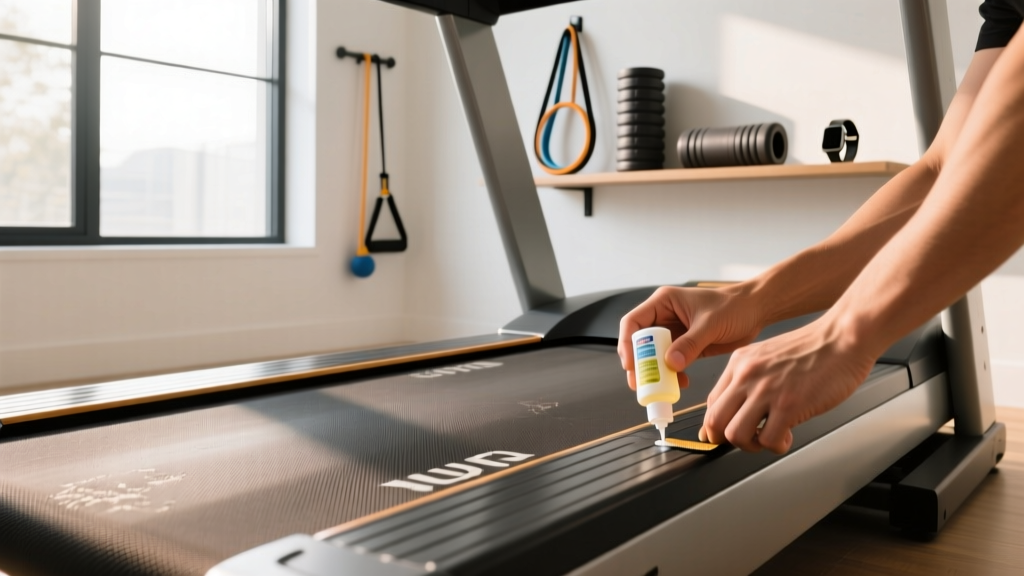
- Silicone Lubrication (Quarterly): Never use WD-40 or petroleum-based products. Purchase 100% liquid silicone treadmill lubricant. Lift the belt, apply a single zig-zag line of about 0.5 ounces down the center of the deck, and run the machine at 2 mph for three minutes to distribute it.
- Vacuum the Motor Hood (Bi-Annually): Dust and pet hair act as thermal insulators. Unplug the machine, remove the plastic motor hood (usually 4 to 6 Phillips-head screws), and use a brush attachment to gently vacuum the motor fins and the PWM board. Do not use compressed air, as it can force dust deeper into the motor bearings.
- Dedicate a 15-Amp Circuit: Treadmills require a dedicated 120V, 15-amp electrical circuit. Plugging your machine into a power strip shared with a space heater or air conditioner will cause voltage drops, forcing the motor to draw excess amperage to compensate, leading to premature winding failure.
Final Verdict: Sizing Up Your Investment
Understanding treadmill motor specifications transforms you from a vulnerable consumer into an informed buyer. The Merit 715T Plus treadmill serves as an excellent benchmark, proving that a well-managed 2.25 CHP motor is more than capable of delivering years of reliable walking and light jogging for average-sized users. However, if your biomechanics demand higher speeds or you carry more mass, you must scale up to a 3.0 CHP or 4.0 CHP continuous duty motor. By prioritizing CHP over Peak HP, matching the motor to your specific workout matrix, and rigorously controlling belt friction, you will protect your investment and ensure your home gym remains the heartbeat of your fitness journey for years to come.
More gear to consider
All reviews
Will a Treadmill Reduce Belly Fat? Rowing Machine Setup & Technique
NordicTrack X22i Incline Trainer Treadmill: Noise Comparison & Fixes
Bifanuo Treadmill E 7 & Air Bike Assault Bike Comparison
Maintaining Your Belt for Daily Treadmill Aerobic Workouts

Walking Pad vs Treadmill with Curved Track: Review & Fixes
