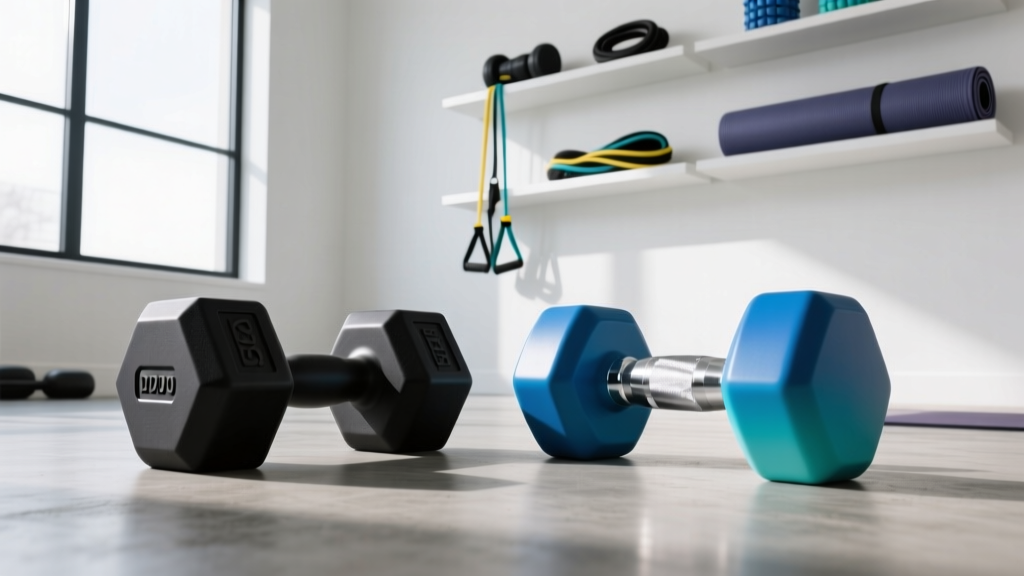
EZ Curl vs Straight Bar: Space Layouts for man with dumbbell Routines
Compare EZ curl bar vs straight bar for space optimization. Discover storage layouts, footprint data, and rack setups for compact home gyms.

The Spatial Dilemma: Barbells in Compact Home Gyms
When designing a high-functioning home gym in a limited footprint, every square inch of floor and rack space must be justified. Arm training often forces a critical equipment decision: the EZ curl bar vs straight bar comparison. While powerlifters prioritize the 86-inch Olympic straight bar for squats and deadlifts, hypertrophy-focused lifters face a different spatial reality. Whether you are a dedicated man with dumbbell routines forming the core of your arm day, or a hybrid athlete trying to maximize a 10x10 garage gym, understanding the physical footprint, storage geometry, and rack compatibility of these bars is essential for an optimized layout.
In this 2026 spatial design guide, we break down the exact dimensions, J-cup clearance mathematics, and storage solutions to help you integrate the right curling bar into your home gym without creating tripping hazards or sacrificing valuable floor space.
The Footprint Face-Off: Dimensions & Clearance Metrics
Before purchasing a specialized barbell, you must map its physical dimensions against your available space. A standard Olympic straight bar dominates the room, while EZ curl bars offer varying degrees of spatial relief. Below is the precise dimensional data for the most common models available on the market today.
| Barbell Type | Total Length | Weight | Sleeve Length | Min. Floor Clearance |
|---|---|---|---|---|
| Standard Olympic Straight Bar | 86" (220 cm) | 45 lbs | 16.3" | 90" x 12" |
| Rogue Curl Bar (Olympic) | 53" (134 cm) | 30 lbs | 10" | 56" x 12" |
| CAP Super Curl Bar (Standard) | 47" (119 cm) | 15 lbs | 7.5" | 50" x 10" |
The J-Cup Dilemma: A Critical Rack Compatibility Warning
The most common spatial design failure in home gyms involves buying a compact EZ curl bar that physically cannot be racked safely. This is a biomechanical and safety edge case that many generic buying guides completely ignore.
Understanding Inner Rack Dimensions
A standard power rack or squat stand features an inside width of 49 inches. The J-cups themselves typically protrude 1.5 to 2 inches inward from the uprights. This leaves a functional resting shelf of roughly 46 to 47 inches.
- The 47-Inch Failure Mode: Budget EZ curl bars (like the 47-inch CAP Barbell model) are exactly 47 inches long from end to end. If you attempt to rack this bar on standard 49-inch J-cups, the bar sleeves will rest on the absolute microscopic edge of the plastic protectors. A slight uneven pull will cause the bar to slip off the J-cup, potentially damaging your floor or causing severe injury.
- The 53-Inch Solution: Premium Olympic EZ curl bars, such as the Rogue Curl Bar, are engineered at 53 inches. This provides 4 inches of total overlap (2 inches per side) on standard J-cups, ensuring a safe, stable rack position without requiring you to purchase specialized narrow squat stands.
"Spatial optimization isn't just about what fits in the room; it's about what fits safely on your existing infrastructure. Never buy a sub-50-inch curl bar if you plan to rack it inside a standard 49-inch power cage."
Storage Solutions & Vertical Layouts
When the barbell is not in use, its storage footprint dictates the flow of your gym. Let's evaluate the three primary storage layouts for arm-specific bars.
1. Vertical Barbell Holders (Floor Mounted)
Vertical storage towers require a minimal 12" x 12" floor footprint. However, they require a minimum of 8 inches of radial clearance on all sides to allow you to safely grip and lift the bar out of the cradle without pinching your fingers against a wall or adjacent dumbbell rack. Place vertical holders in dead corners, but never in high-traffic walkways.
2. Wall-Mounted Horizontal Hangers
For ultimate space reclamation, wall-mounted barbell hangers utilize zero floor space. They project exactly 4.5 inches from the wall. Installation constraint: You must mount these directly into wooden studs or use heavy-duty toggle bolts in drywall, as a loaded 30lb EZ bar exerts significant shear force. Mount at 48 inches off the floor to avoid shin strikes during walking lunges.
3. Rack-Integrated Storage
If you use a 53-inch EZ bar, you can store it horizontally on the safety spotter arms at the very bottom of your power rack. This keeps the floor completely clear for deadlifts or kettlebell swings, though it requires bending down to retrieve the bar.
The Hybrid Layout: Integrating Barbells and Dumbbells
For the lifter whose programming relies heavily on adjustable dumbbells (such as Nuobell or Bowflex 1090s) for isolation work, the arm station layout must accommodate both modalities. According to biomechanical data tracked by resources like ExRx.net, combining straight bar drag curls with dumbbell hammer curls provides comprehensive brachialis and biceps brachii stimulation.
The Optimal 4x4 Foot Arm Zone Layout:
- Center: Place your adjustable dumbbell cradles facing your primary lifting mirror. This requires roughly 36 inches of width.
- Flank (Left): Position a 3-tier vertical dumbbell rack for fixed hex dumbbells (if applicable) or a wall-mounted hanger for your 53-inch EZ curl bar.
- Flank (Right): Keep a 24-inch clearance zone for plate loading. If using an Olympic EZ bar, you need space to slide 10lb and 25lb bumper plates onto the sleeves without hitting the wall.
2026 Market Pricing & Top Space-Saving Models
When budgeting for your space-optimized gym, consider the cost-to-footprint ratio. Here are the top contenders that balance spatial efficiency with durability.
- Rep Fitness EX Curl Bar ($149.99): At 51 inches long, this bar offers a great middle ground. It fits most standard racks safely and features angled grips that reduce wrist strain during close-grip skull crushers in low-ceiling basements. (Check specs at Rep Fitness).
- Titan Fitness Curl Bar ($119.99): A budget-friendly 47-inch option. Warning: Only purchase this if you have dedicated narrow squat stands (42-inch inside width) or plan to use it exclusively from the floor.
- Rogue Curl Bar ($245.00): The gold standard for spatial versatility. The 53-inch length guarantees rack compatibility, and the machined knurling is aggressive enough for heavy sets without tearing calluses.
Final Verdict: Which Bar Wins the Space War?
The EZ curl bar vs straight bar debate ultimately hinges on your specific spatial constraints and exercise selection. A standard 86-inch straight bar is entirely impractical for dedicated arm work in rooms narrower than 10 feet, as the sleeves will constantly strike walls or adjacent equipment.
For the modern home gym, the 53-inch Olympic EZ curl bar is the undisputed champion of space optimization. It provides the necessary length for safe J-cup racking, reduces the required floor clearance by over 30%, and offers ergonomic grip angles that allow for heavier loads in confined spaces. Pair it with a wall-mounted storage hanger, and you reclaim your floor space entirely, leaving ample room for your dumbbell routines, mobility work, and conditioning flows.
More gear to consider
All reviews
Barbell Collar Types: Safety Beyond a Biceps Workout Using Dumbbells

Maintaining a Dumbbell and Kettlebell Set: Cast Iron vs Competition
Cast Iron vs Competition Kettlebells: Hamstring Curl Dumbbell Shift

Best Adjustable Dumbbells for a Total Body Dumbbell Routine (2026)
Barbell Collars For Your Workout With Bench And Dumbbells Setup