EZ vs Straight Bar Care & Correct Form for Dumbbell Bench Press
Compare EZ curl bar vs straight bar maintenance, plus how correct form for dumbbell bench press impacts joint health and equipment lifespan.

The Dual Approach to Longevity: Equipment Care and Joint Preservation
When building a sustainable training routine in 2026, longevity must be viewed through a dual lens: the physical lifespan of your iron, and the biomechanical lifespan of your joints. In the 'Free Weights & Racks' category, few debates highlight this intersection better than the EZ curl bar vs straight bar comparison. While the straight bar is a staple for raw load capacity, the EZ bar was engineered specifically to mitigate connective tissue wear and tear. However, protecting your body isn't just about the pulling equipment you choose; it equally depends on your pushing mechanics. Mastering the correct form for dumbbell bench press is just as critical to shoulder and wrist longevity as choosing the right barbell finish is to rust prevention.
This guide breaks down the metallurgical maintenance of your curl bars, the biomechanical realities of wrist angles, and the precise setup required to keep your upper body joints healthy for decades of lifting.
EZ Curl Bar vs Straight Bar: Equipment Maintenance & Lifespan
The physical longevity of your barbells depends entirely on their finish and your maintenance cadence. EZ curl bars, with their complex cambered bends, are notoriously difficult to clean compared to straight Olympic bars. The tight inner angles trap chalk, dead skin, and moisture, accelerating oxidation if neglected.
Finish Types and Maintenance Protocols
According to BarBend's barbell maintenance guide, the finish dictates your care routine. Bare steel and black oxide require weekly oiling, while chrome needs bi-weekly attention. In the 2026 home gym landscape, ceramic polymer coatings (Cerakote) have become the gold standard for EZ bars due to their extreme corrosion resistance, requiring only a simple wipe-down with a microfiber cloth and zero oil.
| Barbell Finish | Corrosion Resistance | Maintenance Routine | Estimated Lifespan (Indoor) |
|---|---|---|---|
| Bare Steel | Very Low | Brush & oil weekly | 5-10 years (high rust risk) |
| Black Oxide | Low | Brush & oil bi-weekly | 10-15 years |
| Hard Chrome | High | Nylon brush monthly | 20+ years |
| Cerakote (Ceramic) | Extreme | Wipe down as needed | Lifetime |
Biomechanical Longevity: Wrist Angles and Joint Stress
Why does the EZ bar exist? The straight bar forces the wrists into full supination (palms facing directly up) during curls. For lifters with limited radial-ulnar deviation or a high carrying angle (cubitus valgus), this places severe torque on the medial epicondyle and the wrist's triangular fibrocartilage complex (TFCC).
The EZ curl bar introduces a 30 to 45-degree semi-supinated grip. This slight angle aligns the radius and ulna more naturally, reducing valgus stress on the elbow and minimizing ulnar deviation strain on the wrist. If your goal is longevity, the EZ bar is vastly superior for high-volume isolation work, preserving the connective tissues that often degrade first in veteran lifters.
Translating Joint Care to Pushing: Correct Form for Dumbbell Bench Press
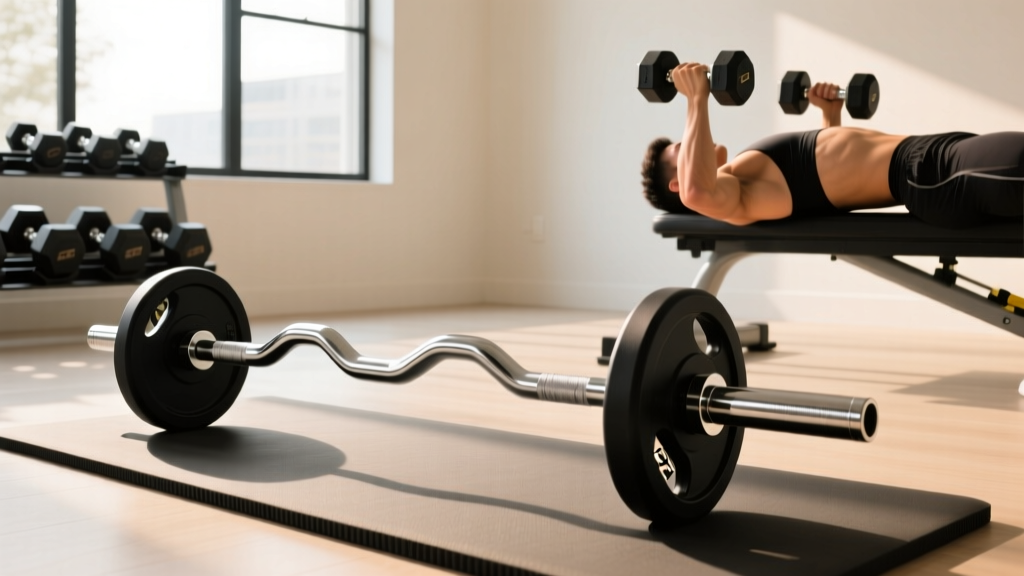
Just as the EZ bar saves your wrists on pulling days, strict mechanics save your shoulders on pushing days. The ExRx kinesiology database notes that the dumbbell bench press allows for a greater range of motion and natural wrist rotation compared to a barbell, but only if the setup is flawless. Relying on the correct form for dumbbell bench press is your primary defense against rotator cuff degradation and AC joint impingement.
The 4-Step Setup for Joint Preservation
- Scapular Retraction and Depression: Before the dumbbells even leave your knees, pinch your shoulder blades together and pull them down toward your hips. This creates a stable 'shelf' on the bench, elevating the sternum and physically pulling the rotator cuff tendons away from the acromion process, preventing subacromial impingement.
- The 45-to-60 Degree Elbow Tuck: Never flare your elbows to 90 degrees (perpendicular to your torso). This grinds the humeral head against the labrum. Tuck your elbows to a 45 or 60-degree angle relative to your torso. This aligns the pectoral fibers for optimal force production while keeping the anterior deltoid and biceps tendon safe from shear forces.
- Wrist Stacking: A common failure mode is letting the wrists bend backward (extension) under heavy loads. The correct form for dumbbell bench press demands 'wrist stacking'—the center of the dumbbell handle must sit directly over the radius and ulna bones of your forearm. This transfers the load directly through the skeletal structure rather than relying on the small flexor tendons of the wrist.
- Controlled Eccentric and Soft Lockout: Lower the weights over 2-3 seconds until you feel a deep stretch in the pecs without anterior shoulder pain. Press up explosively but stop just short of a hard, bone-on-bone elbow lockout to maintain muscular tension and protect the olecranon joint.
'The dumbbell bench press is often prescribed for shoulder rehabilitation because it allows the lifter to find a pain-free groove. However, without strict scapular control and wrist stacking, the instability of dumbbells can actually accelerate joint wear.' — American Council on Exercise (ACE)
Storage Solutions: Protecting Your Rack and Bar Sleeves
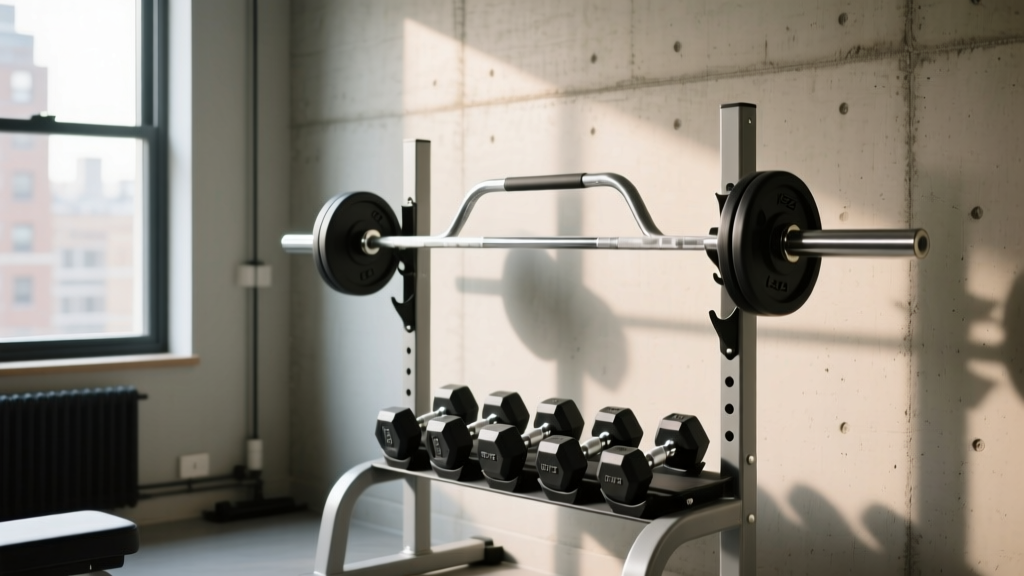
Equipment longevity extends to how you store it. Straight Olympic bars are easily stored on horizontal wall racks or vertical plate trees. EZ curl bars, however, are notoriously awkward. Their cambered ends prevent them from sitting flush in standard horizontal bar holders, often causing the sleeves to scrape against raw steel brackets.
UHMW Liners and Dedicated Cradles
If you are storing your EZ bar on a power rack, ensure your J-cups are lined with UHMW (Ultra-High Molecular Weight) plastic. Dropping a 35-pound EZ bar onto bare steel J-cups will dent the sleeves, compromising the rotation of the internal bushings. For long-term storage, invest in a dedicated vertical barbell cradle with a padded base. Storing an EZ bar vertically by its straight sleeve section prevents the bent shaft from warping under its own weight over years of gravity exposure—a rare but documented failure mode in cheap, low-tensile steel import bars.
Summary Matrix: Equipment & Biomechanical Care
| Focus Area | Pulling (EZ vs Straight Bar) | Pushing (Dumbbell Bench Press) |
|---|---|---|
| Primary Joint Risk | Medial epicondyle & TFCC (wrists) | Subacromial space & AC joint |
| Equipment Solution | Use EZ bar for 30° semi-supination | Use dumbbells for natural arc & rotation |
| Form / Care Cue | Nylon brush cleaning; avoid 90° flaring | 45° elbow tuck; strict wrist stacking |
| Storage Longevity | Vertical cradle to protect cambered bends | UHMW-lined racks to prevent knurl wear |
Final Thoughts on Sustainable Lifting
True longevity in the iron game requires a holistic approach. Upgrading to a Cerakote-finished EZ curl bar and committing to a 5-minute weekly cleaning routine will ensure your equipment outlives your lifting career. Simultaneously, respecting your body's biomechanics by utilizing the EZ bar's angled grips and enforcing the correct form for dumbbell bench press will keep your connective tissues resilient. Treat your joints with the same meticulous care that you treat your knurling, and you will be lifting pain-free well into the future.
More gear to consider
All reviews
Beyond the Dumbbell Burpee Deadlift: Olympic Barbell Knurling Guide

Cast Iron vs Competition Kettlebell Care & Dumbbells at Academy Sports

Fixing Your Back Workout with Dumbbells and Barbell: Neoprene Mistakes
Olympic Barbell Setup and Side Dumbbell Curls: Full Gym Walkthrough

Hexagon Shaped Dumbbells: 2026 Rubber vs Urethane Market Trends