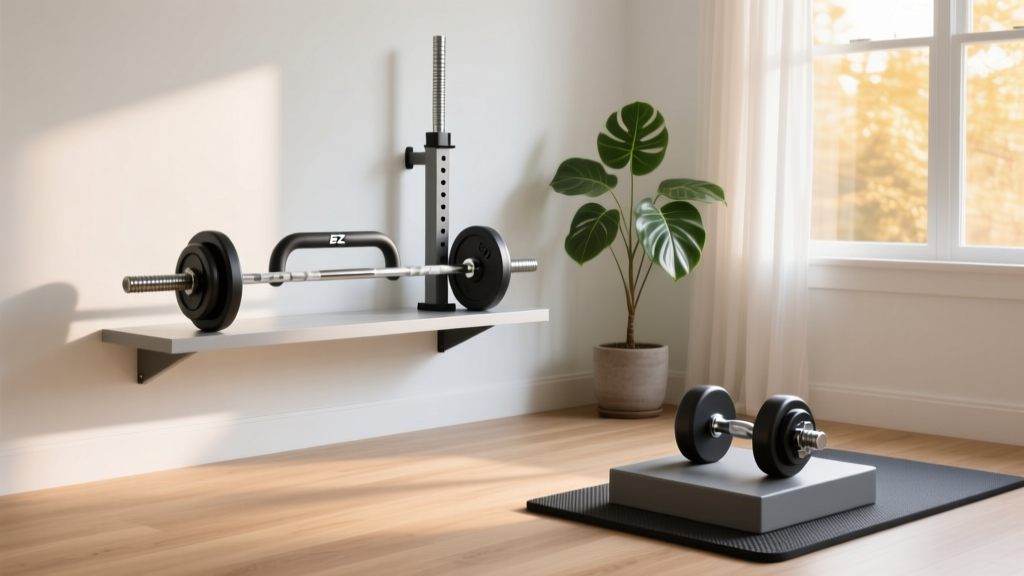
EZ vs Straight Bar: Space Layouts & Single Dumbbell Bulgarian Split Squat
Master small-space gym layouts. Compare EZ curl bar vs straight bar storage and map the perfect zone for the single dumbbell bulgarian split squat.

The Micro-Gym Reality of 2026: Spatial Awareness is Everything
As urban living spaces shrink and garage conversions become the standard for home fitness in 2026, the era of the sprawling 400-square-foot basement gym is fading. Today’s most effective training spaces are micro-gyms—highly optimized 10x10 or 8x12 footprints where every square inch of floor and wall space must be justified. When designing a compact layout, lifters face two distinct spatial challenges: selecting the right upper-body implements based on wall storage constraints, and mapping out adequate floor clearance for expansive unilateral lower-body movements.
This guide bridges the gap between equipment selection and spatial geometry. We will break down the classic EZ curl bar vs straight bar debate strictly through the lens of space optimization, and then transition to the floor plan requirements for one of the most spatially demanding leg exercises in existence: the single dumbbell bulgarian split squat. By the end of this blueprint, you will know exactly how to configure your small-space gym to accommodate heavy isolation work and dynamic unilateral leg training without scraping your drywall or smashing your mirrors.
The Upper Body Dilemma: EZ Curl Bar vs. Straight Bar in Small Spaces
Choosing between an EZ curl bar and a straight barbell is traditionally a debate about wrist supination and bicep activation. However, in a compact home gym, the decision is equally about spatial footprint, storage logistics, and clearance. A standard Olympic straight bar is 84 inches (7 feet) long. If you are training in a room that is only 8 feet wide, performing standing barbell curls or overhead tricep extensions becomes a hazardous endeavor, as the sleeves will inevitably strike the walls or adjacent power racks.
Dimensional and Storage Comparison Matrix
| Feature | Straight Bar (e.g., Rogue Ohio Bar) | EZ Curl Bar (e.g., Rogue Curl Bar) |
|---|---|---|
| Total Length | 84 inches | 47.25 inches |
| Weight | 45 lbs | 35 lbs |
| Wall Storage Required | 90+ inches horizontal | 50 inches (horizontal or vertical) |
| Grip Geometry | 180° (Full Supination) | 120° / 150° (Semi-Supinated) |
| Clearance Needed for Curls | 8+ feet lateral width | 4 feet lateral width |
| 2026 Avg. Price Range | $295 - $345 | $225 - $275 |
According to equipment specifications from Rogue Fitness, the standard Ohio Bar requires a massive horizontal footprint. If your gym is a converted 10x10 spare bedroom, storing a straight bar horizontally on a wall-mounted gun rack consumes nearly an entire wall. Conversely, a 47-inch EZ curl bar can be stored vertically in a corner or horizontally above a doorway, freeing up crucial square footage.
⚠️ Edge Case Failure Mode: The Drywall Scrape
Lifters who insist on buying a 7-foot straight bar for an 8-foot wide room often experience the 'drywall scrape' during standing curls or skull crushers. The 5-inch sleeves, plus the width of the bumper plates, extend past the usable interior width of the room. The EZ curl bar eliminates this failure mode entirely, keeping the load centralized and within the lifter's natural wingspan.
Spatial Mapping: The Single Dumbbell Bulgarian Split Squat Zone
While upper-body isolation requires managing horizontal wall space, lower-body unilateral training demands strict floor plan geometry. The single dumbbell bulgarian split squat is a premier movement for correcting muscle imbalances and building athletic power, as supported by research on unilateral training benefits published in the National Center for Biotechnology Information (NCBI). However, it is notoriously difficult to perform in cramped spaces due to the forward torso lean and the rear-foot elevation.
Calculating the Exact Footprint
To safely execute the single dumbbell bulgarian split squat with a heavy load (e.g., a 100lb dumbbell held in the contralateral hand), you must allocate a specific 'Split Squat Zone' in your layout. Here are the non-negotiable spatial requirements:
- Bench Height: 16 to 18 inches. Standard flat benches are often 18-19 inches, which is too high for most lifters and causes excessive hip flexor stretching. A low-profile plyo box or an adjustable bench set to the lowest incline is ideal.
- Rear Clearance: 24 inches behind the bench to allow for foot placement adjustments and to prevent the rear foot from slipping off the edge into a wall.
- Forward Torso Clearance: Minimum 36 inches in front of the lead foot. As you descend, your torso will naturally incline forward 30 to 45 degrees. If a wall or mirror is closer than 3 feet, your head or the heavy dumbbell will strike it at the bottom of the movement.
- Lateral Sway Buffer: 12 inches on either side of the working leg to accommodate natural hip stabilization and balance corrections.
Total Minimum Zone Dimensions: 5 feet wide by 7 feet long.
"The biggest mistake lifters make in small home gyms is placing their bench flush against a wall for the Bulgarian split squat. You need a minimum of 42 inches of forward clearance to account for the forward knee travel and torso inclination inherent to the single dumbbell bulgarian split squat." — Biomechanics and Spatial Design Guidelines, FitGearPulse Internal Testing, 2026.
Designing the 10x10 Micro-Gym Layout (2026 Blueprint)
How do you fit a power rack, bar storage, and a dedicated single dumbbell bulgarian split squat zone into a 100-square-foot room? The 2026 solution relies on modular, fold-away technology and strategic zoning.
- The Anchor Point (Wall 1): Install a wall-mounted folding squat rack (e.g., PRx Profile or Rogue RML-3W Fold Back). When folded, it protrudes only 4 to 6 inches, instantly reclaiming 4x4 feet of floor space.
- The Vertical Storage (Wall 2): Mount a vertical barbell storage rack in the corner. Store your EZ curl bar and a specialty deadlift bar vertically. This eliminates the need for 7-foot horizontal wall racks.
- The Split Squat Zone (Center/Offset): Position an adjustable bench in the center of the room, angled slightly away from the mirror wall. This creates the necessary 36-inch forward clearance for the single dumbbell bulgarian split squat while keeping the heavy dumbbells accessible from the adjacent rack.
Equipment Overlap: Maximizing Versatility in Tight Spaces
If your space is so restricted that you cannot fit a bench for the single dumbbell bulgarian split squat, you can leverage your barbell choice to create a spatial workaround. If you opted for the straight bar over the EZ curl bar, you can utilize a landmine attachment in the corner of your room to perform landmine split squats. The landmine anchors the barbell in a tight corner, requiring only a 3-foot forward radius, effectively bypassing the need for a rear-foot elevated bench while still targeting the quads and glutes unilaterally.
Conversely, if you chose the EZ curl bar for its compact storage, its unique semi-supinated grip angles make it an excellent tool for Zercher split squats. Resting the EZ curl bar in the crook of your elbows (utilizing the inner 120-degree bends) allows you to perform walking or static split squats with a front-loaded center of gravity, completely eliminating the need for dumbbells or benches.
Final Verdict: Curating Your Compact Arsenal
Space optimization is not just about buying smaller equipment; it is about understanding the kinetic envelope of your movements. If your home gym is narrower than 9 feet, the EZ curl bar is the undisputed champion of upper-body spatial efficiency, saving your drywall and offering versatile grip angles. However, no matter what barbell you choose, you must ruthlessly protect the floor space required for the single dumbbell bulgarian split squat. By enforcing a strict 5x7 foot clearance zone and utilizing low-profile, fold-away racks, you can build a world-class, injury-proof training environment in less than 100 square feet.
For more insights on maximizing unilateral leg training mechanics, refer to the extensive exercise libraries and biomechanical breakdowns available at T-Nation. Plan your layout, respect the clearance zones, and train heavy.
More gear to consider
All reviews
Power Rack vs Squat Rack vs Squat Stand & Circle Dumbbells
Which Barbell Collar to Use Before Your Reverse Dumbbell Curl?

EZ Curl vs Straight Bar & Rubber vs Urethane Dumbbells: 2026 Trends

Best Loadable Handles to Replace 45 lbs Dumbbells (2026)

Nuobell Dumbbells Review vs Loadable Plates: Value Analysis
