EZ Curl Bar vs Straight Bar for Your Quick Dumbbell Workout Space
Optimize your home gym layout. We compare the EZ curl bar vs straight bar for spatial footprint, storage, and enhancing your quick dumbbell workout.

The Spatial Reality: Dimensions and Storage Footprints
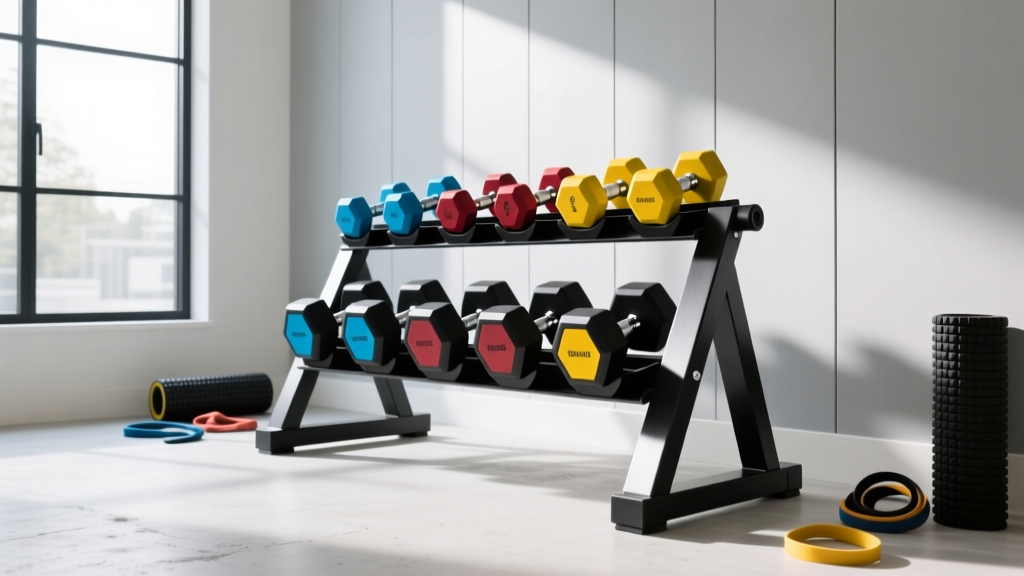
Designing a highly functional home gym in 2026 requires ruthless spatial optimization. When square footage is at a premium, every inch of clearance matters. Many lifters build their routine around a quick dumbbell workout using space-saving adjustable sets like the Nuobell 80lb or PowerBlock Pro EXP. However, adjustable dumbbells have inherent physical limitations: their fixed shaft length (typically 16 to 17 inches) and bulky selectorized heads make heavy triceps skull crushers, close-grip bench presses, and strict drag curls incredibly awkward, as the bulky heads often collide.
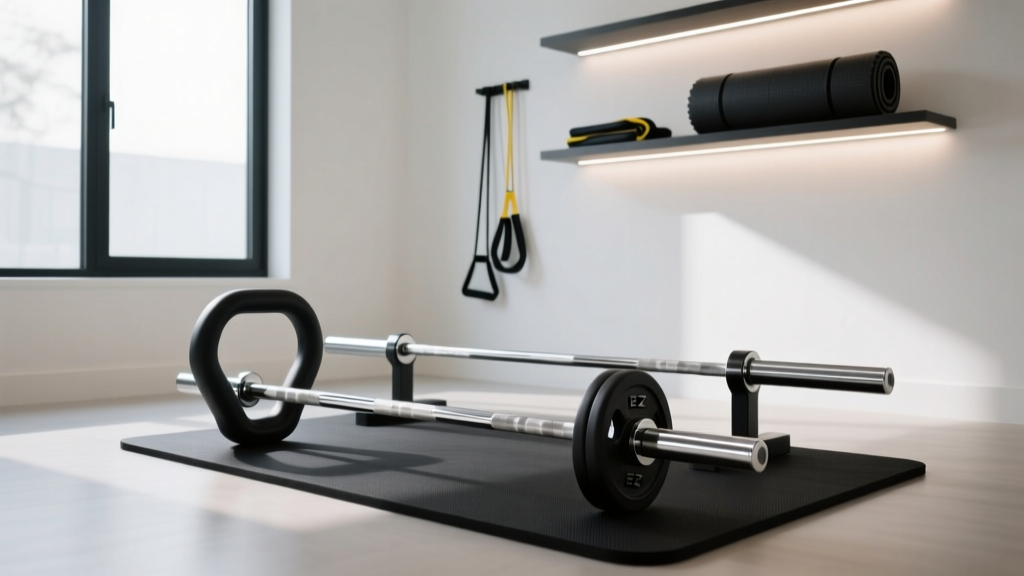
To bridge this gap without sacrificing your compact layout, you need a dedicated barbell. But which one? The debate between the EZ curl bar vs straight bar is usually framed around muscle isolation, but for the space-conscious lifter, it is fundamentally a question of geometry, storage logistics, and layout efficiency.
Exact Dimensional Breakdown
Let us look at the hard numbers. A standard Olympic straight barbell (such as the Rogue Ohio Bar) measures exactly 86.75 inches in length and weighs 45 lbs. In contrast, a high-quality Olympic EZ curl bar (like the Rogue Curl Bar) measures just 47.25 inches in length and weighs 35 lbs.
Layout Callout: The Rack Clearance Rule
A standard power rack is 49 inches wide (outside upright to outside upright). An EZ curl bar fits perfectly flush inside the rack when hung on J-cups or a dedicated crossmember hanger. A straight bar extends nearly 20 inches past the rack on both sides, demanding a minimum 9-foot wide clearance zone just to store it horizontally.
Biomechanics in Tight Quarters: EZ vs. Straight
While spatial footprint heavily favors the EZ bar, we cannot ignore the biomechanical reality of training in confined spaces. According to biomechanics data cataloged by ExRx.net, the straight barbell forces the wrists into full supination (palms facing directly up). While this maximizes biceps brachii activation, it places immense torque on the medial epicondyle and the radioulnar joint.
In a cramped home gym, you do not always have the luxury of adjusting your stance or stepping back to accommodate your natural carrying angle. If your wrists are locked into a wall or a tightly packed rack, the straight bar can quickly lead to wrist impingement or golfer's elbow. The EZ curl bar offers 45-degree and 30-degree grip angles, allowing for a semi-supinated grip that aligns with the body's natural carrying angle, drastically reducing joint strain when your movement envelope is restricted by low ceilings or nearby walls.
Head-to-Head Spatial Comparison Matrix
| Feature | Olympic Straight Bar | Olympic EZ Curl Bar | Space-Saving Impact |
|---|---|---|---|
| Total Length | 86.75 inches | 47.25 inches | EZ saves 39.5" of horizontal wall space. |
| Weight | 45 lbs (20 kg) | 35 lbs (15.8 kg) | EZ is easier to maneuver in tight aisles. |
| Sleeve Length | 16.3 inches | 10 inches | EZ limits max plate load (approx 200 lbs). |
| Vertical Storage | Requires 24"x24" floor base | Fits inside rack uprights | EZ eliminates need for freestanding holders. |
| Avg. Cost (2026) | $250 - $325 | $150 - $295 | EZ is generally more budget-friendly. |
Integrating Bars into a Quick Dumbbell Workout Layout
The core philosophy of the modern compact gym is the 'hybrid transition.' You want to move seamlessly from a high-density quick dumbbell workout into targeted barbell isolation without spending five minutes swapping collars or moving equipment.
Scenario A: The 10x10 Apartment Gym
In a 100-square-foot room, a full power rack is often replaced by a folding wall-mounted squat rack (like the PRx Performance Profile) and a set of adjustable dumbbells. Verdict: Choose the EZ Curl Bar. A straight bar is virtually unusable here; the sleeves will scrape the drywall during bicep curls, and you cannot safely perform standing overhead triceps extensions without hitting the ceiling. The EZ bar allows you to perform preacher curls over an adjustable bench and skull crushers while lying on the floor, maximizing your vertical and horizontal clearance.
Scenario B: The Garage Rack Periphery
If you have a standard 4-post power rack situated in the center of a two-car garage, space is slightly less restricted, but workflow efficiency is paramount. Verdict: The Straight Bar (with vertical storage). Because you likely use the straight bar for heavy compound movements (bench press, squats) as part of your broader routine, it earns its footprint. To optimize the layout, store the straight bar vertically in a 24x24 inch floor holder tucked into the corner of the rack, keeping the floor clear for your quick dumbbell workout circuits and kettlebell swings.
Failure Modes and Edge Cases to Avoid
When buying a bar for a small space, lifters often make a critical error: purchasing a 'Standard' (1-inch diameter sleeve) EZ curl bar to save money. These bars are typically 42 inches long and cost around $40, but they require cheap, cast-iron standard plates. Standard plates are thicker, less durable, and force you to maintain two separate plate ecosystems (Olympic for your main lifts, Standard for your curl bar), effectively doubling your required storage footprint.
The Fix: Always purchase an Olympic (2-inch sleeve) EZ curl bar. While the initial investment is higher (expect to pay between $150 for a Titan Fitness Olympic EZ Bar and $295 for a Rogue Curl Bar), it allows you to use the same bumper plates and steel collars you already own. This unified ecosystem is the golden rule of space optimization.
Expert Verdict: Which Should You Choose?
If your home gym is strictly dedicated to accessory work, bodybuilding isolation, and supplementing a quick dumbbell workout routine in a room smaller than 150 square feet, the Olympic EZ Curl Bar is the undisputed champion of spatial efficiency. It fits inside your rack, spares your wrists in tight corners, and eliminates the need for a massive horizontal wall hanger.
However, if you are a strength athlete who needs to occasionally perform heavy floor presses, close-grip bench presses, or Zercher squats, the Straight Bar is non-negotiable. Just be prepared to allocate a 2-foot by 2-foot corner for a vertical barbell storage stand to keep your workout floor clear and safe.
More gear to consider
All reviews
Cast Iron vs Competition Kettlebells for Your Dumbbell Routine for Men
Rubber Hex vs Urethane: Best Dumbbells for a Dumbbell Quad Workout

Barbell Collar and Clamp Types Comparison: Securing Heavy Shrugs Without a Dumbbell Shrug Machine

Compact Gym Layouts: Kettlebells & Rowing Exercise With Dumbbells

Cast Iron vs Competition Kettlebell Care & Dumbbells for Arm Fat