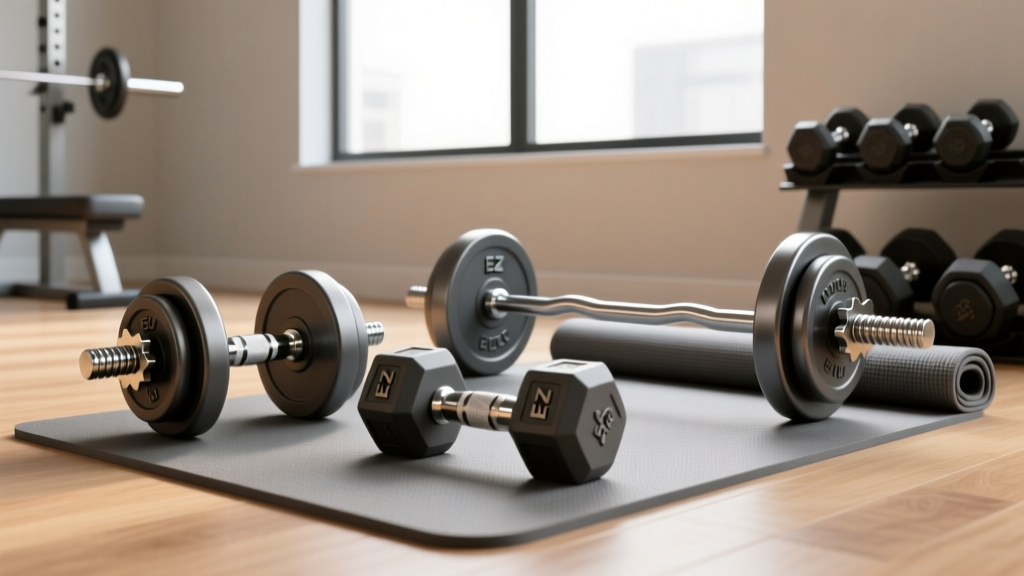
EZ Curl Bar vs Straight Bar & Barbell vs Dumbbell Row
Compare the EZ curl bar vs straight bar for biceps, and dive into the barbell vs dumbbell row debate to optimize your 2026 back and arm training.

Upper Body Mechanics: The Ultimate Equipment Debate
When constructing a comprehensive upper-body hypertrophy program, the implements you choose dictate not just muscle stimulation, but joint longevity and systemic fatigue. In the free weights and racks category, two perennial debates dominate the gym floor: the isolation debate of the EZ curl bar vs straight bar for bicep development, and the compound pulling debate of the barbell vs dumbbell row for back thickness. As we navigate the training landscape in 2026, understanding the biomechanical nuances and equipment specifications of these tools is critical for intermediate and advanced lifters. This guide breaks down the exact physics, product specifications, and programming strategies you need to optimize your arm and back training while minimizing injury risk.
The Curling Conundrum: EZ Curl Bar vs Straight Bar
The bicep curl is a staple of arm training, yet the choice of barbell can drastically alter the stress placed on the distal biceps tendon and the medial epicondyle of the humerus. The core of the EZ curl bar vs straight bar debate hinges on the anatomical 'carrying angle' (cubital valgus) of the human arm.
The Straight Bar: Maximum Supination, Maximum Torque
A standard Olympic straight bar forces the wrists into full supination (palms facing directly up). While this aligns perfectly with the primary function of the biceps brachii—supination and elbow flexion—it ignores the natural outward angle of the forearm when the arms hang at the sides. For lifters with a pronounced carrying angle, forcing the wrists into a perfectly straight, supinated line creates immense rotational torque at the elbow and wrist joints. Over time, heavy straight-bar curling is a primary culprit behind medial epicondylitis (golfer's elbow) and distal bicep tendonitis.
The EZ Curl Bar: Ergonomic Angles and Joint Relief
The EZ curl bar introduces angled grips, typically set at 30 to 45 degrees. This allows for a semi-supinated grip that honors the natural valgus angle of the elbow. According to biomechanical analysis platforms like ExRx, utilizing a semi-pronated or neutral grip shifts a marginal amount of the load to the brachialis and brachioradialis, but drastically reduces shear force on the medial elbow ligaments. For lifters pushing past the 100-pound curling threshold, the EZ bar is generally the superior choice for long-term joint preservation.
Expert Insight: If you experience sharp pain on the inside of your elbow during straight bar curls, do not simply reduce the weight. Switch to an EZ curl bar or a Swiss (football) bar immediately to alter the line of pull and allow the inflamed connective tissue to recover.Equipment Teardown: What to Buy in 2026
Not all bars are created equal. When investing in free weights, you must look at tensile strength, knurling depth, and sleeve rotation. Below is a comparison of top-tier options currently dominating the market.
| Feature | Rogue Curl Bar | Eleiko EZ Curl Bar | Standard Olympic Straight Bar |
|---|---|---|---|
| Tensile Strength | 190,000 PSI | 215,000 PSI | 165,000 - 190,000 PSI |
| Shaft Diameter | 28.5mm | 28mm | 28.5mm - 29mm |
| Sleeve Rotation | Composite Bushings | Precision Bearings | Bushings or Bearings |
| Knurl Type | Medium Volcano | Fine Diamond | Aggressive Mountain |
| Approx. Price (2026) | $125.00 | $315.00 | $150.00 - $250.00 |
Premium manufacturers like Rogue Fitness have perfected the balance between aggressive knurling for grip security and smooth sleeve rotation to prevent wrist binding during the concentric phase of the curl. While the Eleiko offers unparalleled bearing smoothness, the Rogue Curl Bar remains the most practical, high-ROI investment for home and commercial gyms alike.
The Horizontal Pull: Barbell vs Dumbbell Row
Transitioning from arm isolation to back development brings us to the second major equipment debate: the barbell vs dumbbell row. Both movements target the latissimus dorsi, rhomboids, and posterior deltoids, but their systemic footprints are vastly different.
The Barbell Row: Systemic Loading and Bilateral Stability
The bent-over barbell row is a cornerstone of posterior chain development. Because you are moving a single, unified implement, the barbell row demands immense isometric contraction from the spinal erectors, glutes, and hamstrings to maintain a neutral spine against the anterior shear force. The National Strength and Conditioning Association frequently highlights the barbell row as a superior movement for overall athletic power and systemic overload. However, this is also its primary flaw for pure hypertrophy: for many lifters, the lower back fatigues long before the lats reach mechanical failure. Furthermore, the barbell limits the range of motion (ROM) at the top of the movement, as the bar physically contacts the torso, preventing peak scapular retraction.
The Dumbbell Row: Unilateral Isolation and Extended ROM
The single-arm dumbbell row solves the limiting factors of the barbell. By bracing the non-working hand and knee on a bench, you drastically reduce lumbar shear force, allowing you to push the target musculature closer to true failure. More importantly, the dumbbell allows the elbow to travel past the midline of the torso, providing a deeper stretch at the bottom and a more complete scapular retraction at the top. In 2026, the chest-supported dumbbell row (performed lying prone on a 30-degree incline bench) has become the gold standard for bodybuilders seeking to eliminate momentum and lower-back fatigue entirely.
'If your goal is pure latissimus dorsi hypertrophy, the chest-supported dumbbell row is biomechanically superior to the unsupported barbell row because it removes the axial loading and spinal erector fatigue that typically short-circuits the set.'
— Biomechanics & Hypertrophy Research Reviews
Decision Framework: Which Row Should You Program?
- Choose the Barbell Row if: You are a powerlifter or strength athlete needing to build isometric lower-back endurance, or if you are short on time and need a high-systemic-fatigue movement that taxes the entire posterior chain.
- Choose the Dumbbell Row if: You are a bodybuilder or masters lifter prioritizing lat isolation, correcting left-to-right strength imbalances, or managing lower back pain from heavy squats and deadlifts.
Programming for Hypertrophy and Joint Health
To build a resilient, muscular upper body, you must strategically periodize these implements. A highly effective 2026 mesocycle structure pairs the heavy, systemic movements early in the workout, transitioning to joint-friendly isolation work as fatigue accumulates.
Sample Pull-Day Integration
- Primary Compound (Heavy): Pendlay Barbell Row – 3 sets of 5-8 reps. (Focus on explosive concentric pulls and strict spinal neutrality).
- Secondary Compound (Hypertrophy): Chest-Supported Dumbbell Row – 3 sets of 10-15 reps. (Focus on the deep stretch and a 2-second pause at peak contraction).
- Primary Isolation (Biceps): EZ Curl Bar Preacher Curls – 3 sets of 8-12 reps. (Utilizing the EZ bar to protect the medial elbow while the biceps are fully stretched).
- Secondary Isolation (Brachialis/Forearms): Straight Bar Reverse Curls – 2 sets of 15-20 reps. (Using a lighter straight bar with a pronated grip to target the brachioradialis without heavy joint loading).
Frequently Asked Questions
Can I build big biceps using only an EZ curl bar?
Yes. The slight reduction in biceps brachii activation caused by the semi-supinated grip is more than offset by the ability to train heavier and more frequently without developing elbow tendonitis. For complete arm development, simply supplement EZ bar curls with hammer curls to target the brachialis.
Why does my lower back hurt during barbell rows?
Pain during barbell rows usually stems from a lack of hamstring flexibility or poor hip-hinge mechanics, causing the lumbar spine to round under load. If mobility is the issue, swap to a single-arm dumbbell row with a bench brace, or utilize a T-bar row machine with chest support to maintain spinal integrity.
Are cheaper EZ curl bars worth the investment?
Budget EZ bars (often priced under $50) typically feature low-tensile steel (under 150k PSI) and poor sleeve rotation. When the sleeves fail to spin freely during a curl, the rotational force is transferred directly into your wrists and elbows. Always invest in a bar with at least 165k PSI tensile strength and quality bushings.
Final Thoughts
The debate of EZ curl bar vs straight bar ultimately comes down to anatomical alignment and joint preservation, with the EZ bar winning out for the majority of lifters seeking pain-free hypertrophy. Meanwhile, the barbell vs dumbbell row debate is less about which is universally 'better,' and more about matching the tool to your specific training goal—systemic overload versus targeted isolation. By understanding the exact specifications of your equipment and the biomechanics of your body, you can engineer a training program that yields maximum results with minimal wear and tear.
More gear to consider
All reviews
Tricep Extension Dumbbell Form: Rubber Hex vs Urethane Value

Power Rack vs Squat Rack vs Stand: Heaviest Dumbbell in the World
Bumper vs Iron Plates & Dumbbell Bench vs Barbell Bench Budget Guide
2026 Plate Market: Bumper vs Iron & The Bottom Half Dumbbell Fly
Bumper vs Iron Plates & 60 Dumbbell Budget Breakdown
