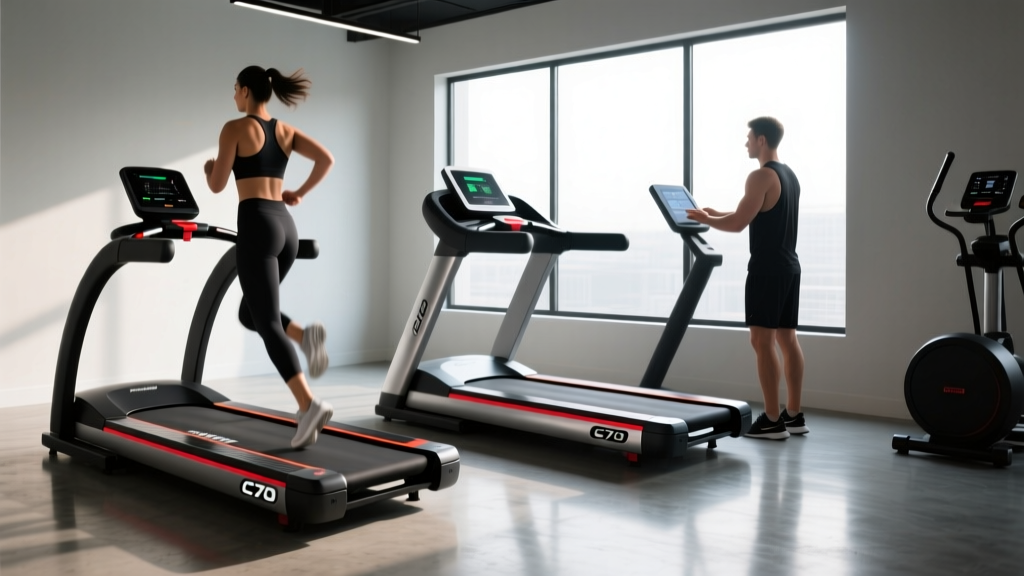
Elliptical vs Treadmill: Space Layouts & WPPRO Folding Treadmill
Maximize your home gym layout. We compare elliptical vs treadmill footprints, ceiling clearances, and review the space-saving WPPRO folding treadmill.

The Spatial Dilemma: Choosing Cardio for Compact Floorplans
When designing a home gym in 2026, the battle between an elliptical and a treadmill is rarely just about biomechanics or calorie burn; it is fundamentally a battle of spatial geometry. Urban apartments, converted guest rooms, and shared living spaces demand rigorous space optimization. While traditional fitness advice focuses on joint impact and cardiovascular output, interior layout constraints often dictate the final purchase. According to the Mayo Clinic's Home Fitness Guide, consistency is the primary driver of home exercise success, and a machine that disrupts your living space's traffic flow will quickly become an expensive clothes rack.
Historically, the elliptical has won the space war by default. However, the recent evolution of compact, high-torque folding mechanisms has leveled the playing field. In this guide, we dissect the elliptical vs. treadmill debate strictly through the lens of space optimization, layout design, and safety clearances, featuring a spatial analysis of the highly efficient WPPRO folding treadmill.
The Static vs. Dynamic Footprint Matrix
To properly plan your room layout, you must differentiate between a machine's static footprint (its physical dimensions on the floor) and its dynamic operational envelope (the space required to use it safely). Below is a comparative matrix of standard cardio machines against compact alternatives.
| Machine Type | Static Footprint (L x W) | Stored Footprint | Dynamic Rear/Side Clearance | Ceiling Height Add-On |
|---|---|---|---|---|
| Standard Commercial Treadmill | 80" x 35" | 80" x 35" (Non-folding) | 72" Rear / 24" Sides | +0" to +6" (Incline) |
| WPPRO Folding Treadmill | 63" x 27" | 27" x 27" (Folded Deck) | 72" Rear / 24" Sides | +0" to +5" (Incline) |
| Front-Drive Elliptical | 70" x 28" | 70" x 28" (Rarely folds) | 12" Rear / 12" Sides | +15" (Pedal Apex) |
| Compact Vertical Elliptical | 49" x 30" | 49" x 30" | 12" Rear / 12" Sides | +18" (Pedal Apex) |
The Clearance Trap: Why Treadmills Demand More Room
The most critical spatial differentiator between an elliptical and a treadmill is the rear clearance requirement. The U.S. Consumer Product Safety Commission (CPSC) strictly mandates a minimum of 72 inches (6 feet) of unobstructed clearance behind any treadmill. This is not a mere recommendation for comfort; it is a vital safety parameter to prevent severe friction burns and impact injuries if a user falls and is dragged toward the rear roller. Ellipticals, being closed-chain kinetic systems where the user's feet remain on the pedals, only require about 12 inches of rear clearance for the machine's rear stabilizer bar.
⚠️ Layout Warning: The Incline Ceiling StrikeWhen placing an elliptical in a room with standard 8-foot (96-inch) ceilings, a 6-foot-tall user on a high-incline elliptical can experience a pedal apex that raises their total height to over 82 inches. This leaves less than 14 inches of overhead clearance, creating a claustrophobic environment and risking head strikes on ceiling fans or low-hanging fixtures. Treadmills generally keep the user's head closer to the baseline ceiling height, even at a 15% incline.
Case Study: Space Engineering in the WPPRO Folding Treadmill
For homeowners who require the biomechanical specificity of running but lack the 14-foot linear run required for a standard treadmill plus safety clearance, the WPPRO folding treadmill presents a masterclass in spatial compromise. Priced in the $350–$450 range, the WPPRO is engineered specifically for multi-use rooms and micro-apartments.
Dimensional Analysis and Hinge Mechanics
Unlike traditional folding treadmills that merely tilt the deck up at a 45-degree angle (still consuming massive floor space), the WPPRO utilizes a vertical hydraulic-assist stow mechanism. When deployed, it commands a 63" x 27" running area—adequate for walking, jogging, and light running for users under 6'2". When folded, the deck locks vertically, reducing the protruding footprint to just 27 inches from the wall.
- Motor Housing: The 2.5 HP continuous-duty motor is housed in a low-profile, elongated cowl rather than a bulky square base, allowing the machine to slide flush under standard 30-inch deep desks or console tables when folded.
- Hydraulic Drop System: A common failure mode in budget folding treadmills is the sudden, uncontrolled dropping of the heavy deck, which damages flooring and poses a crush hazard to pets. The WPPRO incorporates a soft-drop pneumatic cylinder that releases the deck gradually when the safety pin is pulled.
- Transport Wheels: Dual polyurethane transport wheels on the front stabilizer allow a single user to pivot the 110-lb frame into a closet or corner with minimal floor-scuffing.
Strategic Room Layouts for Compact Cardio
Integrating cardio equipment into a living space requires treating the machine as a piece of architectural furniture. Here are three optimized layout frameworks validated by space-planning ergonomics and guidelines supported by the American Council on Exercise (ACE) for home environment setups.
1. The 'Closet Conversion' (Best for the WPPRO)
If you have a deep reach-in closet (minimum 28 inches deep and 60 inches wide), you can create a hidden cardio alcove. By removing the lower closet shelving and installing a heavy-duty tension rod or sliding barn door, the WPPRO folding treadmill can live permanently in its folded state. When it is time for a workout, you pull it out just past the closet threshold. Crucial requirement: You must ensure the 72-inch rear clearance extends safely into the bedroom or hallway, free of trip hazards like area rugs.
2. The 'Corner Tuck' (Best for Compact Ellipticals)
Front-drive ellipticals like the Bowflex Max Trainer series or NordicTrack FS7i excel in corner placements. Because they do not require rear fall-zone clearance, you can push the rear stabilizer within 4 inches of a baseboard. Angle the machine at a 45-degree diagonal into the corner. This opens up the room's centerline and allows the user to face outward into the room or toward a wall-mounted TV, maximizing the perceived volume of the space.
3. The 'Dual-Purpose Office' (Best for Under-Desk Treadmills or WPPRO)
For the work-from-home professional, placing the WPPRO folding treadmill against a wall opposite a standing desk allows for rapid context switching. The low-profile console of the WPPRO allows it to be folded and slid partially beneath a 30-inch deep standing desk. This layout requires a room width of at least 10 feet to accommodate the desk, the folded machine, and the operational pull-out zone.
Vibration Dampening and Floor Protection
Space optimization is not just about square footage; it is about acoustic and vibrational footprint, especially in multi-story homes or apartments. Treadmills generate high-impact, low-frequency vibrations (heel strike) that travel through floor joists, whereas ellipticals generate smooth, continuous rotational force.
'When optimizing a home gym layout, the flooring matrix is just as important as the wall clearances. Ignoring acoustic dampening turns a compact treadmill into a structural nuisance for anyone living below you.'
To mitigate this without sacrificing valuable floor space to massive rubber platforms, utilize the following layered approach:
- Base Layer: 3/8-inch thick vulcanized rubber mat (high density, minimum 60 durometer). Avoid cheap PVC or EVA foam puzzle mats, which compress permanently under the concentrated point-load of a treadmill's rear roller.
- Isolation Pads: Place 2-inch neoprene isolation pads specifically under the treadmill's front motor housing and rear stabilizer feet. This decouples the machine from the subfloor, reducing structural vibration transfer by up to 40%.
Final Verdict: Which Fits Your Floorplan?
The choice between an elliptical and a treadmill ultimately hinges on your specific spatial geometry and safety tolerances.
- Choose a Compact Elliptical if: Your room lacks the 12-to-14-foot linear run necessary for safe treadmill operation, you have low ceilings (under 8 feet) but ample floor width, and you prioritize a zero-clearance rear footprint.
- Choose the WPPRO Folding Treadmill if: You demand the specific bone-density and gait-training benefits of running, you have a dedicated 6-foot safety corridor behind the machine, and you need the ability to reclaim 70% of the machine's floor space via vertical folding when the workout concludes.
By respecting the dynamic operational envelope and prioritizing intelligent clearance planning, you can seamlessly integrate high-performance cardio into even the most restrictive modern floorplans.
More gear to consider
All reviews
Under Desk Treadmill Review: Do Most NordicTrack Treadmills Fold?

What Treadmill MPH Do You Need? Under Desk Office Budget Breakdown

Bike Types vs. Treadmill 10 Minutes Calories Burned: Expert Review

Echelon Stride Folding Treadmill vs Rowing Machine: 2026 Guide
Under Desk Treadmill Office Review: ProForm Sport 6.0 Treadmill Alternatives