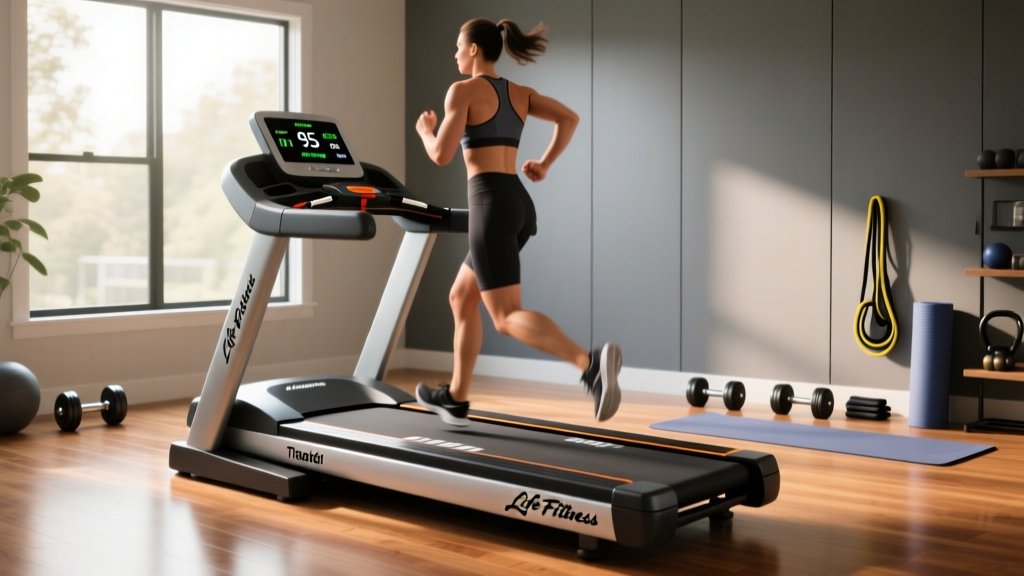
Elliptical vs Treadmill: Testing the Life Fitness 95Ti Treadmill
We compare ellipticals and treadmills for home cardio, featuring a hands-on review of the commercial-grade Life Fitness 95Ti treadmill.

Building a premium home gym in 2026 requires navigating a sea of conflicting advice, especially when settling the ultimate cardio debate: elliptical vs treadmill. While consumer-grade machines dominate big-box store floors, serious fitness enthusiasts and home-gym builders often look to commercial benchmarks for longevity and performance. To anchor this comparison, we brought in a heavy-hitter from the commercial world: the Life Fitness 95Ti treadmill. By testing this iconic machine against top-tier ellipticals, we can uncover the real-world biomechanical, spatial, and financial realities of outfitting a high-end home cardio zone.
The Commercial Benchmark: Hands-On with the Life Fitness 95Ti Treadmill
The Life Fitness 95Ti is a staple in commercial gyms, frequently found in the refurbished market for high-end home installations. It represents the pinnacle of traditional treadmill engineering, but how does it translate to a residential setting?
Deck, Motor, and Footprint Realities
At the heart of the 95Ti is a 4.0 HP continuous-duty AC motor. Unlike the 2.5 HP DC motors found in $1,500 home treadmills that overheat during marathon training blocks, this AC motor is designed for 12+ hours of daily use. The running surface measures a generous 22 inches by 60 inches, accommodating runners with long strides without the claustrophobia of shorter consumer belts. Life Fitness utilizes their proprietary FlexDeck shock absorption system, which claims to reduce joint stress by up to 30% compared to running on asphalt.
Expert Insight: The 95Ti is exceptionally heavy, tipping the scales at roughly 460 lbs. While this mass eliminates the 'wobble' common in lighter treadmills during sprint intervals, it dictates strict placement requirements in a home environment (more on this below).Biomechanics and Joint Impact: What the Data Says
When choosing between an elliptical and a treadmill, the primary differentiator is ground reaction force (GRF). Running on a treadmill—even one with advanced cushioning like the 95Ti—generates impact forces equivalent to 2 to 3 times your body weight with every footstrike. Conversely, ellipticals offer a closed-kinetic-chain movement, keeping your feet planted on the pedals and reducing GRF to near zero.
'For individuals managing osteoarthritis or recovering from lower-extremity injuries, the elliptical provides a cardiovascular stimulus comparable to running, but without the repetitive compressive forces on the tibiofemoral joint.'
— Adapted from biomechanical analyses published by the American Council on Exercise (ACE).
However, for pure bone-density maintenance and sport-specific training, the treadmill wins. The CDC physical activity guidelines emphasize the importance of weight-bearing exercises for long-term skeletal health, an area where the elliptical falls short. If you are training for a marathon or prioritize bone density, the Life Fitness 95Ti treadmill is the superior tool. If you are managing chronic knee pain or prioritizing active recovery, a premium elliptical like the Precor EFX885 is the better investment.
Head-to-Head Specification Matrix
To understand how a commercial treadmill stacks up against both commercial and premium home ellipticals, we mapped out the critical specifications. This matrix highlights the stark differences in power requirements, spatial footprint, and pricing in the current market.
| Metric | Life Fitness 95Ti (Treadmill) | Precor EFX885 (Comm. Elliptical) | Sole E95 (Home Elliptical) |
|---|---|---|---|
| Drive System | 4.0 HP AC Motor | Magnetic Resistance / Front Drive | 10.5 kg Flywheel / Front Drive |
| Footprint (L x W) | 83' x 35' | 83' x 31' | 82' x 33' |
| Machine Weight | ~460 lbs | ~340 lbs | 236 lbs |
| Power Requirement | 120V / 20-Amp Dedicated | 120V / 15-Amp Standard | 120V / 15-Amp Standard |
| Est. Price (2026) | $4,500 - $6,000 (Refurb) | $7,500+ (New/Refurb) | $1,999 (New) |
Space, Power, and Maintenance: The Hidden Home Gym Costs
The most frequent failure point for home gym builders purchasing commercial cardio equipment is ignoring infrastructure requirements. The Life Fitness 95Ti treadmill is not a plug-and-play consumer device.
Electrical and Structural Demands
- The 20-Amp Circuit Rule: The 95Ti's 4.0 HP AC motor requires a dedicated 20-amp, 120V circuit. Plugging this treadmill into a standard 15-amp bedroom circuit shared with lights or a TV will result in tripped breakers and potential motor damage. Upgrading a circuit costs between $250 and $500 depending on your electrical panel's proximity.
- Floor Joist Loading: A 460 lb machine plus a 220 lb runner creates a dynamic point-load exceeding 700 lbs concentrated on four leveling feet. If you are installing this on a second-floor residential build (typically rated for 40 PSF live load), you must place the treadmill perpendicular to the floor joists, ideally directly over a load-bearing wall, or reinforce the subfloor with 3/4-inch plywood.
- Ceiling Clearance: The 95Ti features a 15% incline. At maximum incline, the deck raises significantly. You must add 12 to 14 inches to your height to calculate required ceiling clearance to avoid head strikes during steep incline walking.
Ellipticals, by contrast, are generally much more forgiving. Even commercial ellipticals like the Precor EFX885 draw significantly less peak amperage because they rely on magnetic resistance and user momentum rather than driving a massive continuous belt against gravity.
Final Expert Recommendation: Which Should You Buy?
The choice between an elliptical and a treadmill ultimately hinges on your biomechanical needs, space, and budget. Here is our decision framework for 2026:
- Choose the Life Fitness 95Ti Treadmill if: You are a dedicated runner training for distance events, you prioritize bone-density loading, and you have a dedicated ground-floor or basement gym space with a 20-amp circuit. The refurbished market makes this commercial titan accessible, offering a 15-year lifespan that consumer treadmills simply cannot match.
- Choose a Premium Elliptical (e.g., Sole E95 or Precor EFX885) if: You are managing joint degradation, recovering from lower-body injuries, or require a machine that can be placed on a standard residential floor without structural reinforcement. Ellipticals also offer a superior upper-body integration, allowing for a more generalized full-body caloric burn without the impact penalty.
Frequently Asked Questions
Can I use a treadmill and elliptical on the same electrical circuit?
No. If you are running a commercial treadmill like the Life Fitness 95Ti, it requires its own dedicated 20-amp circuit. Running an elliptical, TV, and AC unit on the same circuit will cause voltage drops that can fry the treadmill's lower control board.
Is the Life Fitness 95Ti still supported with parts in 2026?
Yes. Life Fitness maintains an exceptional parts distribution network. Because the 95Ti (and its sibling, the 95T) are ubiquitous in commercial gyms, third-party refurbishers and OEM part suppliers readily stock replacement drive belts, control boards, and deck overlays.
Which burns more calories: an hour on the elliptical or the treadmill?
At matched perceived exertion levels, the treadmill typically yields a 5% to 10% higher caloric burn due to the energy required to lift your body weight against gravity with each step. However, users can often sustain longer, higher-intensity sessions on an elliptical due to the lack of impact fatigue, potentially equalizing the total session caloric expenditure.
More gear to consider
All reviews
Stair Climber vs BA04 Treadmill: Beginner Home Guide

Treadmill Porn: Head-to-Head Walking Pad Comparison 2026
Walking Pad vs Treadmill: How Many Calories to Burn on Treadmill to Lose Weight

Ice Hockey Treadmill Training: Best Folding Models for Small Spaces
Does Incline Treadmill Burn More Calories? Folding Space-Saver Review
