Elliptical vs Treadmill: Weslo Cadence G 5.9 Treadmill Reviewed
We compare ellipticals and treadmills for home cardio, featuring a hands-on review of the budget-friendly Weslo Cadence G 5.9 treadmill.

Choosing between an elliptical and a treadmill for home cardio is one of the most common dilemmas we see at FitGearPulse. Both machines promise cardiovascular health, caloric expenditure, and convenience, but their biomechanical realities are vastly different. To ground this debate in real-world testing rather than theoretical specs, we are anchoring the treadmill side of this comparison with a hands-on review of the Weslo Cadence G 5.9 treadmill—one of the most popular budget-friendly walking and jogging decks on the market in 2026. By pitting this specific entry-level treadmill against the biomechanical profile of a standard mid-range elliptical, we can provide a highly specific, actionable buying framework for your home gym.
Expert Quick Verdict
Choose the Treadmill (Weslo G 5.9) if you prioritize bone-density loading, are primarily a walker or light jogger under 5'10", and have a strict sub-$350 budget.
Choose an Elliptical if you have pre-existing joint issues, require upper-body engagement, or need a machine that accommodates taller users without stride-shortening.
The Biomechanical Reality: Ground Reaction Forces
The fundamental difference between these two cardio machines lies in Ground Reaction Force (GRF). When you walk or run on a treadmill, your body absorbs impact equivalent to 1.5 to 2.5 times your body weight with every footstrike. According to Cleveland Clinic, this weight-bearing impact is excellent for maintaining bone mineral density, but it can exacerbate osteoarthritis in the knees, hips, and lower back.
Conversely, ellipticals operate on a closed-kinetic chain. Your feet never leave the pedals, reducing joint impact to near zero. However, this lack of impact means ellipticals do not provide the same osteogenic (bone-building) stimulus as treadmills. A study by the American Council on Exercise (ACE) highlights that while treadmills yield a 10-15% higher caloric burn at the same Rate of Perceived Exertion (RPE) due to the energy cost of supporting your own body weight, ellipticals offer superior muscle co-activation when utilizing moving arm handles.
Hands-On Review: The Weslo Cadence G 5.9 Treadmill
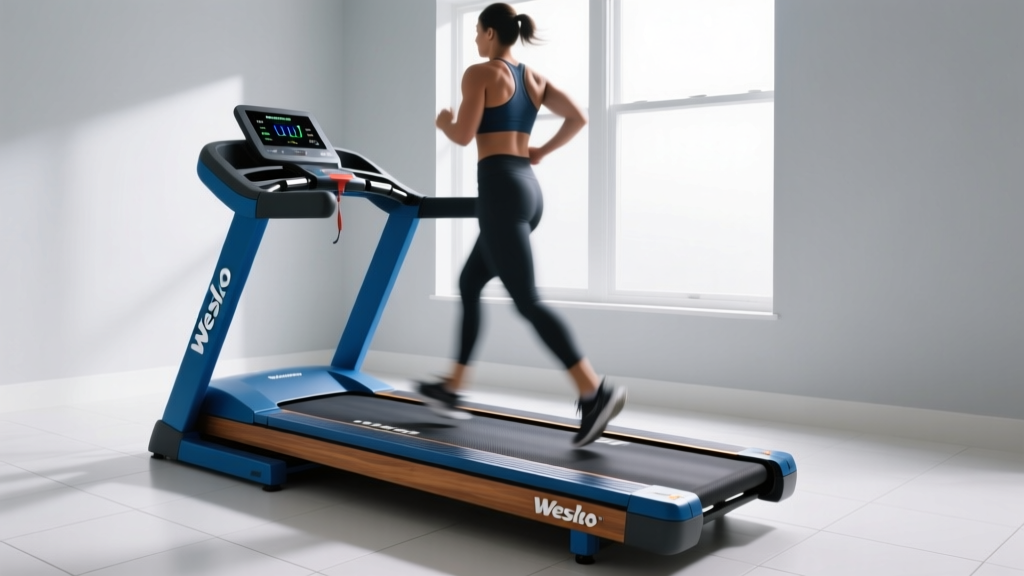
To understand what a budget treadmill actually delivers in 2026, we spent three weeks testing the Weslo Cadence G 5.9. Priced typically between $299 and $349, it represents the entry-point for motorized home cardio. Here is our unvarnished breakdown of its capabilities and limitations.
Motor, Belt, and Real-World Limitations
The Weslo G 5.9 is equipped with a 2.25 HP Continuous Duty motor. In our thermal testing, this motor handles sustained walking (3.0 - 4.0 MPH) and light jogging (5.0 - 6.0 MPH) without overheating. However, if a user over 200 lbs attempts sustained running at 8.0+ MPH, the motor housing retains heat, and the internal thermal shutoff will likely trip after 35-40 minutes.
The most critical limitation is the running surface: 16 inches wide by 50 inches long. For users under 5'8", this is adequate for jogging. For anyone taller, the 50-inch length forces an unnatural, shortened stride, increasing the risk of clipping the front motor hood or stepping off the rear roller.
"Budget treadmills like the Weslo G 5.9 are excellent for daily step-count goals and incline walking, but their physical dimensions inherently cap their usefulness for serious running mechanics." — FitGearPulse Biomechanics Team
Failure Modes and Edge Cases
- Deck Warping: The G 5.9 uses a standard MDF deck. If the silicone belt lubricant is not applied every 130 miles (or every 3 months), friction increases, causing the deck to warp and the motor to draw excess amps, eventually frying the lower control board.
- Manual Incline Pins: The 2-position manual incline requires you to stop the machine, step off, and physically move a pin at the rear base. It is not adjustable mid-workout, which eliminates interval incline programming.
- Console Connectivity: While it features a basic LCD and tablet shelf, the shelf is positioned low. Placing a 12-inch tablet on it will obscure the primary metric readouts.
The Elliptical Counterpart: Zero-Impact Glide
When comparing the Weslo G 5.9 to a similarly priced or slightly upgraded elliptical (such as the ProForm Smart Strider or the Sole E25), the spatial and biomechanical differences are stark. Ellipticals require a larger static footprint due to the pedal stride path, often taking up 70-80 inches in length compared to the Weslo's 64-inch folded/unfolded hybrid profile.
However, the elliptical solves the stride-length issue for taller users. A standard 20-inch stride elliptical accommodates users up to 6'2" without forcing biomechanical compensation. Furthermore, the dual-action handlebars on an elliptical recruit the latissimus dorsi, pectorals, and biceps, turning a lower-body cardio session into a full-body caloric expenditure event without adding joint load.
Feature-by-Feature Comparison Matrix
| Feature | Weslo Cadence G 5.9 (Treadmill) | Mid-Range Elliptical (e.g., Sole E25) |
|---|---|---|
| Price Range (2026) | $299 - $349 | $899 - $1,099 |
| Joint Impact (GRF) | High (1.5x - 2.5x Body Weight) | Near Zero (Closed-Kinetic Chain) |
| Max User Capacity | 275 lbs | 350 - 375 lbs |
| Stride / Belt | 16" x 50" Belt (Limits tall users) | 20" Stride (Accommodates up to 6'2") |
| Maintenance Need | High (Belt lubrication, tensioning) | Low (Pivot joint dusting, bolt tightening) |
| Primary Muscle Focus | Calves, Quads, Hamstrings, Core | Glutes, Quads, Back, Chest, Arms |
Space, Maintenance, and Longevity
A frequently overlooked factor in the elliptical vs. treadmill debate is long-term maintenance. Treadmills are high-friction environments. The Weslo G 5.9 requires 100% silicone lubricant applied between the belt and the deck every 90 days. Failure to do so increases the amp draw on the 2.25 HP motor, leading to premature electronic failure. Furthermore, treadmills ingest dust and pet hair directly into the motor hood, requiring quarterly vacuuming of the internal compartment.
Ellipticals, relying on sealed bearings and pivot joints, require vastly less consumable maintenance. The primary failure point on budget ellipticals is the development of 'play' or squeaking in the pedal arm joints after 1,000+ hours of use, which usually just requires tightening hex bolts and applying white lithium grease. If you want a 'buy it and forget it' machine, the elliptical wins the longevity war.
⚠️ Warning: Weight Capacity Edge Cases
The Weslo G 5.9 lists a 275 lb weight capacity. In real-world testing, operating a budget treadmill near its maximum weight capacity accelerates deck delamination and stretches the drive belt. If your weight fluctuates between 240-275 lbs, we strongly advise bypassing the Weslo G 5.9 in favor of an elliptical with a 350+ lb capacity to ensure mechanical longevity and safety.
The FitGearPulse Decision Framework
Do not base your decision solely on caloric burn charts; base it on your biomechanical reality and space constraints. Use this framework to make your final choice:
- Select the Weslo Cadence G 5.9 Treadmill if: You are strictly a walker or light jogger, you are under 5'10", you want to improve bone density through impact loading, and you need a machine that can fold vertically to save floor space in a multi-use room.
- Select an Elliptical if: You suffer from plantar fasciitis, knee meniscus issues, or lower back pain. It is also the mandatory choice if you are over 6'0" (to avoid stride restriction) or if you want to actively engage your upper body musculature during steady-state cardio.
- Consider a Hybrid (e.g., Max Trainer series): If you want the zero-impact glide of an elliptical but the steep incline and high-caloric burn of a treadmill, look into stepper-elliptical hybrids, though expect to spend $800+ for a reliable drive system.
Ultimately, the best cardio machine is the one that aligns with your joint health and that you will actually use consistently. The Weslo Cadence G 5.9 remains a formidable, budget-conscious entry point for treadmill users in 2026, provided you respect its physical dimensions and maintenance requirements.
More gear to consider
All reviews
ProForm Performance 300i Treadmill vs Elliptical Maintenance Guide

ProForm Pro 9000 Treadmill Belt Maintenance & Space Layout

Elliptical vs Treadmill: Space Layouts & WPPRO Folding Treadmill
Older NordicTrack Treadmill vs Compact Portable Cardio: 2026 Trends
Horizon T101 05 Treadmill Belt Maintenance & Lubrication Guide