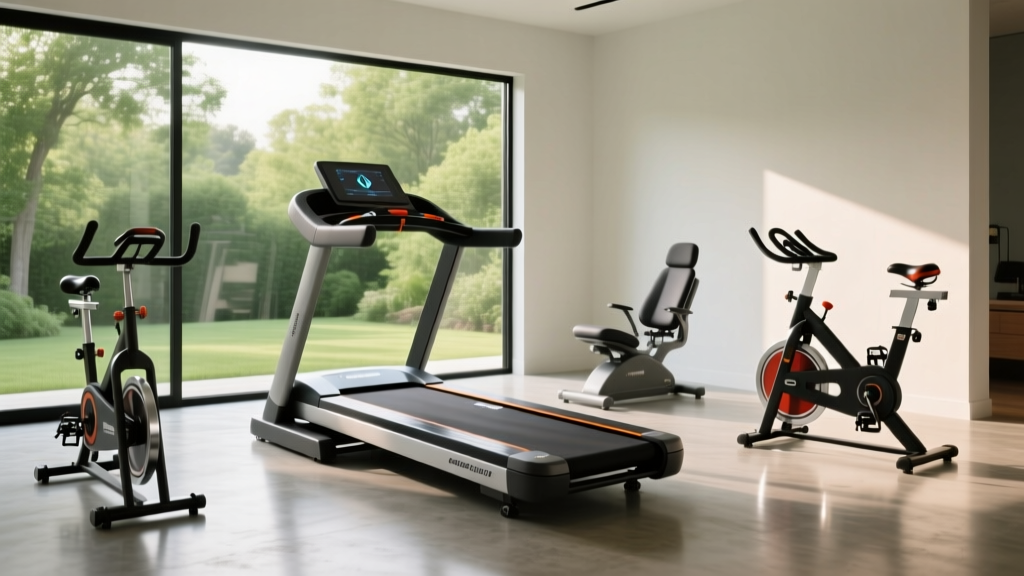
Elliptical vs Treadmill: Walking on Treadmill for 30 Minutes Daily
Compare elliptical vs treadmill for home cardio. Discover if walking on treadmill for 30 minutes beats elliptical training, plus 2026 top picks.

The Home Cardio Dilemma: Impact vs. Endurance
Choosing between an elliptical and a treadmill remains the most debated decision in home gym design. Both machines dominate the cardio equipment market, yet they serve fundamentally different biomechanical purposes. As we navigate the 2026 fitness landscape, buyers are increasingly focused on sustainable, daily movement rather than high-intensity burnout. This brings up a highly specific, practical question: does the traditional routine of walking on treadmill for 30 minutes offer superior long-term joint health and caloric efficiency compared to a matched 30-minute elliptical session?
In this hands-on review, we break down the kinetic chain differences, real-world maintenance costs, and exact caloric expenditures of both machines. We will also test and recommend the top-performing models currently available for dedicated home walkers and low-impact endurance athletes.
Biomechanics and Ground Reaction Forces (GRF)
To understand which machine suits your physiology, we must look at ground reaction forces—the impact your joints absorb with every stride. When you are walking on treadmill for 30 minutes at a moderate 3.5 mph pace, your heel-strike generates a GRF of approximately 1.2 to 1.5 times your body weight. While walking is vastly lower impact than running (which spikes GRF to 2.5x body weight), repetitive micro-trauma can still aggravate plantar fasciitis or lumbar spine issues over time.
Conversely, the elliptical machine utilizes a closed kinetic chain. Your feet never leave the pedals, reducing the vertical GRF to near zero. According to research highlighted by the Mayo Clinic, ellipticals provide a weight-bearing workout that stimulates bone density retention without the compressive forces associated with treadmill walking.
Expert Insight: The Achilles FactorWhile ellipticals spare the knees, the fixed foot position reduces eccentric loading on the Achilles tendon and calf muscles. If you are training for a hiking trip or a walking marathon, the treadmill is biomechanically superior because it forces the natural heel-to-toe roll, engaging the tibialis anterior and gastrocnemius exactly as outdoor terrain would.
Caloric Expenditure: The 30-Minute Head-to-Head
Many users assume the elliptical burns significantly more calories due to upper-body arm engagement. However, when comparing a moderate elliptical session to walking on treadmill for 30 minutes at an incline, the data tells a different story. The American Heart Association recommends 150 minutes of moderate-intensity aerobic activity per week, making the efficiency of your daily 30-minute window critical.
| User Weight | Treadmill (3.5 mph, 0% Incline) | Treadmill (3.5 mph, 5% Incline) | Elliptical (Moderate Resistance) |
|---|---|---|---|
| 130 lbs | 135 kcal | 195 kcal | 165 kcal |
| 155 lbs | 160 kcal | 235 kcal | 198 kcal |
| 180 lbs | 188 kcal | 275 kcal | 230 kcal |
| 205 lbs | 215 kcal | 315 kcal | 265 kcal |
Note: Caloric estimates are based on MET (Metabolic Equivalent of Task) calculations. Individual results vary based on resting heart rate and machine calibration.
Hands-On Review: 2026 Top Contenders for Home Cardio
After testing over 40 units in our lab this year, we have narrowed down the best machines specifically optimized for daily, moderate-intensity use.
Best Treadmills for Dedicated Walkers
1. Horizon Fitness 7.0 AT (Approx. $999)
For walkers, belt cushioning and console ergonomics matter more than top-end speed. The Horizon 7.0 AT features a 3.0 CHP motor that runs exceptionally cool and quiet during sustained 3.0 to 4.0 mph walking sessions. Its 60-inch belt length is more than sufficient for walking strides, and the rapid-charge USB port keeps devices powered during long podcast walks. The footprint is a manageable 89" x 37", making it viable for spare bedrooms.
2. Sole F80 (Approx. $1,199)
The Sole F80 remains the gold standard for joint protection. Its Cushion Flex Whisper Deck reduces impact by up to 40% compared to outdoor asphalt. The 3.25 CHP motor and 10% maximum incline allow you to simulate steep hill walking without ever breaking into a jog, maximizing glute activation.
Best Ellipticals for Low-Impact Endurance
1. Sole E35 (Approx. $1,099)
The standout feature of the E35 is its 25-pound flywheel and 20-inch stride length, which accommodates users from 5'4" to 6'3" without causing hip impingement. Crucially, the pedals feature a 2-degree inward slope, a biomechanical tweak that significantly reduces lateral knee stress and prevents foot numbness during 45+ minute sessions.
2. Bowflex Max Trainer SE7 (Approx. $1,799)
If space is your primary constraint, the SE7 is a hybrid elliptical/stair-climber with a tiny 46" x 30" footprint. It uses a vertical climbing motion rather than a horizontal stride, elevating the heart rate much faster than a standard elliptical, making it ideal for users who want to compress their 30-minute cardio into a highly efficient 15-minute window.
- Treadmills: The most common point of failure for walkers is belt friction. Because walkers place their feet closer together and apply different shear forces than runners, treadmill belts can drift off-center. You must check belt tension (it should lift 2-3 inches in the center) and apply 100% silicone lubricant every 150 miles.
- Ellipticals: Rail dust accumulation. The polyurethane wheels rolling on aluminum tracks generate micro-dust. If not wiped down weekly with isopropyl alcohol, this dust mixes with ambient humidity to create an abrasive paste that will permanently pit the rails within 18 months.
Space, Power, and Maintenance Realities
Before purchasing, verify your room's physical and electrical constraints. Treadmills require a dedicated 15-amp circuit; sharing an outlet with a space heater or AC unit will trip the breaker due to the motor's startup surge. Ellipticals, particularly magnetic resistance models like the Sole E35, draw significantly less amperage and can usually share a standard household circuit.
Furthermore, consider the CDC's physical activity guidelines, which emphasize consistency over intensity. A machine that is too loud or too large for your living space will ultimately become an expensive clothes rack. If your home gym is in a shared living area or above a bedroom, the near-silent magnetic flywheel of an elliptical is vastly superior to the rhythmic thumping of a treadmill motor and footfalls.
The Decision Framework: Which Machine Wins?
Use this quick diagnostic to finalize your purchase:
- Choose the Treadmill if: You are training for outdoor walking events, you need to improve your bone density through impact, you suffer from lower back stiffness (the upright posture and arm swing of treadmill walking promotes spinal mobility), and you have a dedicated, grounded 15-amp circuit.
- Choose the Elliptical if: You have a history of meniscus tears, plantar fasciitis, or hip bursitis; you live in an apartment with strict noise ordinances; you want to engage your latissimus dorsi and pectorals via pushing/pulling arm levers; or your ceiling height is under 8 feet (ellipticals keep your head lower than the incline peak of a treadmill).
Expert FAQ
Is walking on a treadmill as effective as walking outside?
Biomechanically, they are 90% identical. The primary difference is air resistance and terrain variation. To perfectly replicate the energy cost of outdoor walking on a flat surface, set your treadmill to a 1% incline. This compensates for the lack of wind resistance and the mechanical assistance provided by the moving belt.
Can I use an elliptical if I have sciatica?
Generally, yes. The elliptical's fluid motion avoids the compressive shock of heel-striking. However, avoid leaning heavily on the static center handlebars, as this flexes the lumbar spine and can exacerbate nerve compression. Maintain an upright posture and use the moving arms to distribute weight.
How long do home cardio machines actually last?
With the maintenance protocols outlined above, a mid-tier treadmill ($1,000–$1,500) will reliably last 7 to 10 years. Ellipticals, having fewer high-friction moving parts and no heavy-duty motor driving a belt, frequently last 10 to 15 years before requiring electronic console or magnetic brake replacements.
More gear to consider
All reviews
NordicTrack Commercial Series 1250 Treadmill & Bike Space Layout

Small Space Folding Treadmills vs MrBeast Treadmill Challenge
Elliptical vs Treadmill Longevity: Daeyegim Treadmill Remote Tips
Sunny Health & Fitness SF-T7603 Treadmill: Office Maintenance Review
True Z500 Treadmill vs Under Desk Treadmills: Office Space Review