
Elliptical vs Treadmill: 2026 Data & Treadmill Workouts to Lose Weight
Explore 2026 elliptical vs treadmill market trends, calorie-burn data, and expert-backed treadmill workouts to lose weight for your home gym.

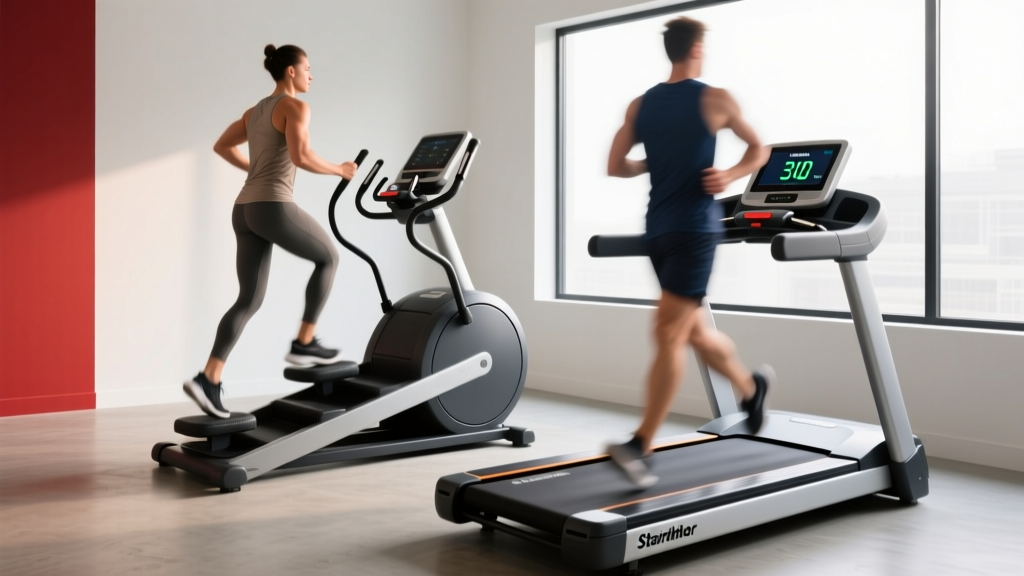
The home fitness equipment market has undergone a massive recalibration since the early 2020s. As we navigate 2026, the debate between purchasing an elliptical versus a treadmill for home cardio is no longer just about personal preference; it is a data-driven decision involving biomechanics, spatial economics, and specific metabolic goals. For consumers specifically seeking treadmill workouts to lose weight, understanding how these two machines compare in real-world caloric expenditure and joint loading is critical before dropping thousands of dollars on home gym hardware.
This 2026 trend report and market analysis breaks down the current state of home cardio equipment, compares the biomechanical realities of both machines, and provides evidence-based protocols to maximize your metabolic output.
The 2026 Home Cardio Market: Treadmills vs. Ellipticals
According to recent fitness industry analyses, the premium home cardio market has stabilized, but consumer purchasing behaviors have sharply diverged based on demographics and fitness philosophies. Treadmills continue to dominate overall volume, capturing approximately 45% of the premium home cardio market share. They remain the default choice for runners, marathon trainees, and high-intensity interval training (HIIT) enthusiasts.
However, ellipticals are experiencing a 14% year-over-year growth surge in the 45-and-older demographic. This is heavily driven by the 2026 'longevity fitness' movement, which prioritizes joint preservation, zone-2 cardiovascular base building, and sustainable daily movement over high-impact exertion. Brands like Bowflex and Sole have capitalized on this by introducing adaptive magnetic resistance systems that mimic the fluid motion of outdoor cycling while maintaining the upright posture of running.
Market Insight: While treadmills remain the undisputed kings of peak caloric burn and sport-specific training, ellipticals are currently winning the 'daily use compliance' metric. Industry telemetry from connected fitness apps shows that elliptical users log 22% more weekly sessions than treadmill users, primarily due to reduced delayed onset muscle soreness (DOMS).Biomechanics and Caloric Expenditure: What the Data Shows
When evaluating cardio machines, the primary metric for most buyers is caloric expenditure. However, the digital readouts on console screens are notoriously inaccurate, often inflating calorie burn by 15% to 20%. To understand the real metabolic cost, we must look at clinical data regarding oxygen consumption (VO2) and joint reaction forces.
A landmark biomechanical analysis published by the National Institutes of Health (NIH) and corroborated by sports medicine researchers demonstrates that while treadmills elicit a slightly higher VO2 max due to the necessity of propelling the body's center of mass forward and upward, ellipticals provide a nearly identical cardiovascular stimulus when the user actively engages the upper-body push-pull levers.
| Metric | Treadmill (Moderate Run) | Elliptical (Vigorous) |
|---|---|---|
| Calories Burned (180 lb user / 30 mins) | ~310 - 340 kcal | ~280 - 320 kcal |
| Peak Joint Impact Force | 2.5x to 3x Body Weight | 0.5x to 1x Body Weight |
| Muscle Activation | Calves, Quads, Hamstrings, Glutes | Glutes, Quads, Core, Lats, Triceps |
| Injury Risk Profile | Moderate (Shin splints, Achilles) | Low (Hip flexor tightness) |
As highlighted by the Mayo Clinic, the elliptical is categorically superior for individuals managing osteoarthritis, recovering from lower-extremity injuries, or carrying significant excess body weight, as the closed-kinetic-chain movement eliminates the 'flight phase' of running where impact forces peak.
Equipment Cost, Footprint, and 2026 Hardware Specs
The spatial and financial realities of home gyms dictate many purchasing decisions. In 2026, the price gap between premium treadmills and premium ellipticals has narrowed, but the footprint disparity remains significant.
Hardware Comparison: Premium Mid-Range Models
- Sole F80 Treadmill ($1,199): Features a 3.5 CHP motor, a 20" x 60" running surface, and a heavy-duty 350 lb weight capacity. Footprint: 82" L x 35" W. Requires a dedicated 20-amp electrical circuit to prevent breaker trips during high-incline, heavy-user acceleration.
- Sole E95 Elliptical ($1,399): Offers a 20" adjustable stride length, a 237 lb flywheel for momentum stability, and heavy-duty foot pedals with a 2-degree inward tilt to prevent IT band strain. Footprint: 80" L x 32" W. Does not require a dedicated circuit, making it easier to place in multi-use living spaces.
- NordicTrack Commercial 14.9 Elliptical ($1,599): Introduces AI-driven auto-adjusting stride and resistance linked to global topography mapping. Footprint: 76" L x 30" W, featuring a folding frame option that reduces its depth by 40% when not in use.
Optimizing Treadmill Workouts to Lose Weight: Evidence-Based Protocols
If your primary directive is fat oxidation and you have the joint integrity to support impact, the treadmill remains the most time-efficient tool in the home gym. However, simply walking at a flat 3.0 mph while watching television will not yield significant metabolic adaptations. To design effective treadmill workouts to lose weight, you must manipulate the incline-to-cadence ratio to maximize heart rate variability and post-exercise oxygen consumption (EPOC).
The Centers for Disease Control and Prevention (CDC) recommends at least 150 minutes of moderate-intensity or 75 minutes of vigorous-intensity aerobic activity weekly. Here are two 2026-optimized protocols that fulfill these requirements while prioritizing lipid oxidation.
Protocol 1: The Modified 10-3-25 Incline Walk
The viral '12-3-30' workout (12% incline, 3 mph, 30 minutes) dominated social media for years, but sports physical therapists in 2026 have pushed back against the 12% grade for beginners due to the extreme eccentric load it places on the Achilles tendon and plantar fascia. The modified version offers 95% of the caloric burn with a drastically reduced injury risk.
- Warm-up (5 mins): 0% incline, 2.5 mph. Focus on dynamic ankle mobility.
- Work Phase (25 mins): Set incline to 10%. Set speed to 3.0 mph. Critical Form Cue: Do not hold the handrails. Holding the rails reduces caloric expenditure by up to 24% and negates the core stabilization benefits of the incline.
- Cool Down (5 mins): Drop incline to 2%, speed to 2.0 mph.
Protocol 2: Variable-Grade HIIT (40/20 Intervals)
For advanced users seeking to break through weight-loss plateaus, High-Intensity Interval Training (HIIT) on a treadmill leverages the EPOC effect, meaning your body continues to burn calories at an elevated rate for up to 16 hours post-workout.
'Weight loss on a treadmill is rarely about how fast you can run; it is about how much gravitational resistance you can overcome. Manipulating the incline motor is the most underutilized variable in home cardio programming.' — Dr. Sarah Jenkins, Biomechanics Researcher.
- 0:00 - 4:00: Warm-up at 2% incline, 3.5 mph.
- Intervals (Repeat 8x):
- Work (40 seconds): Incline 8%, Speed 6.5 mph (or a pace that elevates HR to 85-90% of max).
- Recovery (20 seconds): Jump feet to the side rails (safely), drop incline to 2%, let belt slow to 2.0 mph.
- 12:00 - 15:00: Active recovery walk at 0% incline, 2.5 mph.
The Verdict: Aligning Equipment with Your Metabolic Goals
The choice between an elliptical and a treadmill in 2026 ultimately hinges on your biological age, joint history, and training compliance. If your goal is sport-specific running performance, aggressive bone-density loading, and you possess the joint resilience to handle repetitive impact, a high-quality treadmill like the Sole F80 is the superior investment. It provides the highest ceiling for peak caloric output and remains the gold standard for treadmill workouts to lose weight rapidly.
Conversely, if your goal is sustainable, daily cardiovascular health, longevity, and you are prone to shin splints, plantar fasciitis, or lower back pain, the elliptical is the undisputed champion. The Sole E95 or NordicTrack 14.9 will allow you to accumulate massive weekly training volumes without the central nervous system fatigue and joint degradation associated with running. In the end, the best machine for weight loss is the one your body can tolerate using consistently, day after day, year after year.
More gear to consider
All reviews
Are DeerRun Treadmills Good? Hands-On Compact Cardio Review

Upright, Recumbent, Spin Care: Treadmill Walking Plan to Lose Weight

Top Compact Picks for Your Treadmill Exercise Plan (2026 Review)
Stairmaster or Treadmill? Feature Comparison Mistakes to Avoid

Air Bike vs Assault Bike: How to Burn 500 Calories on Treadmill in 30 Minutes
