Elliptical vs Treadmill: The Rise of Omnidirectional Treadmills
Analyze the 2026 home cardio market: elliptical vs treadmill debates disrupted by omnidirectional treadmills. Expert data, pricing, and ROI.

The 2026 Home Cardio Paradigm Shift
For over two decades, the home fitness industry has been anchored by a binary debate: elliptical vs treadmill. Consumers traditionally chose between the low-impact, gliding mechanics of the elliptical and the high-caloric, weight-bearing stride of the linear treadmill. However, as we navigate the 2026 fitness equipment market, a massive disruption is altering this duopoly. Omnidirectional treadmills (ODTs)—once confined to commercial VR arcades, military simulation, and high-end tech campuses—have successfully miniaturized and entered the premium home cardio sector.
This trend report analyzes the shifting market dynamics between traditional linear machines and the emerging omnidirectional treadmill category. By examining biomechanics, spatial footprints, and long-term user adherence, we provide a data-driven framework for home gym investments in 2026.
2026 Market Snapshot: The Engagement Crisis
According to recent industry data, traditional linear cardio machines experience a 68% abandonment rate after 14 months of home ownership. Conversely, immersive and multi-planar cardio devices, heavily driven by the integration of omnidirectional treadmills with VR ecosystems like Meta Quest 3S and Apple Vision Pro, are growing at a CAGR of 14.2%. The market is shifting from caloric expenditure to cognitive engagement.
Traditional Linear Cardio: Elliptical vs. Treadmill
The Biomechanical Baseline
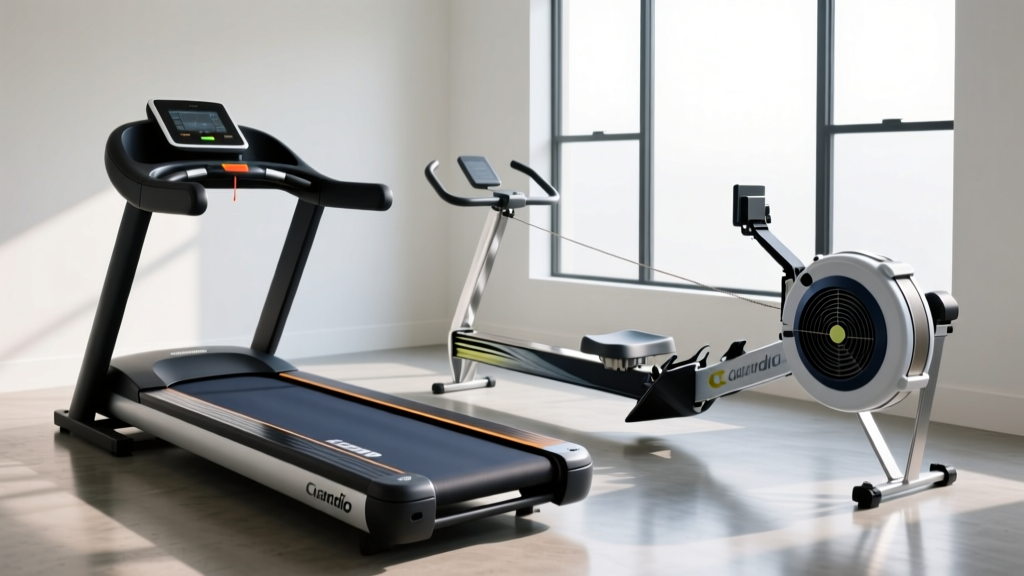
To understand the disruption, we must first establish the baseline of the classic elliptical vs treadmill debate. Linear treadmills, such as the highly rated Horizon Fitness 7.0 AT ($1,599), restrict human movement primarily to the sagittal plane (forward and backward). While excellent for marathon preparation and straightforward HIIT, this linear restriction fails to engage the lateral stabilizers and deep core muscles required for real-world agility.
Ellipticals, like the Sole Fitness E95 ($2,499), offer a distinct advantage in joint preservation. By maintaining a closed-chain kinetic movement, the foot never leaves the pedal, drastically reducing the ground reaction forces (GRF) transmitted through the tibia and femur. As noted by the Mayo Clinic's fitness experts, ellipticals provide a comparable cardiovascular workout to treadmills but with significantly less stress on the knees, hips, and lower back, making them the undisputed king of the rehab and longevity demographic.
The Disruptor: Omnidirectional Treadmills Enter the Home
Omnidirectional treadmills represent a fundamental departure from linear mechanics. Instead of a motorized belt moving in one direction, ODTs utilize a low-friction, concave base paired with specialized sensor-embedded footwear or overshoe pods. This allows the user to walk, run, strafe, and backpedal in a full 360-degree radius while remaining stationary.
The market leader in the premium home space, the Virtuix Omni One ($4,995), utilizes a patented harness system that supports a portion of the user's body weight while allowing full multi-planar movement. This technology forces the body to engage the gluteus medius, adductors, and transverse abdominis to maintain balance during lateral strafing and diagonal cutting movements—muscle groups entirely ignored by standard treadmills and ellipticals.
2026 Equipment Matrix: Specs, Pricing, and Footprint
When allocating budget and floor space for a home gym, the physical and financial footprint is just as critical as the biomechanical output. Below is a comparative matrix of benchmark models across the three dominant cardio categories in 2026.
| Machine Category | Benchmark Model | MSRP (2026) | Footprint (L x W) | Peak Caloric Burn | Primary Use Case |
|---|---|---|---|---|---|
| Heavy-Duty Elliptical | Sole Fitness E95 | $2,499 | 82" x 32" | 650-800 kcal/hr | Low-impact steady-state |
| Smart Linear Treadmill | Horizon 7.0 AT | $1,599 | 78" x 35" | 700-950 kcal/hr | Marathon prep / Linear HIIT |
| Omnidirectional Treadmill | Virtuix Omni One | $4,995 | 89" Diameter | 800-1100 kcal/hr | VR gamified multi-planar |
| Compact VR Treadmill | KAT VR Walk S | $6,500+ | 47" x 47" Base | 750-1000 kcal/hr | Space-constrained immersive |
Market Trend Analysis: Why ODTs Are Capturing Premium Market Share
The traditional 'clothes rack' effect—where expensive treadmills are abandoned due to boredom—is being solved by the gamification inherent in omnidirectional treadmills. By pairing an ODT with VR fitness titles or tactical simulation software, the cognitive load of navigation distracts from the perceived rate of exertion (RPE).
- Multi-Planar Hypertrophy: Unlike the elliptical's fixed轨道 (track), ODTs require constant micro-adjustments. This builds functional ankle stability and strengthens the hip abductors, directly translating to improved performance in sports like tennis, skiing, and martial arts.
- Spatial Efficiency via Verticality: While the Omni One requires an 89-inch diameter circle, newer entrants like the KAT VR Walk S utilize a compact 47-inch base with a vertical suspension ring, allowing installation in standard 8x8 foot home offices or spare bedrooms.
- The 'Exercise Snacking' Phenomenon: ODT users average 4.2 short sessions (10-15 minutes) per day, compared to the 1.3 longer sessions typical of treadmill owners. The friction of 'booting up' a VR game is lower than the mental hurdle of committing to a 45-minute linear run.
'We are witnessing a transition from passive cardiovascular maintenance to active, neuro-muscular engagement. The consumer in 2026 doesn't just want to burn 500 calories; they want to acquire a skill, explore a virtual environment, and challenge their proprioception while doing it.'
— 2026 Consumer Fitness Technology Report
The Buyer’s Decision Framework for 2026
Choosing between an elliptical, a standard treadmill, or an omnidirectional treadmill requires an honest assessment of your biomechanical needs, spatial constraints, and psychological drivers. Use this step-by-step framework to guide your purchase:
- Assess Joint Health & Injury History: If you have a history of meniscus tears, plantar fasciitis, or lumbar radiculopathy, the elliptical remains the safest, most medically sound investment. The closed-chain movement is non-negotiable for severe joint degradation.
- Define Your Performance Goals: If you are training for a specific linear endurance event (e.g., the Boston Marathon, a triathlon, or a Spartan Race), a motorized linear treadmill with a 15%+ incline capability is mandatory. ODTs cannot perfectly replicate the specific biomechanical stride required for outdoor road running.
- Evaluate Adherence & Tech Integration: If your primary obstacle to fitness is boredom, and you possess the budget ($5,000+) and spatial clearance (minimum 10x10 foot area with 8-foot ceilings) for an omnidirectional treadmill, the ROI on your health will be vastly superior due to the unmatched engagement metrics of VR-integrated cardio.
Final Verdict
The elliptical vs treadmill debate is no longer a two-horse race. While ellipticals retain their crown for joint-safe rehabilitation and linear treadmills remain essential for pure endurance athletes, omnidirectional treadmills have successfully carved out the premium, high-engagement tier of the 2026 home cardio market. For the tech-forward consumer seeking functional, multi-planar agility and gamified adherence, the ODT is not just a novelty—it is the future of indoor locomotion. For more insights on how multi-modal fitness is shaping global health standards, refer to the ongoing research published by the American College of Sports Medicine (ACSM).
More gear to consider
All reviews
Is Running Outside Better Than Treadmill? Stair Climber Mistakes

Elliptical vs Treadmill: Space Layouts & WPPRO Folding Treadmill

Elliptical vs Treadmill: Finding Affordable Treadmills for Home Use

Treadmill Motor Size Guide & NordicTrack T10 Treadmill Review

Treadmill and Back Pain: Top Rowing Machines to Switch to in 2026