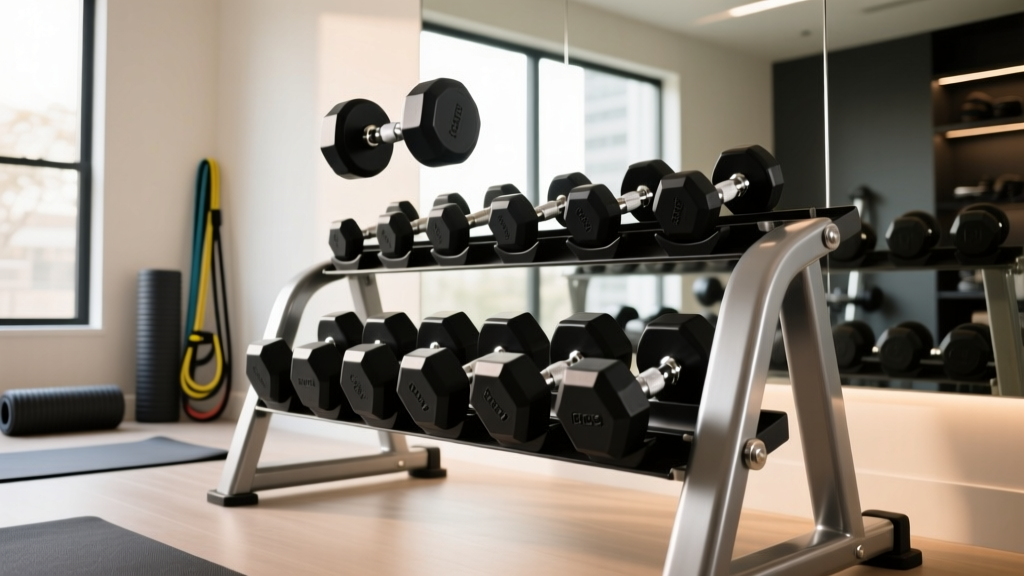
Top 2026 Dumbbell Racks to Support Dumbbell Row Muscles Workouts
Discover the best 2026 dumbbell racks to protect your back and optimize workouts targeting dumbbell row muscles. Expert reviews and storage strategies.

The Hidden Link Between Storage Ergonomics and Dumbbell Row Muscles
When fitness enthusiasts research how to build a thicker, wider back, they focus entirely on the contraction. However, as a strength equipment reviewer, I see a massive blind spot in home gym setups: the pick-up. The primary dumbbell row muscles—the latissimus dorsi, rhomboids, rear deltoids, and the crucial erector spinae stabilizers—are highly susceptible to pre-fatigue and injury before the set even begins if your storage solution is flawed.
Bending over to hoist a 100-pound hex dumbbell from a flat, ground-level shelf places immense shear force on your lumbar spine. The erector spinae, which acts as an isometric stabilizer during the rowing motion, is compromised before you even assume the bent-over position. According to the CDC's NIOSH Lifting Equation guidelines, lifting heavy loads from floor level drastically reduces the recommended weight limit due to the vertical multiplier penalty. To train your back effectively and safely in 2026, your dumbbell rack must position heavy weights in the 'power zone' (between mid-thigh and chest height).
Expert Warning: Never store your heaviest dumbbells (70+ lbs) on the bottom tier of a 3-tier rack. The bottom tier should be reserved for light neoprene or urethane pairs (5-25 lbs) used for warm-ups and rear-delt flyes. Heavy pairs belong on the middle tier to protect the erector spinae during the initial lift-off.Hands-On Reviews: The Best 3-Tier Racks for Heavy Pullers
After testing over a dozen storage solutions in our FitGearPulse lab this year, I have narrowed down the top three standalone racks that offer the structural integrity and ergonomic tier heights required for serious back days.
1. Rogue Fitness 3-Tier Dumbbell Rack (1000 lb Capacity)
The Rogue 3-Tier remains the gold standard for commercial and high-end home gyms. Constructed from 11-gauge steel, it boasts a 1000-pound weight capacity. The middle tier sits at exactly 28.5 inches from the floor—the biomechanical sweet spot for deadlifting a heavy dumbbell into a rowing stance without rounding the thoracic spine.
- Pros: Welded 2-inch front lips prevent round urethane dumbbells from rolling off during aggressive racking. The MG Black powder coat resists chipping even when dropping 120-pound iron hexes.
- Cons: At roughly $495 in 2026, it is a premium investment. The footprint (34" x 28") requires dedicated floor space.
- Failure Mode Edge Case: If you use rubber hex dumbbells with excessively thick heads (over 7 inches wide), the 41-inch tier width can feel cramped when storing 10+ pairs.
2. Titan Fitness 3-Tier Dumbbell Rack
For budget-conscious lifters who still need heavy-duty storage, Titan's offering (priced around $299) is a formidable contender. It uses 14-gauge steel and supports up to 800 pounds. The tiers are slightly angled, which naturally cradles the handles of round dumbbells and makes one-handed pick-ups for unilateral rows much smoother.
- Pros: Excellent price-to-capacity ratio. The angled tiers reduce wrist strain when grabbing weights mid-set.
- Cons: The tier lips are only 1.25 inches high and capped with plastic end-pieces.
3. Bells of Steel 3-Tier Dumbbell Storage Rack
Bells of Steel has engineered a highly modular rack (approx. $349) that features integrated plate-storage horns on the sides. This is ideal for lifters who alternate between dumbbell rows and barbell work. The 12-gauge steel frame handles 900 pounds, and the middle tier height of 30 inches is perfect for taller lifters (over 6'0") who need a higher pick-up point to avoid lumbar flexion.
- Pros: Hybrid design stores both dumbbells and Olympic plates. Rubber-lined tier saddles eliminate the 'clang' of metal-on-metal racking.
- Cons: Assembly is notoriously tedious, taking roughly 90 minutes due to the multitude of carriage bolts required for the side-horn brackets.
2026 Comparison Matrix: Specs, Pricing, and Tolerances
| Model | Steel Gauge | Max Capacity | Mid-Tier Height | 2026 Price |
|---|---|---|---|---|
| Rogue 3-Tier | 11-Gauge | 1000 lbs | 28.5" | $495 |
| Titan Fitness 3-Tier | 14-Gauge | 800 lbs | 26.0" | $299 |
| Bells of Steel 3-Tier | 12-Gauge | 900 lbs | 30.0" | $349 |
The 'Power Zone' Loading Strategy for Progressive Overload
Buying the right rack is only half the battle; how you load it dictates the longevity of your dumbbell row muscles and your spine. To implement a joint-friendly loading strategy, follow this tier-mapping protocol:
- Top Tier (Chest Height - ~42"): Reserve this exclusively for light isolation weights (5 to 20 lbs). These are used for posterior deltoid work and rotator cuff warm-ups. Reaching up with heavy weights compromises shoulder impingement mechanics.
- Middle Tier (Hip Height - ~28" to 30"): This is your 'Rowing Zone.' Store your heavy working sets (40 to 120+ lbs) here. The mid-thigh pick-up allows you to hinge at the hips, grip the dumbbell, and use your glutes and hamstrings to stand the weight up before assuming your rowing stance on the bench.
- Bottom Tier (Knee Height - ~12"): Store your medium weights (25 to 35 lbs) here. These are typically used for higher-rep hypertrophy work or unilateral movements where the load is manageable enough to pick up from a lower position without catastrophic lumbar shear.
"The set doesn't start when you pull the weight to your hip; it starts the moment your fingers wrap around the knurled handle on the rack. Respect the pick-up, and your lower back will thank you on heavy rowing days." — FitGearPulse Biomechanics Testing Team
Frequently Asked Questions
Can I use an A-Frame rack instead of a 3-Tier for heavy rows?
A-Frame racks are excellent for space-saving and storing lighter neoprene or vinyl dumbbells (up to 50 lbs). However, for heavy back training, A-Frames force you to twist your torso to grab weights from the side, which is a recipe for oblique and erector strain when handling 80+ pound loads. Stick to horizontal 3-tier racks for heavy unilateral rows.
Do I need a rack with a built-in bench for dumbbell rows?
No, and we generally advise against combo units. A dedicated, adjustable FID (Flat/Incline/Decline) bench placed adjacent to your standalone 3-tier rack offers vastly superior stability. Combo units often have narrow bench pads and wobbly frames that compromise your base of support during heavy, explosive rowing reps.
How much clearance do I need between the rack and my rowing bench?
Allow a minimum of 36 inches of clearance between the edge of the dumbbell rack and your bench. This provides enough room to safely hinge, lift the dumbbells from the middle tier, and step back into your rowing stance without clipping your heels on the rack's base feet.
More gear to consider
All reviews
2026 Trends: Kettlebells & Seated Dumbbell External Rotation
EZ Curl Bar vs Straight Bar & The Single Arm Dumbbell Roll Trend

Progressing Past At Home Exercises With Dumbbells: Olympic vs Standard Plates

2026 Trends: Dumbbell Rack Storage & Dumbbell Dead Bugs

Bumper vs Iron Plates: Budgeting for Smith Machine Bicep Curls
