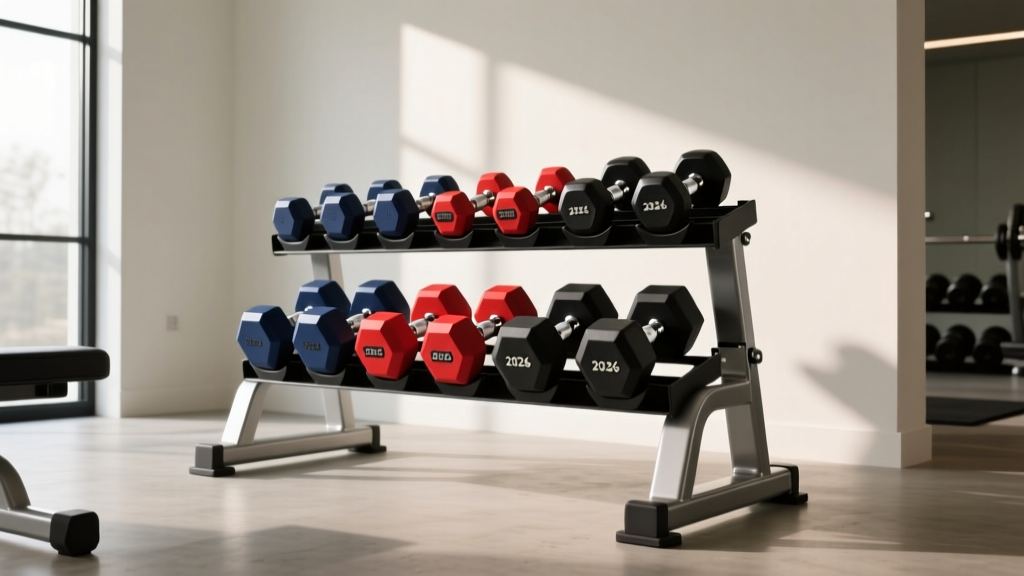
2026 Dumbbell Rack Budget: Storage for Dumbbell Pull Downs
Analyze 2026 dumbbell rack budgets and storage solutions to optimize floor space and safety for bench exercises like dumbbell pull downs.

Building a functional home gym in 2026 requires navigating a complex landscape of rising equipment costs, shifting supply chains, and the eternal struggle for floor space. While most lifters obsess over the weight of their adjustable dumbbells or the tensile strength of their barbells, the unsung hero of a safe and efficient workout environment is proper storage. This is especially true when performing expansive, floor-dependent movements. If you are regularly executing dumbbell pull downs (straight-arm pullovers) or heavy bench work, a scattered floor is not just an eyesore—it is a severe liability.
In this comprehensive budget breakdown and value analysis, we will dissect the current market for dumbbell racks and storage solutions. We will evaluate entry-level, mid-tier, and premium options, analyzing their true return on investment (ROI) and how they specifically facilitate safer, more effective workout flows for exercises that demand a clear perimeter.
The Biomechanics of Space: Why Dumbbell Pull Downs Demand Proper Storage
To understand the value of a high-quality dumbbell rack, we must first look at the biomechanics of the exercises you are performing. Dumbbell pull downs—often referred to as straight-arm dumbbell pullovers when performed lying supine on a flat or decline bench—require a massive range of motion overhead. During this movement, your arms extend far behind your head, and your feet are either planted firmly on the floor or hooked securely under a bench pad.
Consider the failure scenario: You are holding a 50-pound dumbbell overhead. Your triceps and lats fatigue, forcing you to abort the rep and drop the weight to the floor. If your workout space lacks a dedicated 3-tier rack and your floor is cluttered with other hex or urethane dumbbells, a dropped weight can easily ricochet off scattered gear, or worse, your foot might be planted on an unstable 20-pound dumbbell when you attempt to sit up. According to safety guidelines published by the National Strength and Conditioning Association (NSCA), maintaining a clear, unobstructed perimeter around lifting zones is the primary defense against non-impact tripping and crushing injuries in both commercial and home facilities.
2026 Storage Budget Breakdown: Tiers and Value Analysis
The dumbbell storage market has matured significantly. Gone are the days when a flimsy wire rack was your only option. Today, manufacturers utilize laser-cut steel, precision-welded gussets, and angled trays designed to accommodate everything from neoprene-coated light weights to massive 100-pound urethane blocks. Below is a matrix breaking down the three primary budget tiers for 2026.
| Tier | Est. Price Range | Typical Capacity | Footprint | Best Application |
|---|---|---|---|---|
| Entry-Level | $50 - $90 | 150 - 250 lbs (3-4 pairs) | ~2.5 sq ft (A-Frame) | Light neoprene/vinyl sets; tight spaces |
| Mid-Tier | $130 - $180 | 500 - 800 lbs (8-10 pairs) | ~8 sq ft (3-Tier Horizontal) | Standard hex/rubber sets; daily heavy use |
| Premium | $250 - $450+ | 1,000+ lbs (12+ pairs) | ~12 sq ft (Commercial 3-Tier) | Urethane/Pro-grade sets; lifetime investment |
Model-by-Model Value Analysis: Where Should You Put Your Money?
To provide actionable specificity, let us break down three distinct models that represent the best value proposition in their respective categories this year.
1. The Budget Pick: CAP Barbell A-Frame Dumbbell Rack
Current Market Price: $65 - $80
Build Quality: 11-gauge steel tubing with a basic powder coat.
The CAP Barbell A-Frame is a staple for beginners. Its vertical design minimizes the footprint, making it ideal for apartment gyms or garage corners. However, from a value perspective, it has strict limitations. The steep angle of the A-frame means it can only safely hold 3 to 4 pairs of standard hex dumbbells (typically 5 to 25 lbs). If you attempt to load it with heavier 40lb or 50lb dumbbells, the center of gravity shifts dangerously, creating a tipping hazard. Verdict: Excellent ROI for light, high-rep endurance sets, but inadequate for progressive overload or heavy compound movements.
2. The Value King: REP Fitness 3-Tier Dumbbell Rack
Current Market Price: $149 - $169
Build Quality: 11-gauge steel, 2.3 x 2.3-inch uprights, angled rubber-lined trays.
The REP Fitness 3-Tier rack is widely considered the gold standard for mid-tier home gyms in 2026. It holds up to 10 pairs of dumbbells (ranging from 5 to 50 lbs) and features a slightly angled tray design that makes reading the weight markings and gripping the handles significantly easier than flat-tier racks. The rubber lining on the trays prevents the loud, abrasive clanking of metal-on-metal and protects the knurling or rubber coating of your dumbbells. Verdict: Unbeatable value. It provides 80% of the utility of a premium commercial rack at 40% of the cost.
3. The Lifetime Investment: Rogue 3-Tier Dumbbell Rack
Current Market Price: $295 - $345
Build Quality: 12-gauge steel, laser-cut brackets, Rogue's signature MG Black powder coat.
If you are investing in high-end urethane dumbbells (which can cost upwards of $2 to $3 per pound), pairing them with a cheap rack is a false economy. The Rogue 3-Tier rack is built to withstand the abuse of a commercial facility. It accommodates 12 pairs of dumbbells and features ultra-wide, flat shelves that easily handle the massive girth of 70lb+ urethane blocks. The weld quality is flawless, and the footprint is designed to align perfectly with standard power racks and benches. Verdict: A premium price tag, but it is a 'buy it for life' asset that will never need replacing.
Spatial Mapping: Rack Placement for Optimal Flow
Buying the right rack is only half the battle; placing it correctly is what actually enhances your workout safety and efficiency. The American Council on Exercise (ACE) frequently emphasizes the importance of environmental design in home fitness spaces to reduce cognitive load and physical risk.
The 36-Inch Halo Rule:When setting up your bench for dumbbell pull downs, ensure there is a minimum 36-inch clearance on all sides of the bench. Your dumbbell rack should be positioned parallel to the bench, roughly 24 inches away from the lifter's dominant side. This allows you to safely reach and lift the dumbbells into position for pullovers without twisting your spine or stepping backward into the rack's steel uprights.
- Avoid the 'Head-Zone': Never place a tall A-frame or vertical rack directly behind the head of the bench. If you lose control of a dumbbell during a pull down, it will swing backward; a steel rack in that zone guarantees dented drywall or a damaged weight.
- Anchor Heavy Racks: While 3-tier horizontal racks are inherently stable due to their wide base, if you have children or pets in the home gym space, use L-brackets to anchor the rear uprights to a wall stud. A fully loaded 800lb rack can tip if a child attempts to climb the lower tier.
- Manage Rubber Off-Gassing: If you buy budget rubber hex dumbbells and store them tightly packed on a 3-tier rack, the trapped heat can exacerbate off-gassing. Ensure your rack is placed near a ventilation source or garage window.
The True Cost of Clutter: Calculating Your ROI
When evaluating the budget for a dumbbell rack, many home gym owners make the mistake of viewing it as a 'non-essential' accessory compared to the weights themselves. Let us run a quick value analysis on the hidden costs of not buying a proper mid-tier rack.
The Hidden Costs of Floor Storage:
1. Floor Damage: Dropping a 40lb hex dumbbell onto a rubber mat that is sitting on top of uneven concrete or hardwood can easily crack the subfloor or tear the mat. Repairing a garage epoxy floor costs an average of $3 to $7 per square foot.
2. Equipment Degradation: Dumbbells left on the floor are kicked, scuffed, and exposed to floor-level moisture, leading to rusted handles and degraded rubber coatings.
3. Time Tax: Bending down to floor level to pick up 50lb dumbbells for every set of pull downs or presses places unnecessary shear force on your lumbar spine before the working set even begins.
Spending $150 on a REP Fitness 3-Tier rack effectively eliminates all three of these hidden costs. The ROI is realized not just in the longevity of your equipment, but in the preservation of your physical health and your home's infrastructure.
Final Verdict: Maximizing Your Home Gym Investment
As we move through 2026, the home gym market continues to reward those who prioritize intelligent spatial planning over mere accumulation of gear. If your programming relies heavily on expansive, bench-based movements like dumbbell pull downs, your storage solution is just as critical as the weights themselves.
For those on a strict budget, the CAP Barbell A-Frame will suffice for lighter, high-rep work, provided you strictly manage its weight limits. For the vast majority of dedicated lifters, the REP Fitness 3-Tier offers the perfect intersection of price, durability, and ergonomic design. Finally, if you are outfitting a premium space with heavy urethane blocks, the Rogue 3-Tier remains the undisputed champion of commercial-grade storage. Clear the floor, protect your ankles, and let your equipment work for you—not against you.
More gear to consider
All reviews
Standing Shoulder Press With Dumbbells: Form & 2026 Adjustable Picks

Olympic vs Standard Plates for Lat Exercise Dumbbell Routines
Olympic vs Standard Plates for Lying Dumbbell Skull Crushers
Best Neoprene Dumbbells for Pull Day Dumbbell Workouts (2026)

Olympic vs Standard Plates: Fueling Your Leg Exercise with Dumbbells
