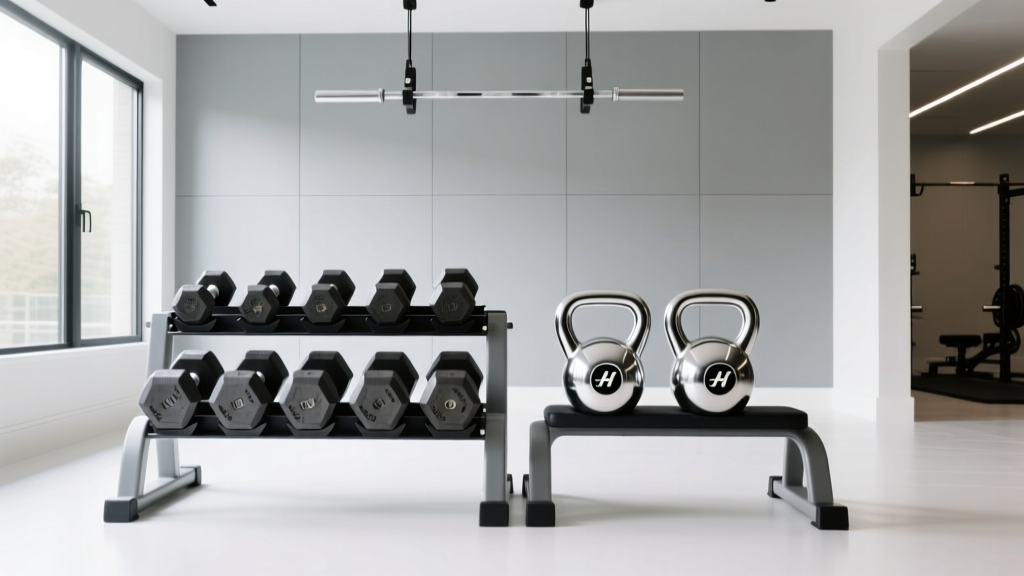
Lat Pull Down Dumbbell Layouts: Cast Iron vs Competition Kettlebells
Optimize your home gym layout. Compare cast iron vs competition kettlebells and explore lat pull down dumbbell alternatives for maximum space efficiency.

The Spatial Reality of Modern Home Gyms
Designing a high-performance home gym in 2026 is an exercise in spatial geometry. Whether you are converting a 150-square-foot garage corner or a dedicated basement room, every inch of floor space and vertical clearance must be justified by functional ROI. When outfitting these compact environments, lifters often chase space-saving illusions. A popular trend in compact home gyms is the 'lat pull down dumbbell' hack—a DIY pulley system where a loading pin, nylon straps, and a carabiner attach to a single adjustable dumbbell or specialized handle to mimic cable lat pulldowns. While this saves the 12 to 16 square feet a dedicated cable tower requires, it creates floor clutter, introduces dangerous swing-momentum risks, and limits unilateral loading capacity.
By contrast, investing in a properly racked set of kettlebells provides a vastly superior spatial and functional footprint. But this leads to the ultimate free-weight dilemma for space-conscious athletes: should you buy traditional cast iron kettlebells or uniform competition steel kettlebells? The answer depends entirely on your layout constraints, racking capabilities, and biomechanical needs. Below, we break down the exact dimensions, storage frameworks, and spatial efficiencies of both styles to help you engineer the perfect free-weight zone.
The Dimensional Divide: Cast Iron vs. Competition
The most critical factor in gym layout design is predictability. When designing custom shelving or mapping out floor clearance, you need to know exactly how your equipment behaves. According to manufacturing specifications detailed by Kettlebell Kings, competition kettlebells adhere to a strict, universal dimensional standard regardless of their mass. Whether you are holding an 8kg (17.6 lb) technique bell or a 48kg (105 lb) beast, the exterior dimensions remain identical: 352mm in height, 280mm in width, and 210mm in depth.
Cast iron kettlebells, conversely, scale in volume as the weight increases. A 12kg cast iron bell might be compact enough to tuck under a bench, but a 32kg cast iron bell from a brand like CAP Barbell or Yes4All becomes a sprawling, wide-handled sphere that disrupts clean storage lines and demands significantly more horizontal rack space.
Specification & Spatial Comparison Matrix
| Feature | Cast Iron Kettlebells | Competition Kettlebells |
|---|---|---|
| Dimensions (W x H x D) | Variable (Scales with weight) | Uniform (280 x 352 x 210 mm) |
| Handle Diameter | Thicker (35mm - 40mm+) | Standardized (33mm) |
| Base Footprint | Variable, often rounded edges | Wide, flat machined base |
| Material | Cast Iron / Powder Coated | Welded Steel (Color-coded) |
| Avg. Cost per Pound | $1.50 - $2.50 | $3.50 - $5.50+ |
| Rack Compatibility | Requires staggered/adjustable tiers | Fits perfectly on uniform 3-tier racks |
Racking, Stacking, and Floor Load Limits
Space optimization is not just about the equipment itself; it is about the storage infrastructure required to house it. If you opt for cast iron bells, you will quickly realize that standard 3-tier kettlebell racks are highly inefficient. Because the bells grow wider as they get heavier, a 24kg and a 32kg cast iron bell cannot sit side-by-side on a standard 32-inch wide competition rack without overlapping handles. You are forced to either buy an oversized, multi-tier angled rack (which eats up 4 to 6 extra square feet of floor space) or store the heavier bells directly on the floor, creating tripping hazards in tight workout zones.
Competition kettlebells solve this spatial nightmare. Because their width never exceeds 280mm, you can densely pack a 3-tier steel rack with up to nine kettlebells in a footprint of just 2.5 square feet. This vertical density is the holy grail of small-gym layout design.
Warning: Point-Load PSI and Subfloor Integrity
When storing heavy steel or iron in a compact area, consider your floor's point-load capacity. A 48kg competition kettlebell resting on a flat base concentrates roughly 105 lbs of force into a 6-inch by 6-inch area. If you are racking heavy bells on a second-floor room with standard joist spacing, or over brittle garage epoxy, always use a 3/4-inch thick vulcanized rubber matting system to disperse the kinetic energy of dropped bells and prevent subfloor cracking. For ground-floor concrete slabs (minimum 3000 PSI), direct racking is generally safe.
The 'Lat Pull Down Dumbbell' Hack vs. Kettlebell Flow
To truly understand space optimization, we must address the cable-machine deficit in small home gyms. Many lifters attempt to bridge the gap between free weights and cables by engineering a 'lat pull down dumbbell' attachment. This usually involves strapping a V-bar or lat handle to a heavy adjustable dumbbell (like a Bowflex 552 or PowerBlock) via a paracord loop, then stepping on the cord to create resistance while pulling down.
While this hack technically saves the footprint of a $2,000 functional trainer, it fails the spatial efficiency test in practice. The adjustable dumbbell must sit perfectly flat to avoid the cord slipping, limiting your range of motion. Furthermore, the maximum resistance is capped by your heaviest dumbbell setting (usually 50 to 90 lbs), which is insufficient for intermediate latissimus dorsi hypertrophy.
The Kettlebell Spatial Alternative: Instead of relying on makeshift dumbbell pulley hacks, integrate heavy kettlebell pullovers and strict tactical rows into your programming. A single 32kg or 40kg competition kettlebell can be stored in the corner of your rack and utilized for high-tension, unilateral back work that mimics the stretch and contraction of a lat pulldown without requiring 10 feet of vertical cable clearance or dangerous DIY rigging. Data from the National Strength and Conditioning Association (NSCA) consistently highlights the efficacy of offset, unilateral free-weight loading for core and latissimus engagement, proving you do not need a cable stack to build a wide back in a small room.
Biomechanical Clearance in Compact Rooms
When mapping out your gym layout, you must calculate the 'swing envelope'—the three-dimensional space required to safely execute dynamic movements like the kettlebell swing, clean, and snatch. This is where handle geometry and bell width drastically impact your spatial requirements.
Cast Iron Clearance Issues
Heavier cast iron kettlebells feature disproportionately thick handles (often exceeding 38mm) and wider horns. During a high-repetition snatch cycle in a room with low ceilings or nearby walls, the wider bell and thicker handle alter the arc of the flip. The bulkier bell is more likely to clip the forearm or require a wider, more lateral swing path to clear the body, demanding an extra 12 to 18 inches of lateral clearance on your left and right sides.
Competition Precision
Competition bells feature a standardized 33mm handle and a perfectly balanced, window-framed horn design. This allows the bell to flip tightly and predictably over the wrist. Because the swing path is highly vertical and consistent across all weights, you can safely perform snatches in a hallway or a narrow garage bay with minimal lateral clearance. As noted in equipment handling guidelines from Rogue Fitness, the uniform window size of competition bells ensures that the hand insertion and parking position remain identical, allowing athletes to maintain strict spatial awareness even when fatigued in tight environments.
2026 Purchasing Framework: Cost per Square Foot
Ultimately, choosing between cast iron and competition kettlebells for a space-optimized gym comes down to budget versus spatial premium. Here is a practical decision matrix to finalize your layout strategy:
- Choose Cast Iron If: You have a sprawling garage, prioritize budget (saving roughly $40-$60 per bell), primarily perform slow, grinding lifts (goblet squats, Turkish get-ups), and do not mind storing heavier bells on the floor.
- Choose Competition If: You are building a dense, vertical rack system in a spare bedroom or apartment. The uniform dimensions allow for custom millwork or tight 3-tier racking, the 33mm handles save your grip during high-volume flows, and the flat bases allow for stable renegade rows without the bell rolling into your drywall.
Skip the unreliable 'lat pull down dumbbell' pulley gimmicks. By investing in three strategically spaced competition kettlebells (e.g., 16kg, 24kg, 32kg) and a compact vertical rack, you secure a lifetime of versatile, space-efficient training that respects both your square footage and your biomechanics.
More gear to consider
All reviews
Bumper vs Iron Plates: Cost & Dumbbell Reverse Fly Alternative

EZ Curl Bar vs Straight Bar & Romanian Deadlift With Single Dumbbell
Neoprene Dumbbell Magnet Setup: Installation & Safety Walkthrough
Best Adjustable Dumbbells for the Dumbbell Snatch Exercise (2026)
Dumbbell Hypertrophy Program Setup: Rack & Storage Budget Guide
