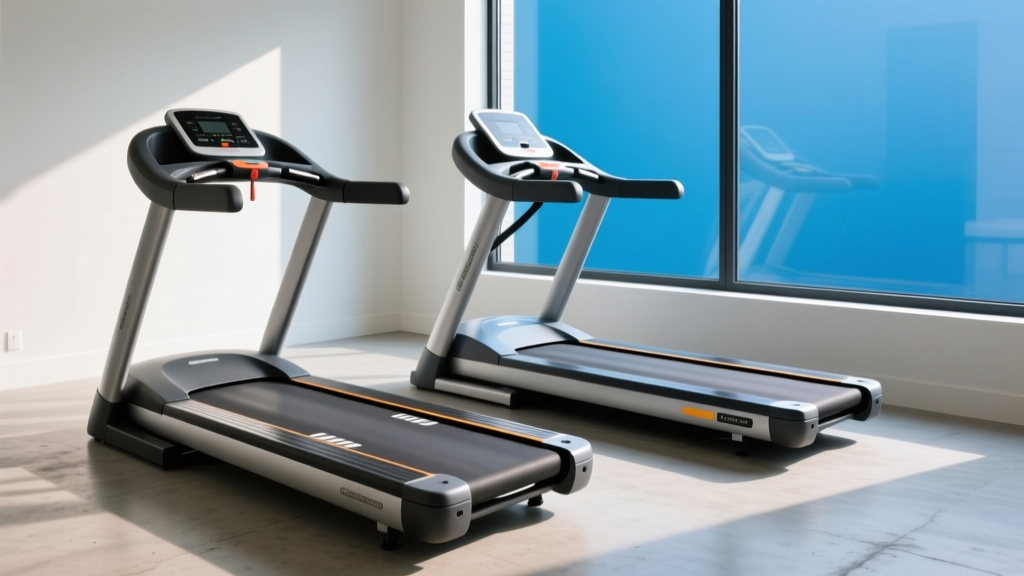
Curved vs Motorized Treadmill: Why Your Treadmill Trips GFCI Outlets
Compare curved manual and motorized treadmills. Discover the electrical physics behind why a motorized treadmill trips GFCI outlets and how to fix it.

The Electrical Divide: Curved Manual vs. Motorized Treadmills
You are halfway through a grueling interval session when the belt suddenly halts, the console goes dark, and you hear the distinct click from the wall. Your workout is over. If you have ever experienced a scenario where your treadmill trips GFCI outlets or standard breakers, you are not alone. This frustrating electrical phenomenon is one of the most common complaints among home gym owners in 2026, and it highlights a fundamental divide in cardio equipment design: the motorized powerhouse versus the curved manual treadmill.
When deciding between a curved manual treadmill (like the Woodway Curve or TrueForm Runner) and a traditional motorized model (like the Sole F80 or NordicTrack Commercial series), most buyers focus on screen size, incline capabilities, or interactive programming. However, the underlying electrical architecture—and how it interacts with your home’s wiring—should be a primary consideration. Below, we break down the biomechanics, the electrical engineering, and the real-world costs of both platforms to help you make an informed decision.
The Physics of the Fault: Why a Motorized Treadmill Trips GFCI Outlets
To understand the comparison, we must first diagnose the electrical failure. When users report that their treadmill trips GFCI (Ground Fault Circuit Interrupter) receptacles, it is usually due to one of three specific engineering realities inherent to motorized belts:
1. Static Discharge and Capacitive Coupling
Motorized treadmills rely on a continuous PVC or urethane belt sliding over a phenolic or MDF deck. This friction generates a massive static electrical charge. If the treadmill’s grounding wire encounters resistance, or if the GFCI outlet is highly sensitive to high-frequency harmonic noise, this static discharge can leak to the ground. A GFCI outlet is designed to trip if it detects a variance as small as 4 to 6 milliamps between the hot and neutral wires. The static 'noise' from a motorized belt frequently mimics a ground fault, causing a nuisance trip.
2. Motor Inductance and Back-EMF
When a heavy user steps onto a motorized belt, the DC or AC motor must work harder to maintain speed, drawing increased amperage. Furthermore, when the console commands a sudden speed drop, the motor generates Back-Electromotive Force (Back-EMF). This inductive kickback can confuse the sensitive microprocessors inside modern 2026 AFCI/GFCI dual-function breakers, resulting in an immediate shutdown.
3. The Startup Surge (Locked Rotor Amps)
While standard breakers trip from overcurrent, GFCIs can trip from the initial power draw anomaly. A 3.0 Continuous Horsepower (CHP) motor can experience a startup surge—known as Locked Rotor Amps (LRA)—that briefly spikes to 15 or 20 amps. If your treadmill is plugged into a shared 15-amp bedroom circuit equipped with a GFCI, the breaker will instantly trip to protect the wiring.
⚠️ Manufacturer Warning: Almost every major motorized treadmill manufacturer explicitly states in their owner's manual: "Do not plug your treadmill into a GFCI outlet." For example, the electrical requirements for the Sole F80 mandate a dedicated 20-amp circuit, completely free of GFCI receptacles, to prevent exactly this issue.The Zero-Draw Alternative: Curved Manual Treadmills
If you want to completely eliminate the risk of electrical faults, blown breakers, and the need to hire an electrician to run a dedicated 20-amp line to your garage or basement, the curved manual treadmill is the ultimate solution.
Curved treadmills, such as the Woodway Curve, operate entirely on human kinetics. The running surface is composed of individual vulcanized rubber slats mounted on ball bearings that glide along a curved track. There is no motor, no power cord, no friction-generating sliding belt, and therefore, zero electrical draw. You can place a manual treadmill in the center of a living room, a high-rise apartment, or an off-grid cabin without ever worrying about a GFCI trip.
Biomechanical Advantages of the Curve
Beyond electrical reliability, curved treadmills offer distinct physiological benefits. Because you must physically pull the belt backward with your hamstrings and glutes to generate momentum, muscle activation patterns change significantly.
- Increased Caloric Expenditure: Studies published in the National Institutes of Health (NIH) demonstrate that running on a non-motorized curved treadmill requires roughly 30% more energy than running on a motorized treadmill at the exact same speed.
- Improved Running Form: The curved geometry naturally encourages a mid-foot or forefoot strike, reducing the heavy heel-strike impact forces associated with shin splints and runner's knee.
- Infinite Incline/Decline Simulation: By shifting your body weight forward or backward on the curve, you instantly alter the resistance, mimicking outdoor wind resistance and terrain changes.
Head-to-Head Comparison Matrix (2026 Market Data)
| Feature | Motorized Treadmill (e.g., Sole F80 / NordicTrack 1750) | Curved Manual Treadmill (e.g., TrueForm / Woodway Curve) |
|---|---|---|
| Power Requirement | 120V, Dedicated 20A Circuit (Non-GFCI) | None (100% Human Powered) |
| GFCI Trip Risk | High (Due to static, inductance, and LRA surges) | Zero (No electrical components) |
| Average 2026 Price | $999 - $2,499 | $3,499 - $7,500+ |
| Maintenance Needs | Silicone belt lubrication, deck replacement, motor brush checks | Occasional bearing inspection, slat tightening |
| Top Speed Capability | 12 to 15 MPH (Motor limited) | Unlimited (Restricted only by user's sprint speed) |
| Interactive Screens | Standard (HD touchscreens, iFIT, Zwift integration) | Rare (Usually requires external tablet mount) |
Troubleshooting the GFCI Trip (If You Choose Motorized)
If you prefer the programmable workouts and motorized assistance of a traditional treadmill, but you are battling persistent breaker trips, follow this step-by-step diagnostic protocol before returning the machine:
- Verify the Circuit Amperage: Check your breaker box. If the treadmill is on a 15-amp circuit shared with lighting, a TV, or an HVAC system, it will trip. You must have a dedicated 20-amp circuit.
- Swap the Outlet Type: Replace the GFCI receptacle with a standard, properly grounded 3-prong receptacle. GFCIs are designed for wet areas (kitchens, bathrooms, garages); they are overly sensitive for heavy inductive motor loads in dry home gyms.
- Eliminate Static Buildup: A dry belt creates static electricity that arcs to the frame and trips the GFCI. Apply 100% silicone treadmill lubricant under the belt according to the manufacturer's schedule (usually every 150 miles). You can also spray an anti-static treatment on the belt surface.
- Check for Moisture Intrusion: If your home gym is in a humid basement or garage, condensation can form inside the motor shroud. This moisture creates a micro-path to the ground, triggering the GFCI. Use a dehumidifier to keep ambient humidity below 50%.
Cost, Footprint, and Long-Term Value
When evaluating the total cost of ownership, the initial purchase price is only half the equation. A premium motorized treadmill like the NordicTrack Commercial 1750 costs around $2,499, but requires a $39/month iFIT subscription to unlock its full potential, alongside potential out-of-warranty motor or control board replacements ($400–$800) after 5 to 7 years of heavy use.
Conversely, a TrueForm Runner (approx. $3,499) or an AssaultRunner Elite (approx. $3,999) demands a higher upfront investment. However, because there is no motor to burn out, no control board to fry during a power surge, and no mandatory software subscriptions, the 10-year cost of ownership is often significantly lower. Furthermore, manual treadmills generally have a smaller physical footprint and do not require a 3-foot safety clearance zone behind the machine, making them ideal for compact urban apartments.
Final Verdict: Which Should You Buy?
Choose a Motorized Treadmill if: You rely on guided programming, require motorized incline/decline features for specific race training, prefer walking or light jogging with digital entertainment, and have the electrical infrastructure (a dedicated 20-amp, non-GFCI circuit) to support it safely.
Choose a Curved Manual Treadmill if: You are a serious runner focused on biomechanics and maximum caloric burn, you want a zero-maintenance machine, you live in an apartment or older home where upgrading electrical panels is cost-prohibitive, and you want to permanently eliminate the headache of a treadmill that trips GFCI outlets. The manual curve is an investment in pure, unadulterated human performance.
More gear to consider
All reviews
X16 Treadmill Buying Guide: Step-by-Step Features
Can You Lose Weight Walking On A Treadmill? Pad Mistakes

Elliptical vs Treadmill: Fixing Treadmill Funny Noises & Wear

Curved vs Motorized Treadmills: How to Connect Apple Watch to Matrix

NordicTrack Commercial 2450 Treadmill: Setup & Feature Comparison
