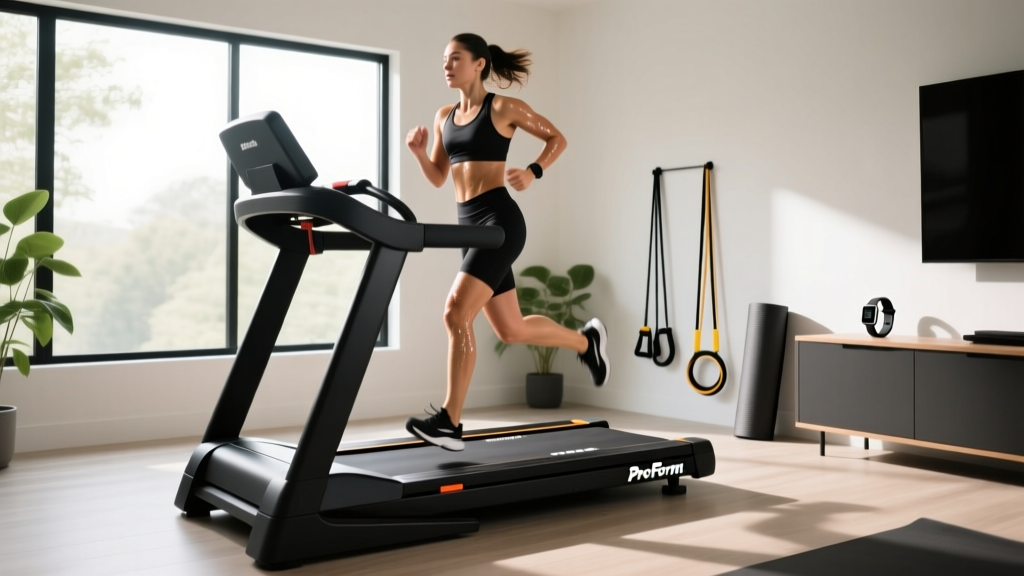
Curved vs Motorized: ProForm 480 Pi Treadmill Guide
Compare curved manual and motorized treadmills. We use the ProForm 480 Pi treadmill as a baseline in this beginner-friendly, step-by-step buying guide.

Step 1: Decode the Biomechanics (Motorized Belt vs. Curved Slat)
When you step onto a traditional motorized treadmill, the belt pulls your feet backward. Your primary job is stabilization and keeping pace with the motor. According to the Mayo Clinic, walking and running on a motorized belt provides excellent cardiovascular benefits with slightly reduced impact compared to asphalt, but it does not fully engage your posterior chain (glutes and hamstrings) the way outdoor running does.
The Motorized Baseline: ProForm 480 Pi Treadmill
The ProForm 480 Pi treadmill is a legendary entry-level model that set the standard for budget home gyms. It features a 1.75 Continuous Horsepower (CHP) motor, a top speed of 10 MPH, and a 0-10% motorized incline. While newer 2026 models like the ProForm Carbon TL have updated touchscreens and app integration, the underlying physics of the 480 Pi's 18" x 50" belt remain the standard for budget motorized cardio: the motor does the pulling, and you do the pacing. This makes it incredibly forgiving for beginners who are just learning to coordinate their stride.
The Curved Challenger: Self-Powered Slat Design
Curved manual treadmills (like the AssaultRunner or TrueForm) have absolutely no motor. The deck is angled at roughly 12 to 15 degrees, and you must push the belt backward with the ball of your foot. This mimics outdoor track running, forcing your hamstrings, glutes, and calf muscles (specifically the gastrocnemius and soleus) to generate 100% of the propulsion. Studies often cite a 30% higher caloric burn on curved treadmills; however, as a beginner, you must understand that this is largely because maintaining a given pace requires significantly more muscular effort and a higher heart rate, not because the machine possesses magic fat-burning properties.
Step 2: Map Your Space, Power, and Maintenance Constraints
Before dropping thousands of dollars, you must evaluate your physical space and electrical infrastructure. Here is a direct comparison matrix using the ProForm 480 Pi treadmill lineage versus a standard curved manual model to help you visualize the physical footprint.
| Feature | Motorized (ProForm 480 Pi Baseline) | Curved Manual (e.g., AssaultRunner) |
|---|---|---|
| Drive System | 1.75 CHP Electric Motor | Self-powered magnetic/slat resistance |
| Top Speed | 10 MPH (Motor limited) | Unlimited (User limited) |
| Incline | 0% to 10% Motorized | Fixed 12% to 15% Curve Geometry |
| Deck Size | 18" x 50" (Standard budget) | 17" x 63" (Extended slat track) |
| Power Requirement | Dedicated 120V / 15A Outlet | None (100% Human Powered) |
| Footprint | ~68" L x 28" W | ~65" L x 32" W (Wider stance) |
Step 3: Calculate the True Cost of Ownership & Failure Modes
The sticker price is only half the story. As a beginner, you need to understand what breaks, when it breaks, and how much it costs to fix over a 5-year period.
Motorized Failure Modes
In budget motorized units like the ProForm 480 Pi, the most common failure point is the motor controller board. If the walking belt is not lubricated with 100% silicone every 3 to 6 months, friction increases. The 1.75 CHP motor draws excessive amperage to compensate for the drag, eventually frying the controller board (a $150-$250 repair). Furthermore, the belt itself will stretch and require tensioning via the rear roller bolts. In 2026, a modern equivalent to the 480 Pi costs around $499, but you must factor in a $50 annual maintenance kit.
Curved Failure Modes
Curved treadmills eliminate the motor and electronics, but they introduce mechanical wear. The vulcanized rubber slats run on a track of ball bearings. Over 3 to 5 years (or roughly 15,000 miles), these bearings can grind out, causing a rattling noise and uneven belt tracking. Replacing a slat belt or bearing track typically costs between $400 and $800. Additionally, if placed in direct sunlight, the UV exposure will dry-rot the rubber slats, leading to cracking. A high-quality entry-level curved treadmill starts around $2,699 today, making it a massive upfront investment.
"When advising clients on home gym equipment, I always emphasize that a curved treadmill is a 'buy it for life' mechanical tool, whereas a budget motorized treadmill is essentially a large electronic appliance with a 5-to-7-year lifespan before a major component requires replacement."
Step 4: Align the Machine With Your Training Goals
The American Heart Association recommends at least 150 minutes of moderate-intensity aerobic activity per week. Both machines can achieve this, but they do so differently. Match your primary goal to the right machine:
- The Zone 2 Walker / Light Jogger: If your goal is to walk at 3.0 MPH while watching TV or listening to a podcast, the ProForm 480 Pi treadmill (or its modern equivalents) is vastly superior. Curved treadmills are notoriously difficult to walk on at slow speeds because the curve geometry forces you to constantly fight gravity to keep the belt moving at a walking pace, which can cause shin splints for beginners.
- The HIIT & Sprint Athlete: If you do Tabata intervals or 400-meter sprint repeats, a curved treadmill is unmatched. You can go from 0 to 18 MPH in two strides without waiting for a motor to spool up, and you can stop instantly by stepping onto the side rails. This makes it a favorite for CrossFit athletes and track sprinters.
- The Marathon Trainer: Long, steady-state runs over 60 minutes are generally more comfortable on a motorized deck with shock absorption (like the ProForm ProShox system). The rigid slat track of a curved treadmill can cause Achilles and calf fatigue during runs exceeding 10 miles due to the constant forefoot striking required.
Step 5: Make Your Final Decision (Beginner's Checklist)
Use this final step-by-step checklist to lock in your purchase and avoid buyer's remorse:
- Test the Slow Walk: Go to a local gym and try walking at 2.5 MPH on a curved treadmill. If it feels jerky, unnatural, or exhausting, rule out curved models immediately.
- Measure Your Ceiling: Curved treadmills sit higher off the ground (often 10+ inches for the deck curve). Ensure you have at least 12 inches of clearance above your head to avoid ceiling strikes during high-knee sprints.
- Check the Used Market: Because the ProForm 480 Pi treadmill is a legacy model, you can often find refurbished or lightly used units for under $250 on local marketplaces. This is an excellent, low-risk way for a beginner to test their cardio consistency before investing $3,000+ in a premium curved manual machine.
- Verify the Warranty: For motorized, demand at least a 1-year motor warranty. For curved, look for a 3-year frame and 1-year parts warranty to protect against early bearing failures.
The Final Verdict
Choose a motorized treadmill in the lineage of the ProForm 480 Pi treadmill if you are a beginner focused on walking, light jogging, budget constraints, and entertainment integration. Choose a curved manual treadmill only if you are an intermediate-to-advanced athlete focused on sprint mechanics, high-intensity interval training, and off-grid, electricity-free conditioning.
More gear to consider
All reviews
What Muscles Does the Treadmill Work? Setup, Noise & Installation

Rowing Machine Buying Guide & Technique: Beyond Treadmill Installation
Elliptical vs Treadmill: Testing the Serene Life Treadmill

How to Change a Treadmill Belt: Complete Care Guide
Cardio Noise Comparison: Setup & Horizon Fitness Treadmill Lube Belt
