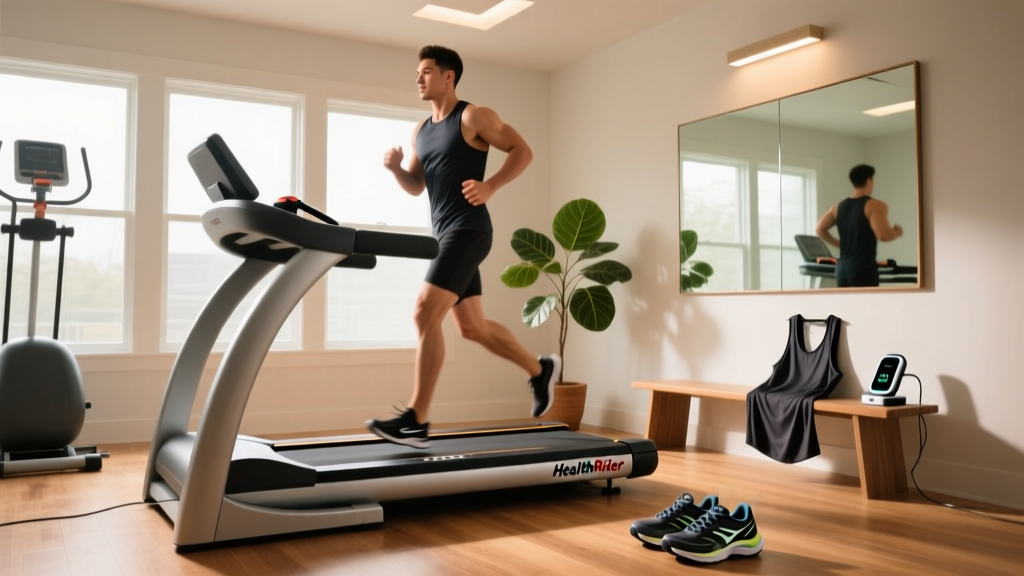
Curved vs Motorized: Is a HealthRider Treadmill Right for You?
Discover the differences between curved manual and motorized treadmills. Our step-by-step guide helps you decide if a HealthRider treadmill fits your needs.

Introduction: Navigating the Modern Treadmill Market
Stepping into the world of home cardio can feel overwhelming, especially when confronted with the stark visual and mechanical differences between traditional motorized belts and the sleek, futuristic curves of manual treadmills. If you are a beginner looking to build a sustainable fitness routine in 2026, you have likely debated whether to invest in a premium curved manual machine or a reliable, budget-friendly motorized option like a HealthRider treadmill.
The American Heart Association recommends at least 150 minutes of moderate-intensity aerobic activity per week. To hit those targets consistently, your equipment must align with your biomechanics, budget, and living space. This step-by-step guide will break down the exact differences between curved and motorized treadmills, helping you make an informed, expert-backed decision.
Step 1: Understand the Core Mechanics
Before comparing specs, you must understand how these machines actually move you. The fundamental difference lies in the power source and belt mechanics.
How Motorized Treadmills Work
A motorized treadmill relies on a continuous-duty electric motor to turn the belt. When you step on a model like the HealthRider H190i, the 2.6 CHP motor pulls the belt beneath your feet at a pre-set speed. Your primary physical job is to keep up with the belt and maintain your center of gravity. Because the machine dictates the pace, it is exceptionally easy for beginners to zone out, watch a screen, and maintain a steady-state heart rate without worrying about speed fluctuations.
How Curved Manual Treadmills Work
Curved treadmills have no motor. They feature a slatted, non-motorized belt that runs on a concave track. You are the engine. By shifting your body weight forward and striking the front curve of the belt, gravity and friction pull the slats down and back. To slow down, you simply shift your weight backward toward the apex of the curve. This requires immense physical engagement and constant micro-adjustments from your stabilizing muscles.
Step 2: Compare Biomechanics and Caloric Output
The way your foot strikes the belt drastically changes your muscle recruitment and joint loading. According to biomechanical research cited by sports science institutions and general guidelines from the Centers for Disease Control and Prevention (CDC), varying your cardio modalities can help prevent overuse injuries.
| Feature | Motorized (e.g., HealthRider H190i) | Curved Manual (e.g., Assault AirRunner) |
|---|---|---|
| Foot Strike | Encourages heel-striking due to belt pull. | Forces midfoot/forefoot strike naturally. |
| Muscle Recruitment | Primary focus on quadriceps and hip flexors. | Heavy engagement of hamstrings, glutes, and calves. |
| Caloric Burn | Baseline metabolic equivalent (MET) burn. | Up to 30% higher caloric burn at the same perceived pace. |
| Joint Impact | Moderate impact; highly dependent on deck cushioning. | Lower impact on knees, but higher load on the Achilles tendon. |
| Max Speed | Capped by motor (usually 10-12 MPH). | Uncapped; limited only by your leg turnover. |
Expert Insight: Beginners transitioning to a curved treadmill often experience severe Delayed Onset Muscle Soreness (DOMS) in their calves and Achilles tendons. This is because the curved belt lacks the motorized 'pull-off' phase, forcing your posterior chain to work 40% harder to lift your foot off the slats.
Step 3: Evaluate Budget, Space, and Maintenance
Your physical environment and wallet will often make the decision for you. The market in 2026 has clearly segmented these two categories.
Cost & Spec Breakdown
The Motorized Route (HealthRider H190i / H90x):
- Price: $399 - $499
- Footprint: 68" L x 28" W (Folds vertically via SoftDrop technology)
- Weight: ~130 lbs
- Maintenance: Requires 100% silicone belt lubrication every 3 months and occasional motor compartment vacuuming to prevent dust-induced overheating.
The Curved Route (Assault AirRunner / TrueForm Runner):
- Price: $3,499 - $4,999 (Budget manual options start around $1,200 but lack premium slat tensioning)
- Footprint: 70" L x 33" W (Does NOT fold)
- Weight: 250 - 280 lbs
- Maintenance: No motor to burn out. Requires annual bearing inspections and slat tension adjustments using a hex key.
Step 4: Your Step-by-Step Transition & Usage Guide
If you decide to purchase a curved manual treadmill, or if you are upgrading from walking to jogging on your HealthRider treadmill, follow this progressive overload protocol to avoid injury.
- Week 1: The Posture Walk (Curved) / Incline Walk (Motorized)
Do not run. On a curved treadmill, walk for 15 minutes focusing on keeping your chest up and eyes forward. Holding the handrails leans you back, neutralizing the curve and ruining the biomechanical benefit. On a motorized HealthRider, use the 10% max incline at 2.5 MPH to build glute strength. - Week 2: The 1:1 Interval Introduction
Alternate 1 minute of light jogging with 1 minute of walking. On a curved machine, practice the 'braking' technique: to stop safely, grab the side rails and let the belt slow naturally rather than trying to backpedal, which can cause a stumble. - Week 3: Form Correction and Cadence
Aim for a cadence of 170-180 steps per minute. Short, quick strides are vastly superior to long, bounding strides on both machine types, but they are absolutely mandatory on a curved treadmill to prevent excessive vertical oscillation. - Week 4: Steady-State Integration
Attempt a continuous 20-minute jog. Monitor your heart rate. You will likely find that your heart rate on a curved treadmill is 10-15 BPM higher than on a motorized treadmill at the exact same perceived pace.
Step 5: The Final Decision Framework
Use this checklist to finalize your purchase. There is no universally 'better' machine, only the right tool for your specific physiological and logistical needs.
Choose a HealthRider Motorized Treadmill If:
- You are a true beginner to cardio and need the machine to dictate and maintain your pace.
- You have a strict budget under $600.
- You live in an apartment or multi-use room and require a folding deck with transport wheels.
- You prefer watching TV or reading while walking, which requires the stable, predictable pace of a motorized belt.
Choose a Curved Manual Treadmill If:
- You are an intermediate-to-advanced runner looking to improve your forefoot strike and posterior chain strength.
- You perform High-Intensity Interval Training (HIIT) and need instant speed changes without waiting for a motor to spool up or down.
- You have a dedicated, permanent home gym space with high weight-bearing floors.
- You want a machine with a longer lifespan, as the lack of an electronic motor eliminates the most common point of failure in home fitness equipment.
Frequently Asked Questions
Can I run barefoot on a curved treadmill?
While the rubber slats provide some grip, running barefoot on a curved treadmill is not recommended for beginners. The friction required to turn the heavy slatted belt can cause severe blistering on the soles of your feet. Always wear zero-drop or low-profile running shoes to maintain the natural foot strike the curve is designed to promote.
Are HealthRider treadmills durable enough for daily use?
Entry-level motorized treadmills in the $400 range, including most HealthRider models, are engineered for light-to-moderate use (roughly 3 to 4 hours per week). If you plan to run 10+ miles a week at high speeds, the continuous-duty motor and belt rollers will experience premature wear. For heavy daily running, you must upgrade to a commercial-grade motorized unit or a curved manual treadmill.
Do curved treadmills require electricity?
No. True curved manual treadmills are entirely self-powered. However, many premium models feature a small, battery-operated or USB-rechargeable digital display to track your heart rate, wattage, and pace. This makes them ideal for garage gyms or off-grid spaces where running heavy extension cords is impractical.
More gear to consider
All reviews
NordicTrack X16 Incline Treadmill Noise: A Step-by-Step Guide

Horizon T202 Treadmill Setup & Motor Horsepower Guide

Treadmill Belt Keeps Moving to the Left? Curved vs Motorized Fixes

Horizon 7.8AT Treadmill Motor Troubleshooting & Horsepower Guide

Treadmill and Knees: Rowing Machine vs. Treadmill for Joint Health
