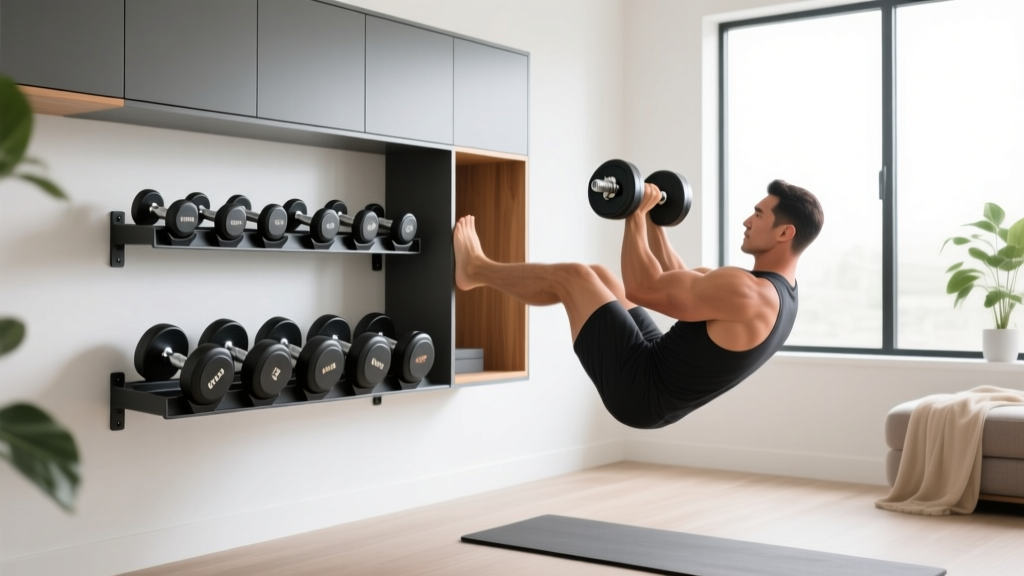
Compact Dumbbell Racks + Free Dumbbell Exercises for Abs PDF
Maximize home gym space with top compact dumbbell racks and layout tips, plus a complete core routine replacing your dumbbell exercises for abs PDF.

The Geometry of a Functional Home Gym
When designing a home gym, most lifters obsess over the equipment they want to buy, but neglect the negative space required to actually use it. As of 2026, the average dedicated home gym footprint hovers around 150 square feet. In a space this constrained, scattered free weights don't just create clutter—they actively rob you of functional training zones. If your dumbbells are strewn across the floor, you eliminate the clear 6x6 foot area necessary for dynamic floor work, mobility drills, and dedicated core training.
Many fitness enthusiasts spend hours searching for a generic dumbbell exercises for abs pdf online, hoping to find a structured core routine. However, they quickly hit a physical wall: their home gym lacks the cleared floor space to execute these movements safely. True space optimization begins with intelligent storage. By selecting the right compact dumbbell rack and applying strategic layout design, you can reclaim your floor space and build a dedicated core zone that makes those PDF guides actually usable.
Top Space-Optimizing Dumbbell Racks
Not all storage solutions are created equal. A rack's 'footprint-to-capacity ratio' is the most critical metric for small home gyms. Below, we break down the top three space-saving racks on the market, analyzing their exact dimensions, structural integrity, and ideal use cases.
1. Rogue A-Frame Dumbbell Rack
For tight corners and narrow alcoves, the Rogue A-Frame is the gold standard. Constructed from 11-gauge steel, it features a 5-degree inward angle on the shelves, which prevents round and hex dumbbells from rolling off during aggressive loading.
- Footprint: 21.5" x 19" (Under 3 square feet)
- Capacity: 500 lbs total
- Price Range: $195 - $215
- Best For: Light to medium dumbbell sets (5-50 lbs) where floor space is at an absolute premium.
2. REP Fitness 3-Tier Horizontal Rack
If you own a full set of heavy hex dumbbells (up to 100 lbs), vertical storage becomes a tipping hazard. The REP Fitness 3-Tier rack utilizes a horizontal layout with UHMW plastic liners on the shelves to protect knurled handles and reduce metal-on-metal noise.
- Footprint: 43" x 22"
- Capacity: 1,000+ lbs
- Price Range: $249 - $289
- Best For: Heavy lifters who need horizontal visibility and ergonomic lifting angles to prevent lower back strain when picking up 70+ lb dumbbells.
3. Yes4All Vertical Neoprene Rack
For budget-conscious lifters using neoprene or cast-iron hex dumbbells, the Yes4All Vertical Rack offers a tiny footprint. However, it requires strict weight distribution—heavier dumbbells must be placed on the bottom tier to maintain a low center of gravity.
- Footprint: 15" x 15"
- Capacity: 300 lbs
- Price Range: $65 - $85
- Best For: Apartment gyms and light-weight rehabilitation setups.
| Rack Model | Footprint (Sq Ft) | Max Capacity | Ergonomic Profile |
|---|---|---|---|
| Rogue A-Frame | 2.8 sq ft | 500 lbs | Moderate (Requires bending) |
| REP 3-Tier | 6.6 sq ft | 1,000+ lbs | High (Top tier at waist height) |
| Yes4All Vertical | 1.5 sq ft | 300 lbs | Low (Heavy squatting required) |
Designing the 6x6 Core Zone
Once your dumbbells are properly racked, you must designate a 'Core Zone.' Biomechanics dictate that dynamic abdominal work requires a minimum clearance of 6 feet by 6 feet (36 square feet) to allow for full limb extension without striking equipment. Place your dumbbell rack in a corner, ideally anchored to a wall stud if using a vertical model, and lay down a 4x6 foot, 3/4-inch thick horse stall mat. This mat provides the necessary spinal cushioning for weighted floor work while absorbing the impact of dropped dumbbells.
Beyond the Dumbbell Exercises for Abs PDF: A Biomechanical Core Routine
Static PDF guides often fail because they ignore the three primary functions of the core: anti-rotation, anti-extension, and spinal flexion. Instead of mindless crunches, use your newly cleared floor space and a single dumbbell to perform this targeted, space-efficient routine. For deeper kinesiology references on core stabilization, consult the ExRx Kinesiology Directory.
1. The Dumbbell Pull-Through (Anti-Rotation)
Setup: Assume a high plank position with your hands under your shoulders. Place a 25-40 lb hex dumbbell on the floor just outside your left hand. Execution: Reach under your torso with your right hand, grab the dumbbell, and drag it across the floor to your right side. Repeat with the left hand. Tempo: 2-1-2-0 (2 seconds drag, 1 second pause, 2 seconds return). Why it works: This forces the obliques and transverse abdominis to resist rotational forces, mimicking real-world athletic demands far better than static side planks.
2. Asymmetrical Weighted Dead Bug (Anti-Extension)
Setup: Lie supine on your mat, holding a 15-25 lb dumbbell in your right hand, extended toward the ceiling. Left arm is empty. Execution: Slowly lower your left leg and your right arm (the one holding the dumbbell) toward the floor. Stop one inch before touching the mat, then return to the start. Failure Point: If your lumbar spine arches off the mat, the weight is too heavy, or your core has fatigued. Switch to a lighter dumbbell immediately to protect your lower back.
3. Lying Dumbbell Pullover Crunch (Spinal Flexion)
Setup: Lie on your back, knees bent, holding a single 10-20 lb dumbbell by the inner plate with both hands above your chest. Execution: Lower the dumbbell backward over your head until your biceps touch your ears, simultaneously performing a hollow-body crunch by lifting your shoulder blades off the mat. Expert Tip: According to the ACE Exercise Library, combining shoulder flexion with spinal flexion increases the lever arm, drastically increasing the torque on the rectus abdominis without requiring heavy, spine-compressing loads.
⚠️ Safety Warning: Spinal Flexion Under LoadNever perform weighted Russian twists with a straight spine and heavy loads. The combination of axial compression and spinal rotation is a primary mechanism for lumbar disc herniation. Stick to anti-rotation movements (like the Pull-Through) when using dumbbells heavier than 25 lbs for core training.
Storage Failure Modes & Edge Cases
Optimizing space isn't just about buying a small rack; it's about anticipating how equipment degrades and interacts with your home environment over time.
Material Degradation: Urethane vs. Rubber
If your dumbbell rack is located in a garage or a poorly ventilated basement, avoid standard rubber-coated dumbbells. Rubber off-gasses volatile organic compounds (VOCs) and degrades into a sticky, black residue when exposed to temperature fluctuations. For long-term storage in non-climate-controlled spaces, invest in urethane-coated dumbbells. Urethane is UV-resistant, odorless, and won't degrade and ruin your rack's finish or your gym mats.
The Tipping Hazard of Vertical Storage
Vertical racks like the Yes4All model are incredible space savers, but they introduce a severe center-of-gravity risk. If a user accidentally bumps the rack while fatigued, or if the floor is uneven, a top-heavy vertical rack will tip. The Fix: Always use L-brackets to anchor vertical racks to a wall stud. If anchoring isn't possible, you must strictly enforce a 'bottom-heavy' loading pattern, ensuring that the combined weight of the bottom two tiers is at least 60% greater than the top tier to maintain a stable base.
Final Thoughts on Gym Layout
Space optimization is an ongoing process. By upgrading to a high-density dumbbell rack, you aren't just tidying up your home gym—you are actively unlocking new training modalities. Reclaiming that 36-square-foot core zone transforms your gym from a simple weight-lifting room into a comprehensive athletic performance center. Ditch the generic printable guides, master your spatial layout, and train your core with the biomechanical precision it deserves.
More gear to consider
All reviews
Cast Iron vs Competition Kettlebells vs Seated Dumbbell French Press

Rubber Hex vs Urethane for Dumbbell Love Handle Exercises (2026)
Olympic Barbell Buying Guide: Weight, Knurling & Press Muscles Worked

Power Rack vs Squat Rack vs Stand: Rear Delt Dumbbell Exercises
The Dumbbells Acronym & Bumper vs Iron Plate Maintenance
