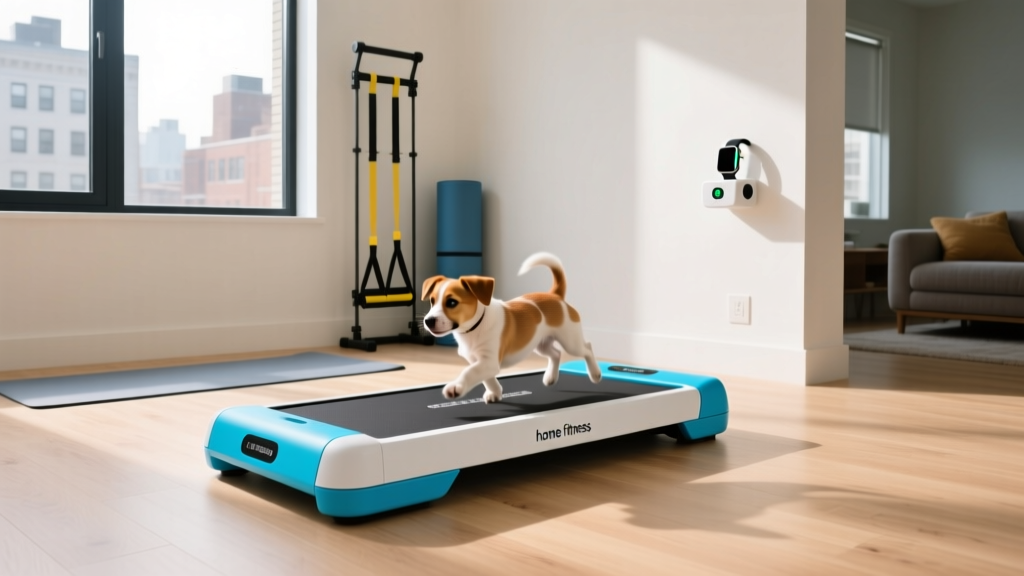
Portable Cardio & Puppy Treadmill Training: 2026 Budget Guide
Analyze 2026 costs for compact portable cardio gear. Discover budget-friendly walking pads ideal for human NEAT workouts and puppy treadmill training.

The Dual-Use Revolution: Compact Cardio Meets Canine Care
In 2026, the demand for compact portable cardio equipment options has surged, driven by the normalization of hybrid work and the shrinking square footage of urban apartments. But a fascinating secondary use case has emerged from the walking pad craze: indoor pet exercise. Specifically, puppy treadmill training has become a primary driver for purchasing low-profile, portable treadmills.
For pet owners, the value proposition is immense. Dedicated dog treadmills cost upwards of $800, feature intimidating side-rails, and are impossible to store under a sofa. Conversely, modern human walking pads offer quiet brushless motors, zero-incline belts, and ultra-low deck heights that perfectly mimic the requirements for early-stage puppy conditioning. However, merging human NEAT (Non-Exercise Activity Thermogenesis) goals with canine development requires a strict budget breakdown and an understanding of mechanical failure modes unique to four-legged users.
Expert Insight: According to canine rehabilitation specialists, introducing puppies to a moving surface between 12 and 16 weeks of age builds immense proprioceptive confidence. However, because their growth plates are still open, sessions must be strictly flat (0% incline) and capped at 3 to 5 minutes. Portable walking pads inherently solve the incline problem, making them the safest budget option for early development.Budget Breakdown: Top 3 Portable Walking Pads for Dual Use
When evaluating compact portable cardio equipment options for both human walking and puppy treadmill training, you must look beyond the sticker price. Motor continuity, minimum speed calibration, and belt texture are the true determinants of long-term value. Below is our 2026 value analysis matrix.
| Model | 2026 Street Price | Motor (Continuous HP) | Min / Max Speed | Dual-Use Value Rating |
|---|---|---|---|---|
| UREVO Strol 2E | $299 | 2.25 HP (Peak) / ~0.8 CHP | 0.5 - 3.8 mph | Good (Human focus) |
| Sunny Health SF-T723016 | $179 | 1.5 HP (Peak) / ~0.5 CHP | 0.5 - 4.0 mph | Fair (Budget pick) |
| WalkingPad C2 Mini | $349 | 1.25 CHP | 0.2 - 3.7 mph | Excellent (Best for pups) |
Value Analysis: Why the WalkingPad C2 Wins for Puppies
While the Sunny Health model is the undisputed budget king for human walking, it fails the puppy treadmill training test due to its minimum speed of 0.5 mph. For a 12-week-old Golden Retriever or French Bulldog, 0.5 mph is a forced trot that can cause joint stress and panic. The WalkingPad C2 Mini, despite costing $170 more, drops down to 0.2 mph. This micro-speed allows the puppy to simply stand on the belt and acclimate to the movement without being forced into a stride, which is the foundational first step of safe indoor canine conditioning.
Hidden Costs and Mechanical Failure Modes
Buying compact portable cardio equipment for dual-use introduces unique wear-and-tear that manufacturers rarely cover under standard warranties. When running a cost-benefit analysis, factor in these edge cases:
- Claw-Induced Belt Delamination ($40-$60 replacement cost): Human running shoes distribute force evenly. Dog claws act as micro-picks. If you do not keep your puppy's nails filed to the quick, they will tear the PVC top-layer of the walking belt within three months, exposing the cotton under-weave and ruining the deck.
- Motor Bearing Clogging (Lethal Failure): Dogs shed heavily, and the static electricity generated by the treadmill belt acts as a magnet for pet dander and hair. This hair wraps around the rear roller bearings and gets sucked into the motor housing. Preventative fix: You must vacuum the motor vents weekly and apply silicone-based belt lubricant monthly to reduce static friction.
- Remote Control Dependency: Puppies are easily startled. Bending over to press a button on a console will trigger a startle response, causing the dog to bolt and potentially slip off the back of the portable pad. A dedicated, responsive remote control (included with the C2 and Strol 2E) is non-negotiable for safe puppy treadmill training.
Step-by-Step Puppy Treadmill Training Protocol
To maximize the ROI of your portable cardio equipment, follow this phased conditioning protocol. This framework minimizes belt-damage from panicked scrambling and ensures positive reinforcement.
- Phase 1: The Static Introduction (Days 1-3)
Unplug the machine. Place a high-value lick-mat (frozen with peanut butter or bone broth) at the front edge of the belt. Allow the puppy to eat off the stationary belt to build positive spatial association. - Phase 2: Harness and Leash Anchor (Days 4-7)
Never use a collar; the sudden stops can damage a puppy's trachea. Use a back-clip harness. Hold the leash loosely—you are not pulling the dog, you are simply preventing them from walking off the side of the narrow portable deck. - Phase 3: Micro-Speed Activation (Week 2)
With the puppy standing on the belt, use the remote to increase the speed to 0.2 mph. Stand in front of the machine with a treat lure. Keep sessions to exactly 2 minutes. The goal is neurological adaptation, not cardiovascular exhaustion. - Phase 4: Pacing and Posture (Weeks 3-4)
Gradually increase to 0.5 mph. Watch the puppy's topline. If their back sways or they begin to 'bunny hop', the speed is too high for their current stride length. Veterinary guidelines emphasize that forced trotting on a treadmill before 6 months of age can lead to improper gait patterning.
"The biggest mistake owners make with compact walking pads is treating them like traditional dog treadmills. Portable pads lack side enclosures, meaning the human must act as the spatial boundary. Your physical positioning at the front-left corner of the machine, armed with a treat pouch and the remote, is the most critical piece of equipment you own during the first month of training."
— Dr. Aris Thorne, DVM, Canine Sports Medicine & Rehabilitation
The Final Verdict: Maximizing Your 2026 Fitness Budget
If your primary goal is strictly human calorie burn and you do not own pets, the Sunny Health SF-T723016 at $179 remains the most cost-effective compact portable cardio equipment option on the market. It delivers reliable NEAT benefits for under-desk use without breaking the bank.
However, if you are integrating puppy treadmill training into your household routine, the value analysis heavily favors the WalkingPad C2 Mini at $349. The $170 premium buys you a lower minimum speed (0.2 mph), a quieter brushless motor that won't terrify a sensitive pup, and a more durable deck construction capable of handling the localized strike-force of canine paws. By utilizing a single piece of compact, foldable gear for both your daily step-count goals and your puppy's early proprioceptive development, you effectively cut your indoor fitness and pet-care hardware budget in half, proving that smart, dual-purpose gear is the ultimate 2026 life hack for small-space living.
More gear to consider
All reviews
LowkeyDeadInside Treadmill Motor Guide: HP vs. CHP 2026

Elliptical vs Treadmill for Home Cardio & Donate Treadmill Pickup

How to Get Rid of Old Treadmill & Switch to a Stair Climber

Air Bike vs Assault Bike Value and Horizon 7 AT Treadmill Review
Choosing a Motor for HIIT Cardio Training on Treadmill
