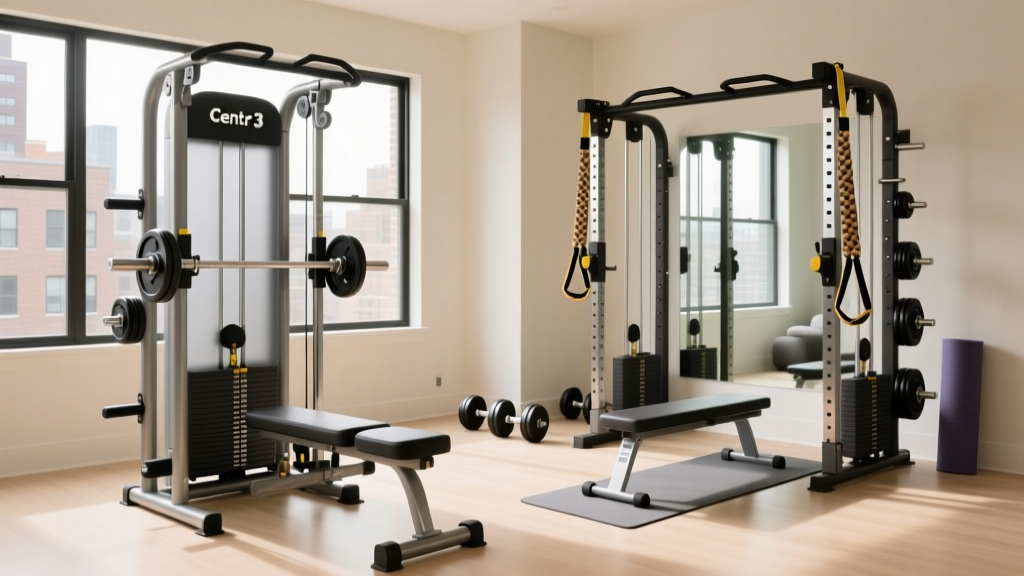
Centr 3 Home Gym vs Custom Budget Setup Under $500
We break down the true cost of the Centr 3 home gym versus building a highly effective, custom budget home gym setup for under $500 in 2026.

The Premium All-in-One Appeal vs. The $500 Reality Check
The fitness technology sector has aggressively pivoted toward high-ticket, all-in-one smart machines, promising elite coaching and sleek aesthetics in a single footprint. At the pinnacle of this trend sits the Centr 3 home gym, a digital cable machine that replaces an entire commercial weight room with eddy-current magnetic resistance and a guided touchscreen interface. But for the pragmatic home athlete, a critical question remains: does the premium hardware justify a price tag that rivals a used car?
As a senior equipment analyst for FitGearPulse, I frequently evaluate whether smart fitness tech outperforms traditional iron. In this comprehensive budget breakdown and value analysis, we are pitting the flagship Centr 3 home gym against a meticulously curated, custom-built budget home gym setup under $500. By examining exact 2026 pricing, biomechanical failure modes, and long-term ownership costs, we will determine which route delivers the highest return on investment for your physical and financial health.
Centr 3 Home Gym Cost Analysis: What Are You Actually Paying For?
Before building our budget alternative, we must audit the true cost of the Centr 3 ecosystem. The upfront marketing often obscures the compounding expenses of smart fitness hardware.
- Base Hardware: The freestanding Centr 3 unit retails for approximately $3,499. Wall-mounted versions require professional installation, adding $250 to $500 in structural retrofitting.
- Mandatory Subscription: The hardware is essentially a paperweight without the Centr App. At $39.99 per month, you are committing to $480 annually just to access the resistance profiles and programming.
- Three-Year Total Cost of Ownership (TCO): Factoring in hardware, shipping, and 36 months of subscriptions, the Centr 3 home gym will cost you roughly $5,418 before accounting for potential out-of-warranty screen or motor repairs.
Expert Insight: Digital resistance (eddy-current motors) provides excellent variable tension, but it lacks the micro-stabilization demands of free weights. According to the American Council on Exercise (ACE), free-weight training recruits up to 20% more stabilizing muscle fibers compared to fixed-path or purely digital cable machines, making traditional iron superior for functional joint integrity.
The $500 Budget Home Gym Blueprint: Exact Gear & Pricing
Building a budget home gym setup under $500 requires ruthless prioritization. We are skipping aesthetic fluff and focusing entirely on progressive overload, cardiovascular health, and joint protection. Here is the exact 2026 shopping list, utilizing high-value, entry-level commercial gear.
1. Strength & Resistance Foundation ($230)
Instead of a digital motor, we rely on gravity and adjustable mechanics.
- Yes4All 50 lb Adjustable Dumbbell Set ($90): While not as sleek as a $400 Bowflex, this cast-iron dial-adjustable pair offers 5lb increments up to 50 lbs per hand. The knurled steel handles provide a secure grip, and the mechanical design has zero electronic failure points.
- Flybird Adjustable Weight Bench ($140): The FID (Flat/Incline/Decline) Flybird bench features a 1.2mm thick commercial steel frame with an 800 lb weight capacity. The 7 back positions and 3 seat positions allow for over 40 distinct exercises, effectively mimicking the multi-angle cable pulls of a smart gym.
2. Cardiovascular & Conditioning ($120)
The Centr 3 integrates cardio via guided screen workouts, but you still have to move. We are allocating budget to a dedicated, high-yield cardio tool.
- YOSUDA Pro Indoor Cycling Bike ($120): Featuring a 30 lbs flywheel and infinite friction resistance, this belt-driven bike operates at under 40 decibels. It provides the high-intensity interval training (HIIT) necessary for cardiovascular adaptation without the recurring app fees of a Peloton or Centr bike.
3. Flooring & Joint Protection ($55)
Never buy interlocking EVA foam puzzle mats for a home gym; they compress under heavy loads and off-gas volatile organic compounds (VOCs) in enclosed spaces.
- Tractor Supply Co. 3/4-inch Horse Stall Mat ($55): This 4x6 foot vulcanized rubber mat weighs 90 lbs. It is virtually indestructible, absorbs the acoustic shock of dropped dumbbells, and provides the exact same shock absorption as $4-per-square-foot premium commercial gym flooring.
4. Pulling Mechanics & Accessories ($80)
A complete gym requires vertical pulling, which dumbbells cannot adequately replicate.
- Iron Gym Total Upper Body Workout Bar ($35): A heavy-duty doorway pull-up bar that uses leverage, not screws, to hold up to 300 lbs. It preserves your doorframes while enabling latissimus dorsi development.
- Rogue Fitness Echo Resistance Bands - Set of 3 ($45): Rogue's latex bands (Light, Medium, Heavy) allow you to simulate cable machine tricep pushdowns, face pulls, and banded squats, bridging the gap between free weights and cable tension.
Head-to-Head Value Matrix: Centr 3 vs. $500 Custom Rig
To visualize the stark contrast in value propositions, refer to the comparison matrix below. Data reflects current 2026 market averages and consumer testing metrics.
| Feature Metric | Centr 3 Home Gym | $500 Custom Budget Setup |
|---|---|---|
| Initial Hardware Cost | $3,499 | $485 |
| 3-Year Total Cost (TCO) | ~$5,418 | $485 (Zero subscriptions) |
| Max Resistance | 225 lbs (Digital) | 100 lbs total (50lb/side DBs) + Bands |
| Stabilizer Muscle Recruitment | Low (Fixed digital path) | High (Free weight mechanics) |
| Space Footprint | 7 ft x 7 ft (Permanent) | 4 ft x 6 ft (Fully collapsible) |
| Resale Value Retention | Poor (Tech depreciation) | Excellent (Iron holds value) |
| Setup / Teardown Time | 2-4 Hours (Professional install) | 3 Minutes (User assembled) |
Space Footprint, Installation, and Failure Modes
When designing a home gym, spatial geometry and structural limitations dictate your choices. As highlighted in Wirecutter's comprehensive home gym guides, measuring your ceiling height and floor load capacity is a mandatory first step.
The Centr 3 Installation Reality
The Centr 3 requires a dedicated 7x7 foot footprint and a minimum ceiling height of 8 feet to accommodate full overhead presses and pull-up attachments. If you opt for the wall-mounted version to save floor space, you must drill into structural wall studs or pour concrete anchors. Failure Mode: Renters or individuals with drywall-over-metal-stud construction cannot safely mount the wall unit, forcing them to buy the heavier, more expensive freestanding frame.
The Budget Rig Spatial Advantage
Our $500 setup is inherently modular. The 4x6 horse stall mat defines the workout zone, but the YOSUDA bike can be rolled into a corner, and the Flybird bench folds flat to slide under a bed or stand vertically in a closet. Failure Mode: The primary vulnerability of the budget setup is user error in assembling the adjustable dumbbells; if the dial is not perfectly aligned before lifting, the weight plates can slip. However, this is easily mitigated by following the manufacturer's locking protocol.
Maintenance and Longevity Analysis
Smart gyms are essentially giant tablets attached to resistance motors. According to independent teardowns by Garage Gym Labs, the internal cooling fans and eddy-current braking systems in digital gyms require dust-free environments to prevent overheating. If the Centr 3's motherboard fails in year four, you are facing a proprietary repair bill that could exceed $800, and the machine is useless while awaiting parts.
Conversely, cast iron and vulcanized rubber do not require software updates. If a Yes4All dumbbell dial jams, the replacement cost is a fraction of a smart motor repair. The Flybird bench utilizes standard hex bolts; if a joint loosens, a $10 Allen key set and two minutes of tightening restores it to factory stiffness. The longevity of analog gear vastly outpaces the planned obsolescence of digital fitness ecosystems.
The 2026 Verdict: Decision Framework
Choosing between the Centr 3 home gym and a budget home gym setup under $500 is not about which machine is 'better' in a vacuum; it is about aligning equipment with your financial liquidity, spatial constraints, and training psychology.
Who Should Buy the Centr 3?
The Centr 3 is justified only if you meet all three of the following criteria:
- You have a dedicated, climate-controlled room with a minimum 7x7 ft footprint.
- You suffer from 'decision fatigue' and require a guided, gamified screen to maintain workout consistency.
- Your disposable income easily absorbs a $5,000+ three-year fitness expenditure without impacting your financial goals.
Who Should Build the $500 Budget Setup?
The custom budget rig is the undisputed champion for the vast majority of home athletes. You should build this setup if:
- You are training in an apartment, garage, or multi-use living space where equipment must be collapsible.
- You prioritize functional, free-weight biomechanics and stabilizer muscle development over guided digital paths.
- You want to achieve 90% of the physiological results for less than 10% of the financial cost, completely avoiding the 'subscription trap' of modern fitness tech.
Ultimately, muscle tissue cannot differentiate between a $3,500 digital magnetic pull and a $90 pair of cast-iron dumbbells; it only recognizes mechanical tension. By executing this $500 budget breakdown, you secure a highly effective, lifelong training facility while keeping thousands of dollars in your investment portfolio.
More gear to consider
All reviews
Layout Optimization for Your Weider Home Gym Exercise Program

Sam Sulek Home Gym in a Rental: No-Damage Mistakes to Avoid

Best Home Gym Wall Colors for Strength Training & Equipment Care
Weider 8630 Home Gym: 2026 Market Trends & Garage Setup Guide

Designing the Dream Home Gym: Floor Plans & Expert Gear Picks
