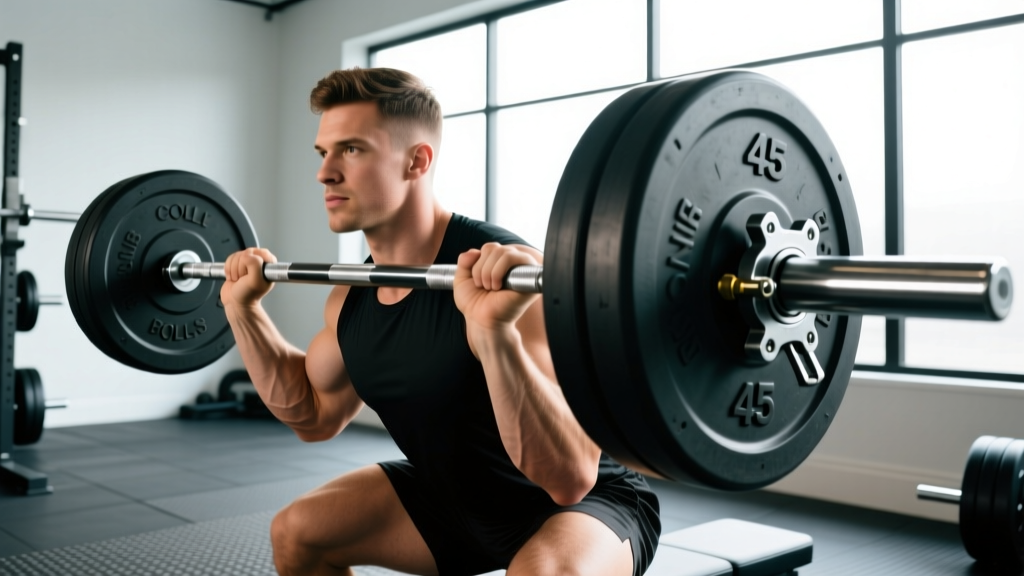
Collar vs Clamp Types: Securing Pull Day Workout Dumbbells & Bars
Compare barbell collar and clamp types to secure heavy deadlifts, rows, and pull day workout dumbbells. Find the best locking mechanisms for your gym.

The Hidden Danger of Plate Shift on Heavy Pull Days
When programming heavy posterior chain and back movements, the focus is almost entirely on grip strength, lat engagement, and hip hinge mechanics. Yet, one of the most overlooked safety and performance factors is how you secure your plates. Whether you are loading a 500-pound deadlift or assembling heavy pull day workout dumbbells for single-arm rows, plate shift alters the barbell or dumbbell's center of mass. This asymmetric torque forces your stabilizer muscles to compensate mid-rep, increasing the risk of wrist strain and lower back tweaking.
As of 2026, the market for barbell collars and clamps has bifurcated into three distinct categories: traditional spring clips, lever-action ABS clamps, and precision-machined competition collars. Furthermore, the explosion in popularity of loadable dumbbell handles has introduced a new variable: sleeve real estate. This guide breaks down the exact clamping forces, material failure modes, and dimensional constraints you need to know to secure your weights properly.
The Big Three: Spring Clips vs. Lever Clamps vs. Screw-Down Collars
Not all collars are created equal. The mechanism of action dictates the clamping force (measured in pounds of lateral pressure) and the longevity of the product.
1. Traditional Spring Clips (The Standard)
Made from heavy-gauge steel wire, spring clips rely on the tension of the metal to grip the sleeve. They are ubiquitous in commercial gyms because they are cheap (usually $5 to $12 per pair) and fast to apply.
- Clamping Force: Low (~30–50 lbs of lateral pressure).
- Best For: Pressing movements, light accessory work, and quick plate changes.
- Failure Mode: Metal fatigue. Over time, the steel loses its temper and tension. They also slip violently during high-impact drops (e.g., deadlifts or Olympic lifts).
2. Lever-Action Clamps (e.g., Rogue AH-1, Lock-Jaw Pro)
These utilize a high-strength ABS plastic or aluminum lever mechanism that cams down against the sleeve, creating immense friction. The Rogue AH-1 Clamp is a prime example of this category, retailing around $35 per pair.
- Clamping Force: High (~150–200+ lbs of lateral pressure).
- Best For: Heavy deadlifts, barbell rows, and general powerlifting.
- Failure Mode: Hinge degradation. In unheated garage gyms, the plastic hinges can become brittle and snap under extreme camming pressure. The rubber inner gaskets also wear smooth after 2–3 years of heavy use.
3. Screw-Down & Competition Collars (e.g., Eleiko, Werksan)
Machined from billet aluminum or steel, these collars use a threaded screw or locking lever to physically clamp a metal band around the sleeve. According to the International Weightlifting Federation (IWF), official competition collars must weigh exactly 2.5 kg each, meaning they become part of the calibrated load.
- Clamping Force: Maximum (Zero-slip guarantee, 300+ lbs of pressure).
- Best For: Olympic weightlifting, calibrated powerlifting meets, and heavy eccentric drops.
- Failure Mode: Thread stripping if over-tightened with a wrench, though the units themselves are virtually indestructible. They are also heavy (5 kg total) and expensive ($90–$130+ per pair).
Head-to-Head Comparison Matrix
| Collar Type | Model Example | Approx. Cost | Weight (per pair) | Slip Resistance | Sleeve Width |
|---|---|---|---|---|---|
| Spring Clip | Generic Gym Brand | $8 | 0.4 lbs | Low | 2.5 inches |
| Lever-Action ABS | Rogue AH-1 | $35 | 1.2 lbs | High | 3.0 inches |
| Lever-Action Mini | Lock-Jaw Pro Mini | $28 | 0.8 lbs | Medium-High | 1.5 inches |
| Competition Screw | Eleiko Olympic | $115 | 11.0 lbs (5kg) | Absolute | 3.5 inches |
The Loadable Dumbbell Dilemma: Sleeve Real Estate
The most critical E-E-A-T insight for modern home gym owners involves the intersection of barbell collars and loadable dumbbells. When you build heavy pull day workout dumbbells for movements like single-arm dumbbell rows, shrugs, or deficit deadlifts, you are typically using loadable handles like the Rogue Loadable Dumbbell Handle or the Titan T3 Loadable Dumbbell.
⚠️ The Sleeve Space Bottleneck:A standard Olympic barbell sleeve is roughly 16.3 inches long. A standard loadable dumbbell sleeve is only 6.5 to 8.0 inches long. If you use a standard 3-inch wide lever clamp (like the Rogue AH-1) on a dumbbell, the collar consumes nearly 40% to 50% of your available loading space. This physically prevents you from sliding on enough 10lb or 25lb plates to reach the heavy weights required for a challenging pull day workout.
The Solution: For loadable dumbbells, you must use low-profile clamps. The Lock-Jaw Pro Mini or specialized 1.5-inch micro-collars are mandatory. They provide adequate lateral friction while leaving maximum sleeve length for plates. Alternatively, some athletes use heavy-duty rubber O-rings or specialized dumbbell spring clips that take up only 0.5 inches of space, though these sacrifice the sheer clamping force needed for heavy, asymmetric rowing movements.
Coach's Note on Asymmetric Loading: During a heavy single-arm dumbbell row, the rotational torque applied to the handle is immense. If your plates are not tightly clamped, they will rattle and shift outward. This shifts the dumbbell's center of gravity away from your hand, artificially increasing the moment arm and placing extreme, unintended shear stress on your wrist and elbow tendons.
Material Degradation & Environmental Failure Modes
When investing in clamps, consider your training environment. As highlighted in extensive testing by Garage Gym Reviews, environmental factors play a massive role in collar longevity.
- UV and Temperature Exposure: ABS plastic lever clamps left in a hot garage or exposed to direct sunlight will experience UV degradation. The plasticizers leach out, making the hinge brittle. A clamp that easily withstands 200 lbs of camming pressure at 70°F might snap in half at 40°F.
- Rubber Gasket Wear: The inner rubber lining of lever clamps is what creates the friction against the zinc or chrome barbell sleeve. Over 3 to 4 years, this rubber compresses and smooths out. Once the gasket is flush with the plastic housing, the clamp will slide off the bar during a dropped deadlift, regardless of how tight the lever is.
- Steel Rust: Traditional spring clips will rust rapidly in humid environments or coastal garages. Rust increases the friction on the sleeve (scratching your bar's finish) but decreases the structural integrity of the steel wire.
Final Verdict & Buying Framework
Securing your weights is not an area to cut corners. Here is the definitive framework for outfitting your gym in 2026:
- For the Olympic Barbell (Deadlifts & Barbell Rows): Invest $30–$40 in a pair of high-quality lever-action clamps (like the Rogue AH-1 or Lock-Jaw Pro). They offer the best balance of speed, security, and price for 95% of lifters.
- For Pull Day Workout Dumbbells (Loadable Handles): Purchase a dedicated set of 1.5-inch low-profile mini-clamps. Do not try to force standard barbell collars onto a 6.5-inch dumbbell sleeve; you will sacrifice your ability to load the weight heavy enough to stimulate muscle growth.
- For Competition & Heavy Eccentrics: If you are doing touch-and-go deadlifts from blocks, or training for sanctioned meets, the $100+ investment in machined aluminum screw-down collars is non-negotiable for absolute zero-slip security.
By matching the collar type to the specific biomechanical demands of the lift—and respecting the physical dimensions of your equipment—you ensure that the only thing failing on your pull day is your grip, not your hardware.
More gear to consider
All reviews
Barbell Collars & Long Head Tricep Exercises Dumbbell Safety

Bumper vs Iron Plates: 2026 Trends & Supinating Dumbbell Bicep Curls

Barbell Buying Guide: Weight, Knurling & Dumbbell Spotting

Kettlebell Care: Cast Iron vs Competition & Dumbbell Upright Row

Tricep Dumbbell Exercise Gear: Rubber Hex vs Urethane Care
