
Barbell Collars vs. Clamps: Dumbbells for Traps Guide
Compare barbell collar and clamp types for heavy lifting. Discover the best securing mechanisms for trap bars and loadable dumbbells for traps.

The Hidden Danger of Heavy Shrugs: Why Collar Selection Matters
When building a massive yoke and upper back, heavy shrugs are non-negotiable. Whether you are pulling 500 lbs on a hex bar or utilizing heavy loadable dumbbells for traps isolation work, the violent, high-frequency vibration of the shrug movement creates a unique mechanical challenge: plate shift. If your collars fail, plates migrate outward, altering the center of gravity and risking catastrophic sleeve unloading. In this head-to-head comparison, we break down the engineering, failure points, and real-world applications of modern barbell collar and clamp types to help you secure your lifts safely.
Head-to-Head: Barbell Collar and Clamp Types Compared
1. Traditional Spring Collars
The classic spring collar (such as the Rogue Spring Collars, priced around $12.50 per pair) relies on the tension of 1.1mm spring steel. While they are lightweight and allow for rapid plate changes, they are the weakest link in high-vibration environments. The steel fatigues over time, losing its outward radial force. Furthermore, they require roughly 2.5 inches of sleeve space, which is highly problematic when loading thick bumper plates onto short-sleeve implements.
2. Lever-Arm Clamp Collars
Lever-arm clamps, like the Rogue Monster Clamp Collars ($45.00 per pair), utilize an aluminum body and a cam-lever mechanism to press a high-durometer nylon insert flush against the plates. These provide immense lateral clamping force. However, their bulky housing consumes about 1.5 inches of sleeve real estate. They are exceptional for Olympic barbell deadlifts but can crowd the sleeve on specialized bars and loadable dumbbells.
3. Snap-Clamp and Jaw Mechanisms
The modern gold standard for high-vibration lifting is the snap-clamp or jaw mechanism. The Lock-Jaw Pro ($49.95 per pair) uses glass-reinforced nylon and an internal steel tension spring that literally 'bites' into the steel sleeve. With a footprint of just 1.2 inches, they maximize loadable space while providing a near-welded lock against lateral migration.
4. Competition-Grade Weighted Collars
In sanctioned Olympic weightlifting, the International Weightlifting Federation (IWF) mandates that collars must weigh exactly 2.5 kg each. Brands like Eleiko manufacture precision-machined steel collars that meet this spec, often utilizing a dual-screw or heavy-duty lever mechanism. While irrelevant for the average home gym user, these collars represent the pinnacle of lateral stability. However, their massive footprint (often exceeding 3 inches) makes them entirely unusable for short-sleeve implements.
⚠️ FitGearPulse Warning: Never use standard spring collars for heavy, repetitive shrugs. The vertical deceleration at the top of a shrug creates a whiplash effect that can compress spring collars inward, allowing plates to shift outward mid-set.The 'Dumbbells for Traps' Dilemma: Sleeve Space and Vibration
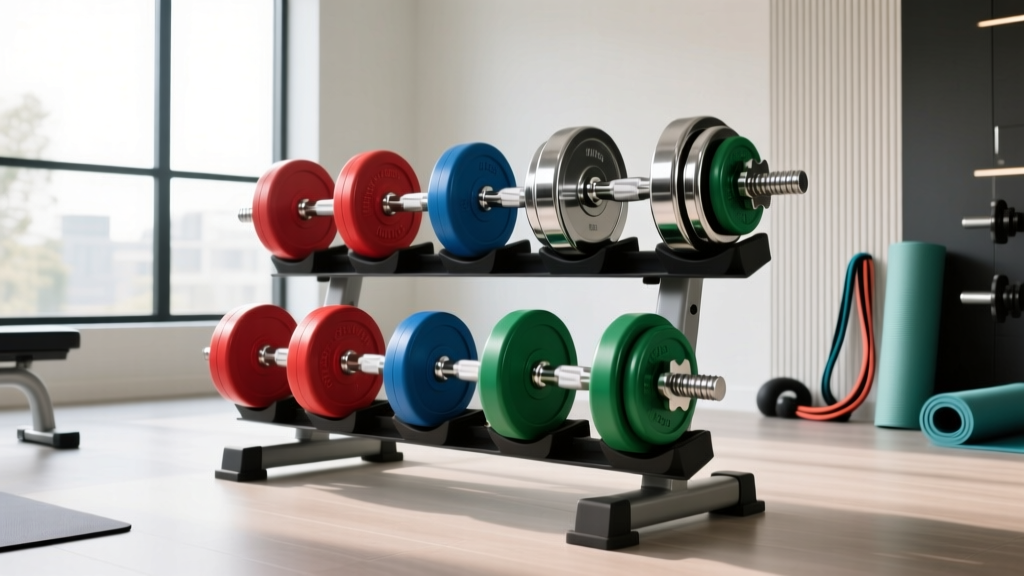
When athletes specifically seek out dumbbells for traps training, they frequently turn to loadable Olympic dumbbell handles (like the Rogue Loadable Dumbbell Handles or Ironmaster 11-inch handles). These implements typically feature sleeves measuring between 6.0 and 8.5 inches. When you stack a 45lb steel plate and a 25lb plate, you are left with less than 2 inches of sleeve space for a collar.
If you attempt to use a 2.5-inch spring collar or a bulky lever clamp, you physically cannot secure the weight. This is where the Lock-Jaw or OSO Pro clamps become mandatory. Their low-profile, 1.2-inch footprint allows you to secure heavy loads on short sleeves without compromising the structural integrity of the lock. Additionally, dumbbell shrugs involve a high degree of rotational torque and lateral swing compared to a trap bar shrug, demanding a collar with an internal steel gripping mechanism rather than just surface friction.
Feature and Performance Matrix
| Collar Type | Avg. Price (Pair) | Sleeve Footprint | Vibration Resistance | Best Use Case |
|---|---|---|---|---|
| Spring Steel | $12 - $15 | ~2.5 inches | Low | Light accessories, warm-ups |
| Lever-Arm Clamp | $40 - $50 | ~1.5 inches | High | Olympic lifts, heavy deadlifts |
| Snap-Jaw (Nylon) | $45 - $65 | ~1.2 inches | Extreme | Loadable dumbbells, trap bars, shrugs |
| IWF Competition | $150+ | ~3.0+ inches | Maximum | Sanctioned Olympic weightlifting |
Real-World Failure Modes and Edge Cases
- Dropped Barbell Impact: When dropping a barbell from the top of a clean or jerk, lever-arm clamps can occasionally pop open if the cam-lever is not fully engaged past the 'dead-center' point. Snap-jaws with positive locking tabs prevent this mechanical failure.
- Chipped Sleeves: Over years of use, barbell and dumbbell sleeves develop deep gouges. Spring collars will glide right over these gouges, failing to grip. Jaw-style collars with internal steel teeth will bite into the grooves, maintaining their hold even on heavily abused gym equipment.
- Bumper Plate Warping: Low-durometer competition bumpers (like 10lb or 15lb fractional plates) tend to warp at the hub. A rigid aluminum lever clamp might not apply even pressure across a warped hub, leaving a micro-gap that allows vibration to rattle the plate loose over a 15-rep shrug set.
- Thermal Expansion and Contraction: In unheated garages during winter, the nylon inserts on cheaper lever clamps become brittle and lose their friction coefficient. Glass-reinforced nylon used in premium snap-clamps maintains its structural integrity across a much wider temperature range (-20°F to 140°F), ensuring your plates stay locked whether you train in a climate-controlled facility or a freezing garage.
The FitGearPulse Decision Framework
- For pure Olympic barbell work and powerlifting: Invest in Lever-Arm Clamps. The 1.5-inch footprint is negligible on a 16.3-inch Olympic sleeve, and the clamping force is unmatched for static, heavy loads.
- For trap bars, hex bars, and loadable dumbbells for traps: Buy Snap-Jaw collars. The short sleeves and extreme vibration of heavy shrugs demand the low profile and steel-tooth grip of a Lock-Jaw or OSO Pro mechanism.
- For high-rep CrossFit or circuit training: Keep a pair of Spring Collars on hand for rapid transitions where absolute maximum security is not a matter of life and death, but prioritize jaw-clamps for any heavy barbell cycling.
Securing your weights is not an area to cut corners. By matching the collar mechanism to the specific biomechanical demands of your lift—especially the violent vibration of heavy trap work—you ensure your equipment works for you, not against you.
More gear to consider
All reviews
Olympic vs Standard Plates for Weight Training with Dumbbells

2026 Value Guide: Kettlebells & Decline Chest Press with Dumbbells
Maintaining Loadable Dumbbells for Flawless Cross Body Dumbbell Curls
EZ Curl Bar vs Straight Bar & The Single Arm Dumbbell Roll Trend

The Long Dumbbell Name Guide: EZ Curl vs Straight Bar Layouts
