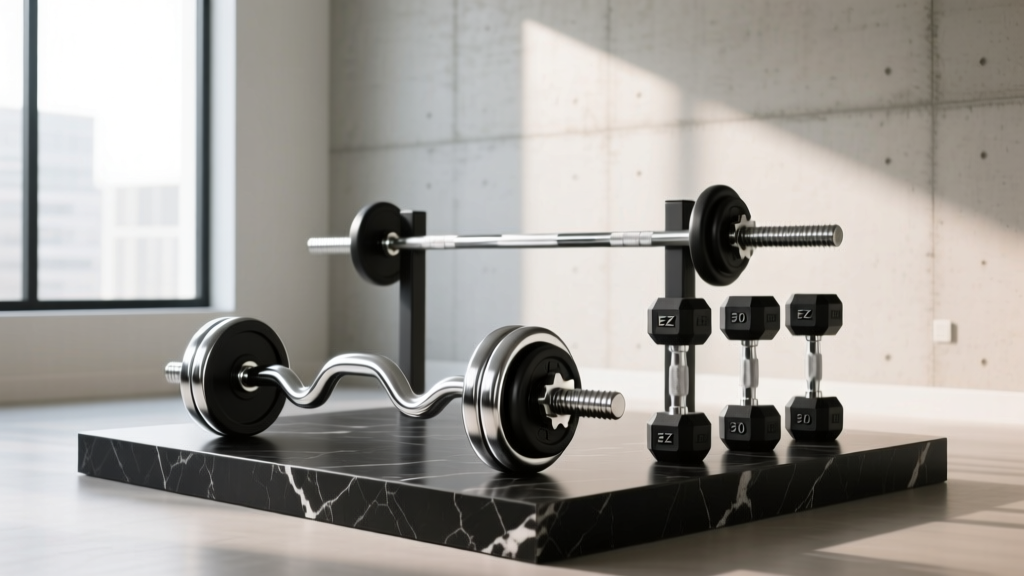
EZ Curl Bar vs Straight Bar Cost & Dumbbell Step Up Workout Value
Compare EZ curl bar vs straight bar costs and biomechanics. Discover if specialty bars beat investing in a dumbbell step up workout for home gyms.

The 2026 Home Gym Allocation Problem: Isolation vs. Compound Utility
Building a home gym in 2026 requires ruthless financial prioritization. With steel prices and shipping costs stabilizing but remaining higher than pre-2020 baselines, lifters are forced to make critical choices about where their capital goes. One of the most common budget dilemmas occurs at the intersection of arm specialization and lower-body development: should you invest in a premium EZ curl bar, stick to a standard straight bar, or divert those funds to facilitate a heavy dumbbell step up workout?
This guide breaks down the exact financial and biomechanical ROI of the EZ curl bar vs straight bar debate, and reveals how the 'opportunity cost' of buying specialized equipment might be sabotaging your overall physique development.
EZ Curl Bar vs. Straight Bar: A Biomechanical and Financial Breakdown
To understand the value proposition, we must first look at the engineering, pricing, and joint mechanics of both bars.
1. The Standard 52-Inch Straight Bar
The standard Olympic straight bar (like the CAP Barbell OB-86B) is the baseline for home gyms. Priced between $35 and $55, it features a 52-inch overall length, a 28mm to 30mm shaft diameter, and 10-inch sleeves.
- Biomechanics: A straight bar forces the wrists into full supination (palms facing directly up). According to ExRx.net's biomechanical directory, this locks the radioulnar joint and places maximum tension on the biceps brachii, but it also introduces significant valgus stress on the elbow and medial epicondyle.
- Failure Modes: Lifters with limited wrist mobility or a history of medial epicondylitis (golfer's elbow) often experience sharp pain during the eccentric (lowering) phase of heavy straight-bar curls.
- Value Proposition: High. At $40, it serves as a functional curling tool, a tricep extension bar, and a light deadlift/row implement.
2. The 47-Inch EZ Curl Bar
The EZ bar features a zig-zag shaft designed to offer multiple grip angles, typically ranging from 15° to 30° of partial supination. Pricing varies wildly based on manufacturing quality: a standard CAP Barbell Super Curl bar runs about $45 to $65, while a premium Rogue Fitness Curl Bar (featuring a 28.5mm Cerakote shaft and needle bearings) retails for $145.
- Biomechanics: The angled grips allow the wrists to sit in a more natural, slightly pronated/supinated position. This dramatically reduces torque on the distal radioulnar joint and mitigates elbow strain during heavy loading.
- Failure Modes: The primary design flaw of the EZ bar is sleeve length. Most EZ bars feature 7.5-inch sleeves. If you use standard 45lb bumper plates (which are thick), you can only fit two plates per side, capping your max load around 185 lbs. Furthermore, cheap EZ bars use bushings instead of bearings, leading to sleeve grinding during rotational movements like skull crushers.
The Opportunity Cost: Funding the Dumbbell Step Up Workout
Here is where the budget breakdown shifts from arm isolation to full-body utility. If you already own a standard straight bar or a basic set of adjustable dumbbells, spending $145 on a premium EZ curl bar yields diminishing returns. That $145 represents a massive opportunity cost.
Instead of upgrading your curling ergonomics, allocating that capital toward a dedicated dumbbell step up workout setup provides a vastly superior return on investment for muscle growth, caloric expenditure, and athletic carryover.
Why the Dumbbell Step Up Workout Wins the ROI Battle
The American Council on Exercise (ACE) highlights the step-up as a premier unilateral lower-body movement. By diverting the $100 saved from skipping the premium EZ bar, you can purchase a 16-inch wooden plyo box ($50) and a pair of 40lb rubber hex dumbbells ($50-$70).
Integrating a heavy dumbbell step up workout into your weekly split offers benefits a curl bar simply cannot match:
- Unilateral Symmetry Correction: Step-ups isolate the left and right legs independently, exposing and fixing strength imbalances that bilateral barbell squats often mask.
- Glute and Quad Bias: By adjusting the box height (14 to 18 inches to achieve roughly 90 degrees of knee flexion) and manipulating torso lean, you can bias the vastus lateralis (quads) or the gluteus maximus.
- Spinal Decompression: Unlike heavy barbell back squats, the dumbbell step up workout places the load in the hands, drastically reducing axial spine compression and lower back fatigue.
'Unilateral training, such as the step-up, not only improves limb symmetry but also enhances core stabilization and functional athletic performance in ways bilateral isolation movements cannot replicate.' — National Strength and Conditioning Association (NSCA)
Value Analysis Matrix: Where Should Your Money Go?
To visualize the budget breakdown, review this cost-to-utility matrix based on 2026 average market pricing for home gym equipment.
| Equipment Investment | Est. Cost | Primary Muscle Targets | Systemic ROI |
|---|---|---|---|
| Premium EZ Curl Bar (e.g., Rogue) | $145 | Biceps, Triceps, Forearms | Low (Isolation) |
| Standard Straight Bar + Hex Dumbbells + Plyo Box | $140 | Quads, Glutes, Core, Biceps | High (Compound + Unilateral) |
| Budget EZ Bar (e.g., CAP) + Dumbbell Step Up Setup | $165 | Full Body (Arms + Legs) | Maximum (Complete Coverage) |
Programming Synergies: The Ultimate Budget Split
If you choose the 'Maximum Coverage' route—buying a budget $50 EZ bar and using the remaining funds to build your lower-body arsenal—here is how you program them together for maximum hypertrophy.
Day 1: Lower Body & Unilateral Focus
- The Dumbbell Step Up Workout: 4 sets of 8-10 reps per leg. Use a 16-inch box. Hold 40-50lb hex dumbbells. Focus on a 3-second eccentric (lowering) phase to maximize muscle damage without needing excessively heavy weights.
- Goblet Squats: 3 sets of 12 reps using a single heavy dumbbell.
- Romanian Deadlifts: 4 sets of 10 reps using the straight bar or dumbbells.
Day 2: Upper Body & Arm Ergonomics
- Close-Grip Bench Press: 4 sets of 8 reps (using the straight bar).
- EZ Bar Skull Crushers: 3 sets of 12 reps. The budget EZ bar's angled grips will save your wrists here compared to a straight bar.
- EZ Bar Preacher Curls: 3 sets of 10 reps. Utilize the outermost 30° grips to target the short head of the biceps.
Final Verdict: Building Your 2026 Arsenal
The debate between the EZ curl bar and the straight bar ultimately comes down to your current equipment gaps and joint health. If you suffer from chronic wrist pain or medial elbow tendinopathy, a budget $50 EZ curl bar is a non-negotiable medical necessity for your arm days. However, if you are a healthy lifter looking to maximize a strict home gym budget, dropping $145 on a premium specialty bar is a poor financial decision.
By utilizing a standard straight bar for basic curls and rows, and diverting the saved capital into a plyo box and hex dumbbells, you unlock the transformative power of the dumbbell step up workout. In the economics of muscle building, compound, unilateral leg training will always yield a higher dividend than marginally more comfortable bicep isolation. Spend smart, train unilaterally, and let your budget drive your gains.
More gear to consider
All reviews
Bumper vs Iron Plates 2026: The Underhand Dumbbell Row Test

Cheap vs Premium Guns: Performance, Reliability, and Real-World Value After 10,000 Rounds

Best Neoprene Dumbbells for Sitting Dumbbell Exercises (2026)

Aldi Dumbbells vs Top Adjustables: 2026 Buying Guide

Optimizing Space for Trap Workouts with Dumbbells: Urethane vs Hex
