
Barbell Collar Types & Dumbbell Front Raise Form Guide
Compare top barbell collar types for secure lifting, then master dumbbell front raise form with biomechanical cues and troubleshooting tips.

Free Weight Mastery: Hardware Security and Biomechanical Precision
Building a resilient, injury-free physique requires mastery over two distinct domains of free weight training: the hardware that keeps your equipment safe, and the biomechanics that keep your joints protected. In this comprehensive 2026 guide, we bridge the gap between equipment maintenance and exercise execution. First, we break down the exact failure modes and pricing of modern barbell collars and clamps. Then, we transition to the mat to dissect dumbbell front raise form, focusing on scapular kinematics, eccentric control, and common anterior deltoid training errors.
Editor's Note: Whether you are loading a barbell for heavy deadlifts or isolating the anterior deltoids with dumbbells, safety and precision are non-negotiable. A slipping weight plate and a hyperextended lumbar spine share the same root cause: a lapse in fundamental setup protocols.The Hardware: Barbell Collar and Clamp Types Compared
Barbell collars are the unsung heroes of the weight room. Their primary job is to prevent weight plates from shifting laterally, which can alter the bar's center of gravity mid-lift and cause catastrophic bails. As of 2026, the market is dominated by three primary mechanisms, each with distinct price points and failure thresholds.
1. Spring Clips: The False Economy
Standard chrome spring clips cost between $5 and $12 per pair. They rely on coil tension to grip the barbell sleeve. While adequate for light, controlled movements like bicep curls, they are a liability for dynamic lifts. Failure Mode: The metal coils suffer from tension fatigue over time. Furthermore, if the barbell sleeve is coated in chalk dust or grease, the smooth metal of the spring clip will slide off during the eccentric phase of a lift or upon ground impact during a dropped deadlift.
2. Polymer Lock-Jaw Clamps: The Home Gym Standard
Lock-Jaw Pro clamps (typically priced around $24.95 per pair) utilize a high-density polymer plastic with a rubberized inner grip and a locking lever. They are lightweight, easy to apply with one hand, and grip the sleeve aggressively. Failure Mode: While excellent for indoor, climate-controlled gyms, prolonged exposure to UV light or freezing temperatures (like in an unheated garage gym in winter) can cause the polymer hinges to become brittle and snap under leverage pressure.
3. CNC Aluminum Lever Collars: Competition Grade
Models like the Rogue HG 2.0 Aluminum Collars ($65.00) or Eleiko Olympic Training Collars ($85.00) represent the pinnacle of barbell security. Machined from aircraft-grade aluminum, they use a cam-lever action to compress a heavy-duty rubber or urethane inner ring against the steel sleeve. Advantage: Zero lateral play, zero temperature degradation, and the ability to withstand thousands of bumper plate drops from overhead heights.
Collar Comparison Matrix
| Collar Type | Model Example (2026) | Price Range | Security Rating | Best Use Case |
|---|---|---|---|---|
| Spring Clip | Generic Chrome Clip | $5 - $12 | 2/10 | Light isolation, machine work |
| Polymer Clamp | Lock-Jaw Pro | $20 - $30 | 7/10 | Home gyms, general fitness |
| Aluminum Lever | Rogue HG 2.0 / Eleiko | $60 - $90 | 10/10 | Olympic lifting, heavy drops |
For a deeper dive into equipment testing, you can review BarBend's comprehensive barbell collar guide, which regularly updates durability metrics based on drop-test data.
The Biomechanics: Perfecting Dumbbell Front Raise Form
Transitioning from barbell security to dumbbell isolation, we must address one of the most commonly butchered exercises in the free weight zone: the front raise. When executed with strict dumbbell front raise form, this movement isolates the anterior deltoid and builds crucial shoulder stability. When executed poorly, it becomes an ego-driven momentum swing that irritates the biceps tendon and lumbar spine.
The Scapular Plane (Scaption) Advantage
The most critical piece of E-E-A-T knowledge regarding the front raise is joint alignment. Most lifters raise the dumbbells perfectly forward in the sagittal plane. However, according to kinesiology data from ExRx, raising the arms strictly in front of the body can cause the greater tubercle of the humerus to impinge against the acromion process, grinding the supraspinatus tendon.
The Fix: Perform the raise in the scapular plane (scaption). Angle your arms approximately 20 to 30 degrees inward from your sides, aligning the movement with the natural resting angle of your shoulder blades. This clears the subacromial space and allows for safer, heavier loading of the anterior deltoid.
Step-by-Step Execution Protocol
- The Stance: Stand with feet shoulder-width apart. Slightly bend the knees (about 10 degrees) to unlock the joints and engage the quadriceps for pelvic stabilization.
- The Grip: Hold the dumbbells with a neutral grip (palms facing your thighs) or a pronated grip (palms facing backward). Neutral grips generally allow for slightly heavier loads due to better biceps brachii leverage.
- The Brace: Inhale and brace your core as if anticipating a punch to the stomach. Depress your scapula (pull your shoulders down away from your ears) to prevent the upper trapezius from hijacking the movement.
- The Concentric Phase: With a slight, locked bend in the elbows (10-15 degrees), raise the dumbbells in the scapular plane until your hands reach eye level (90 degrees of shoulder flexion). Do not go higher than 90 degrees, or the load shifts entirely to the traps.
- The Eccentric Phase: Lower the weight slowly over a 2 to 3-second count. The eccentric portion of the front raise causes significant micro-tearing in the anterior deltoid fibers, which is essential for hypertrophy.
Pro-Tip: The 'Pour the Pitcher' Cue
If you prefer using a pronated (overhand) grip, slightly internally rotate your shoulders at the very top of the movement—as if you are pouring water out of a pitcher. This subtle tweak maximizes the contraction of the anterior deltoid fibers at the peak of the range of motion.
Troubleshooting Common Failure Modes
Even with perfect mental cues, physical limitations can break down your form. Here is how to troubleshoot the most common edge cases encountered during dumbbell front raises.
Failure Mode 1: Lumbar Hyperextension (Swinging)
Symptom: As the dumbbells approach eye level, your lower back arches aggressively, and your ribs flare outward.
Root Cause: The weight is too heavy, or your anterior core (rectus abdominis) is fatigued. Your body uses momentum and spinal extension to cheat the weight up.
Solution: Drop the weight by 20%. Perform the exercise seated on an incline bench set to 75 degrees. The back pad will physically block lumbar hyperextension, forcing the anterior deltoids to do 100% of the work.
Failure Mode 2: Upper Trap Takeover (Shrugging)
Symptom: You feel the burn in your neck and upper back rather than the front of your shoulders.
Root Cause: Failure to depress the scapula before initiating the lift. The upper trapezius is a synergist in shoulder flexion and will dominate if the scapula isn't anchored.
Solution: Before every single rep, actively pull your shoulder blades down into your back pockets. Maintain this depression throughout the entire set.
Failure Mode 3: Grip and Forearm Fatigue
Symptom: Your hands give out before your shoulders do, limiting the hypertrophic stimulus to the deltoids.
Root Cause: Gripping the dumbbell too tightly, or using thick-handled dumbbells without adequate grip conditioning.
Solution: Use lifting straps for your final two working sets. While straps are traditionally reserved for pulling movements, using them for isolation exercises like front raises ensures that the target muscle (the deltoid) reaches true mechanical failure without being bottlenecked by grip endurance.
Frequently Asked Questions
Can I use a barbell for front raises instead of dumbbells?
Yes, barbell front raises are a valid variation. However, they lock your wrists into a fixed pronated position, which can cause discomfort for lifters with poor wrist mobility. Dumbbells allow for a neutral grip and independent arm tracking, making them the superior choice for joint health and addressing unilateral strength imbalances.
How often should I replace my barbell collars?
Spring clips should be replaced every 6 to 12 months if used daily, as the coil tension degrades rapidly. High-quality polymer clamps (like Lock-Jaws) typically last 3 to 5 years indoors. CNC aluminum lever collars are essentially a lifetime purchase; you may only need to replace the inner rubber O-ring after a decade of heavy use.
Should I train front raises on push day or shoulder day?
The anterior deltoid receives massive secondary stimulation during heavy compound pressing movements like the barbell bench press and overhead press. Therefore, dedicated front raises should be treated as an accessory movement. Add 3 sets of 12-15 reps at the end of your Push or Shoulder day, focusing strictly on the eccentric phase rather than moving heavy loads.
More gear to consider
All reviews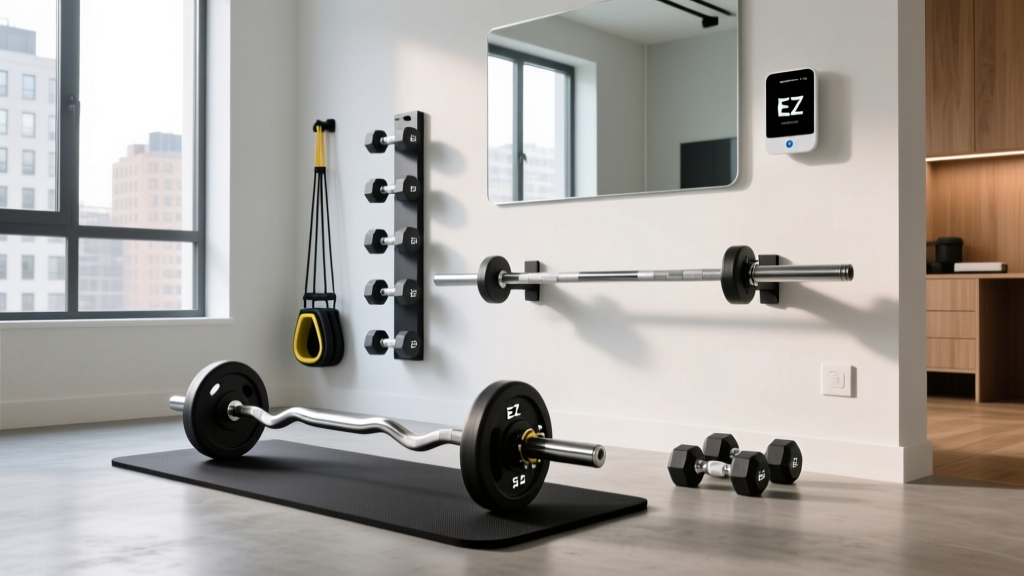
EZ Curl Bar vs Straight Bar for Dumbbell Apartments: 2026 Trends

Complete Free Weight Setup: Barbell Collar Comparison & Plie Dumbbell Squat Guide

Cast Iron vs Competition Kettlebells: Value & Rear Flyes Dumbbells

Power Rack vs Squat Rack vs Squat Stand & Tricep Curl Dumbbell Myths

Maintaining Loadable Dumbbells for Your Best Chest Workout with Dumbbells
