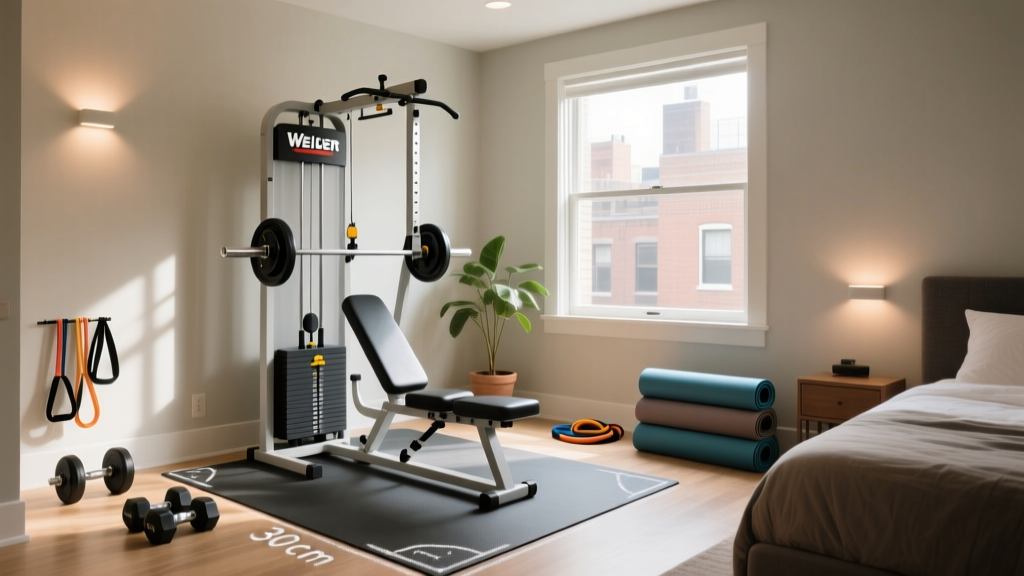
Compact Home Gym Construction: 2026 Foldable Setups
Master compact home gym construction with our 2026 guide to foldable setups. Compare Tonal, Speediance, and folding racks for small-space builds.

Redefining Home Gym Construction for Micro-Spaces
When most people hear the phrase home gym construction, they envision pouring concrete pads, framing 2x4 walls, and dedicating an entire two-car garage to iron. However, the reality of modern fitness spaces in 2026 looks vastly different. With the surge in urban micro-apartments, converted walk-in closets, and shared basement nooks, compact home gym construction is no longer about heavy framing; it is an exercise in structural engineering, spatial geometry, and load distribution.
According to the American College of Sports Medicine (ACSM), space-efficient and wearable-integrated home fitness setups remain a top industry trend. Building a gym in a 50-square-foot footprint requires selecting foldable, wall-mounted, or retractable equipment that delivers commercial-grade resistance without permanently dominating the room. This guide breaks down the structural prerequisites, spatial mathematics, and top-tier foldable equipment required to execute a flawless compact build.
The Structural Reality of Wall-Mounted Loads
The most critical phase of compact home gym construction is understanding the difference between static and dynamic loading. A wall-mounted digital gym might weigh 150 lbs (static load), but when a user performs an eccentric deadlift pulling 200 lbs of digital resistance downward and outward, the sheer force on the mounting brackets can exceed 600 lbs of dynamic torque.
Drywall and standard toggle bolts will fail catastrophically under these conditions. You must anchor directly into wooden or metal studs. As outlined by the structural mounting experts at Family Handyman, standard residential framing places studs 16 inches on-center (OC), though some modern builds use 24 inches OC. For heavy foldable rigs, you must use 3/8-inch by 3-inch structural lag screws driven into the center of the stud, bypassing the drywall entirely to prevent crushing.
2026 Comparison Matrix: Top Foldable & Compact Systems
Choosing the right hardware dictates your construction approach. Below is a technical comparison of the leading space-saving gym solutions on the market.
| Model | Type | Folded Footprint | Max Resistance | Price Range | Mounting Requirement |
|---|---|---|---|---|---|
| Tonal 2 | Digital Smart Gym | ~4.0 sq ft | 200 lbs (Digital) | $3,995+ | Direct Stud Mount (Wood/Metal) |
| Speediance Gym Monster 2 | Freestanding Digital | 12.5 sq ft | 220 lbs per arm | $3,699 | Freestanding (No wall mount) |
| REP Fitness PR-4000 (Fold-Back) | Mechanical Power Rack | ~16.0 sq ft | 1,000+ lbs (Barbell) | $800 - $1,100 | Freestanding or Bolt-Down |
| Fitness Reality 810XLT Super Max | Budget Folding Rack | ~12.0 sq ft | 800 lbs (Barbell) | $250 - $300 | Freestanding |
Deep Dive: Digital Smart Gyms vs. Mechanical Folding Racks
Digital Smart Gyms (Tonal & Speediance)
Digital gyms utilize electromagnetic resistance, eliminating the need for bulky weight stacks. The Tonal 2 remains the gold standard for true zero-footprint construction. When the arms are folded flush against the wall, it protrudes barely 5 inches. However, the installation is rigorous: Tonal requires a dedicated 20-amp electrical circuit and must be mounted to studs capable of supporting 350 lbs of combined static and dynamic load. If your wall has 24-inch OC metal studs, you will need to open the drywall and install reinforced wooden blocking before mounting.
Conversely, the Speediance Gym Monster 2 bypasses wall construction entirely. It features a freestanding base with a foldable main column. When deployed, it requires a 5x2.5-foot operational zone, but the arms and screen fold down into a sleek console that can be rolled into a corner. This is the ideal solution for renters or those with masonry walls where drilling lag bolts is prohibited.
Mechanical Folding Power Racks (REP Fitness & Titan)
For powerlifters and heavy barbell users, digital resistance is insufficient. The REP Fitness PR-4000 with the fold-back upright attachment allows the front pillars of the squat rack to swing 180 degrees flat against the wall. This reduces the depth of the rack from 41 inches to just 4 inches when stored. The construction catch? You must ensure the hinge pins are regularly lubricated with PTFE-based grease, as the sheer weight of the 3x3-inch 11-gauge steel uprights can cause metal-on-metal galling over time.
Expert Warning: The Pinch Point HazardWhen constructing a space with a fold-back rack, never install the rack in a high-traffic hallway. The swing arc of the uprights creates a severe pinch point. Always leave a minimum of 6 inches of lateral clearance between the folded rack and adjacent walls to allow your hands to safely grip and swing the heavy steel pillars.
Spatial Geometry: Calculating the "Swing Arc"
Compact home gym construction requires thinking in three dimensions, specifically regarding the "swing arc" and vertical clearance.
- The Swing Arc: When a folding rack swings open, the uprights travel in a 90-to-180-degree arc. You must maintain a 36-inch clearance radius on both sides of the rack to prevent the steel from striking doors, mirrors, or HVAC vents during deployment.
- Vertical Clearance: Standard residential ceilings are 8 feet (96 inches). If you purchase an 82-inch tall folding rack, you only have 14 inches of clearance. This severely limits overhead pressing and pull-up variations. For 8-foot ceilings, opt for 72-inch tall folding racks and utilize bolt-on dip attachments rather than overhead rigging.
- Barbell Sweep: A standard Olympic barbell is 7.2 feet long (86.4 inches). Ensure your compact room is at least 9 feet wide to allow for lateral barbell sweep during deadlifts and bench presses without damaging the drywall.
Step-by-Step Mounting Framework for Heavy Foldables
If your chosen equipment requires wall mounting, follow this structural framework to ensure longevity and safety:
- Map the Studs: Use a high-quality magnetic stud finder to locate the exact center of the wooden studs. Mark the centerline with painter's tape.
- Verify with a Pilot Hole: Drill a 1/8-inch pilot hole at your mark. If you hit solid wood immediately after the 1/2-inch drywall, you are centered. If you hit empty space, adjust laterally by 3/4 of an inch.
- Pre-Drill for Lag Screws: Drill a 1/4-inch pilot hole into the stud to a depth of 3 inches. This prevents the wooden stud from splitting when the thick lag screw is driven in.
- Torque and Secure: Use a socket wrench to drive 3/8-inch x 3-inch structural lag screws through the machine's mounting bracket, through a 1/2-inch drywall spacer (to prevent crushing the drywall), and into the stud. Torque to approximately 50 ft-lbs.
Flooring and Vibration Dampening
In a compact space, sound and vibration transfer are magnified. Standard interlocking foam tiles are insufficient for folding racks and heavy digital gyms. You must utilize 3/4-inch thick vulcanized rubber horse stall mats (typically 4x6 feet).
For folding racks specifically, the mat serves a secondary structural purpose: friction. When a freestanding folding rack is bumped while in the folded position, it can easily tip over. Placing the base of the rack on a high-density rubber mat increases the coefficient of friction, anchoring the unit to the floor and preventing accidental tipping in tight spaces.
Common Failure Modes in Compact Builds
Even with meticulous planning, small-space gyms face unique environmental and mechanical threats. Watch out for these specific failure modes:
- Drywall Blowout: Caused by mounting wall-mounted cable machines directly to drywall using toggle bolts. The dynamic eccentric loading will eventually rip the drywall paper and gypsum core apart, sending the machine crashing to the floor.
- Retractable Cable Fray: Digital smart gyms use internal retractable cables. In compact spaces where the machine is close to a door or window, UV exposure and temperature fluctuations can degrade the nylon cable sheathing. Keep smart gyms out of direct sunlight.
- Hinge Rust in Basement Closets: Mechanical folding racks stored in unventilated basement closets are prone to hinge oxidation. Apply a light coat of 3-IN-ONE oil to the folding hinge pins every six months to maintain a smooth swing arc.
"The secret to successful compact home gym construction isn't just buying the right foldable equipment; it's engineering the environment around it. Treat your walls, floors, and spatial geometry with the same respect you treat your training programming."
By prioritizing structural integrity, precise spatial mapping, and high-density flooring, you can construct a world-class training facility in a space smaller than a standard parking spot. Whether you opt for the electromagnetic precision of a Tonal or the heavy-duty utility of a fold-back REP rack, the principles of compact construction remain the same: measure twice, anchor deep, and train hard.
More gear to consider
All reviews
Gold's Gym Home Gym Equipment: Complete Strength Setup Walkthrough
Body Solid P2X Powerline Home Gym: Best $500 Budget Setup?

Life Fitness G7 Home Gym Garage Setup: Flooring & Ventilation Errors

Centr Home Gym Renovation: Remodeling Tips & Budget Breakdown

Marcy Platinum Home Gym Configuration and Care Guide