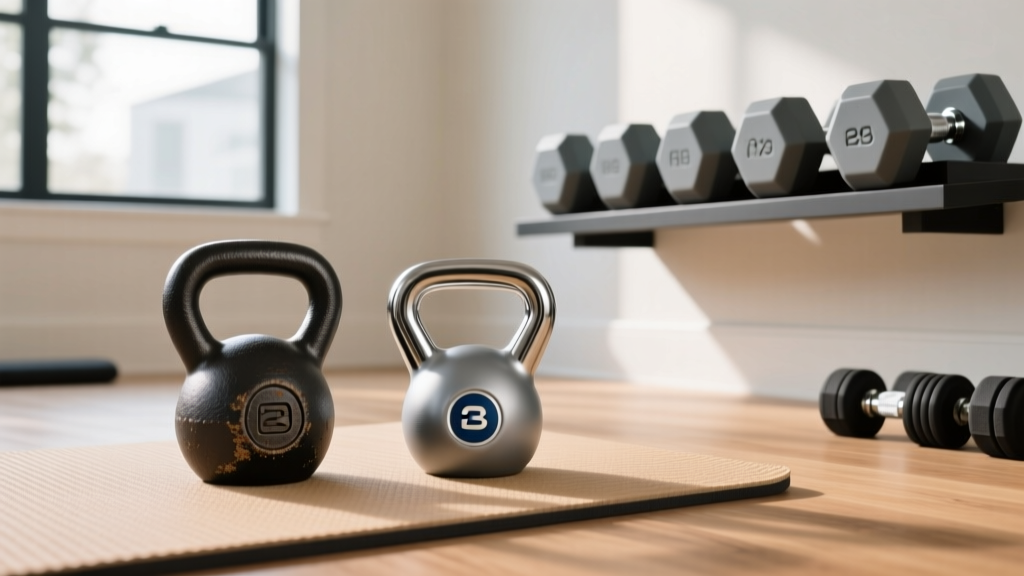
Cast Iron vs Competition Kettlebells & Chest Training with Dumbbells
Compare cast iron vs competition kettlebell costs and value. We analyze budget allocation against adjustable setups for chest training with dumbbells.

When outfitting a home gym in 2026, lifters face a critical budget allocation dilemma: should you invest in a versatile kettlebell arsenal, or prioritize adjustable dumbbells for targeted hypertrophy? This value analysis breaks down the cost-per-pound, longevity, and functional ROI of cast iron versus competition kettlebells, while weighing the opportunity cost against dedicated setups for chest training with dumbbells.
💰 2026 Budget Snapshot
- Cast Iron Kettlebells: $1.40 – $1.90 per lb
- Competition Kettlebells: $3.20 – $4.50 per lb
- Adjustable Dumbbells (5-50lb pair): $350 – $450 flat
Cast Iron Kettlebells: The Budget-Friendly Workhorse
Cast iron kettlebells are poured into molds as a single solid piece of iron, typically finished with an e-coat or powder coat. For the budget-conscious lifter, they offer the lowest barrier to entry for ballistic movements like swings, snatches, and cleans. According to the American Council on Exercise (ACE), kettlebell training yields massive cardiovascular and posterior-chain benefits, and cast iron bells deliver these results without the premium price tag of competition steel.
The Hidden Cost of Dimensional Variance
The primary drawback of cast iron is the lack of standardized dimensions. A 16kg (35lb) cast iron bell from a budget brand might feature a 32mm handle diameter and a compact window, while their 32kg (70lb) bell jumps to a 35mm handle and a massive base. This forces your grip and racking mechanics to adapt to the tool, rather than the tool adapting to your biomechanics. However, at roughly $1.60 per pound from reputable brands like Rep Fitness or Rogue, the financial savings are undeniable for general conditioning.
Failure Modes and Edge Cases
- E-Coat Rusting: While e-coated bells feel smooth and preserve grip texture, a single deep scratch down to the raw iron will cause rapid oxidation in humid garage gyms.
- Powder Coat Abrasion: Aggressive powder coatings can feel like 60-grit sandpaper. During high-rep snatches, this friction will tear calluses and blister the palms, requiring you to sand the handle down manually.
Competition Kettlebells: When to Pay the Premium
Competition kettlebells are constructed from steel, featuring a hollow core and a welded window. Their defining characteristic is absolute dimensional uniformity. Whether you are holding an 8kg or a 48kg competition bell, the handle diameter is exactly 35mm, the height is 28cm, and the width is 21cm.
Technique ROI and Joint Health
According to StrongFirst standards, this uniformity is non-negotiable for high-repetition sport lifting or complex flows. When the bell rests in the rack position, a consistent window size ensures the steel rests flush against your forearm without bruising the radial nerve. While you pay a premium (averaging $3.80 per pound in 2026), the injury prevention and technique consistency offer a massive long-term ROI for serious practitioners.
Structural Vulnerabilities
Because competition bells are hollow steel, they are paradoxically more fragile than solid cast iron when subjected to blunt force trauma. Dropping a 24kg competition bell directly onto bare concrete can dent the thin steel base or, worse, compromise the structural integrity of the welded window. If you train outdoors or on unsealed concrete, you must invest in heavy-duty horse stall mats to protect your $120+ investment per bell.
| Feature | Cast Iron (Standard) | Competition (Steel) |
|---|---|---|
| Material | Solid Cast Iron | Hollow Steel / Welded |
| Handle Diameter | Varies (30mm - 40mm+) | Strict 35mm |
| Base Width | Increases with weight | Uniform 21cm |
| 2026 Avg Cost (per lb) | $1.40 - $1.90 | $3.20 - $4.50 |
| Best Use Case | Grinds, Heavy Swings, Budget Gyms | Sport, Complex Flows, Rack Work |
Opportunity Cost: Chest Training with Dumbbells
Here is where the budget breakdown gets interesting. Many home gym owners attempt to use kettlebells for upper-body hypertrophy, specifically pressing movements. While kettlebell floor presses and bridge presses are excellent for shoulder stability and core integration, they are highly suboptimal for pure pectoral hypertrophy.
If your primary goal is muscle growth in the pecs, prioritizing chest training with dumbbells is vastly superior. The ergonomic arc, independent weight paths, and deeper stretch provided by adjustable dumbbells (like the Nuobell 80 or PowerBlock Sport) allow for optimal motor unit recruitment in the sternal and clavicular heads of the pectoralis major. Biomechanical databases like ExRx.net highlight the necessity of a full range of motion and continuous tension for chest hypertrophy—something the bulky, awkward frame of a heavy kettlebell actively impedes.
The Biomechanics of Stretch-Mediated Hypertrophy
Recent exercise science heavily emphasizes stretch-mediated hypertrophy—the concept that loading a muscle in its fully lengthened position triggers superior growth signaling. When performing chest training with dumbbells, you can lower the weights past the plane of your torso, achieving a deep, loaded eccentric stretch in the pecs. Conversely, when pressing a kettlebell, the massive spherical body of the bell hits your forearm or wrist long before the pectoral muscle reaches its maximum stretch. By restricting the eccentric range of motion, kettlebells inherently cap your hypertrophic ceiling for chest development.
The Financial Showdown: Kettlebell Trio vs. Adjustable Dumbbells
Let's look at a realistic 2026 equipment allocation scenario for a $400 budget:
- Option A (Kettlebell Focus): Buying a cast iron 16kg, 20kg, and 24kg trio costs roughly $270. This gives you phenomenal tools for posterior chain, conditioning, and unilateral leg work, but leaves your chest development severely limited.
- Option B (Hypertrophy Focus): Buying a pair of 5-50lb adjustable dumbbells costs roughly $380. This instantly unlocks hundreds of isolation and compound movements, making chest training with dumbbells highly effective, alongside back, shoulder, and arm work.
"Kettlebells are unparalleled for ballistic power and grip endurance, but if a lifter's primary aesthetic goal is upper body push hypertrophy, diverting funds from a competition kettlebell set to a high-quality adjustable dumbbell system yields a significantly higher visual ROI."
The 2026 Value Verdict: How to Allocate Your Funds
Choosing between cast iron, competition steel, and adjustable dumbbells isn't just about picking a tool; it's about aligning your capital with your physiological goals. Use this decision framework to finalize your purchase:
- Choose Cast Iron If: Your budget is strictly under $200, you prioritize heavy two-handed swings and goblet squats, and you don't plan on performing high-rep clean and jerks where handle variance causes forearm bruising.
- Choose Competition If: You are training for kettlebell sport (GS style), you practice complex juggling or multi-bell flows, and you require the 35mm handle consistency to protect your wrists and radial nerves during heavy rack work.
- Choose Adjustable Dumbbells If: Your main objective is bodybuilding, hypertrophy, and targeted isolation. If you are serious about chest training with dumbbells, the $400 investment in an adjustable pair will outperform any kettlebell setup for pec development and upper-body symmetry.
Ultimately, the smartest home gyms in 2026 don't rely on a single modality. If capital allows, start with a single 16kg or 20kg cast iron kettlebell for swings and Turkish get-ups ($50-$70), and allocate the remaining $350 to a reliable adjustable dumbbell set. This hybrid approach ensures elite posterior chain conditioning without sacrificing the mechanical tension and deep eccentric stretch required for serious chest training with dumbbells.
More gear to consider
All reviews
Adjustable Dumbbell Mistakes & Dumbbell Side Bend Benefits Guide

Olympic vs Standard Weight Plates for Dumbbell Hammer Curls

Power Rack vs Squat Rack Mistakes: Barbell & 15 lbs Dumbbell Pair

Hammer Curls Cable vs Dumbbell: 2026 Adjustable Set Review
Barbell Collar Comparison & Dumbbell Overhead Press Machine Setup
