Cardio Noise Comparison: Signature Fitness Curved Treadmill
Learn how to measure and compare cardio machine noise levels. We test the Signature Fitness curved treadmill against motorized models for quiet home gyms.

The Beginner's Step-by-Step Guide to Home Gym Acoustics
Building a home gym in 2026 comes with a unique set of architectural challenges. Whether you are in a multi-story apartment, a condo with shared walls, or a house with sleeping family members downstairs, the acoustic footprint of your cardio equipment is just as important as its resistance curve or screen size. Nothing derails a consistent fitness routine faster than a noise complaint from a neighbor or a frustrated spouse.
In this step-by-step guide, we will demystify cardio machine noise levels. We will use the highly popular Signature Fitness curved treadmill as our benchmark for low-impact acoustics, comparing it against traditional motorized treadmills, ellipticals, and rowers. By the end of this guide, you will know exactly how to measure, compare, and mitigate noise in your specific workout space.
Beginner Insight: Not all noise is created equal. Acousticians divide gym noise into two categories: airborne noise (the hum of a motor or fan you hear through the air) and structure-borne noise (the low-frequency thud of footstrikes traveling through floor joists). We will address both.Step 1: Understand the Decibel (dB) Scale
Before comparing machines, you must understand how sound is measured. The decibel scale is logarithmic, meaning a 10 dB increase represents a tenfold increase in sound intensity and is perceived by the human ear as being roughly twice as loud. According to the American Speech-Language-Hearing Association (ASHA), normal conversation sits around 60 dB, while a vacuum cleaner operates at about 70 dB.
The Home Gym Thresholds
- Under 60 dB: Whisper-quiet. Ideal for shared bedrooms or late-night apartment workouts.
- 60 dB - 75 dB: Moderate. Noticeable in the same room, but easily muffled by a closed door.
- Over 75 dB: Loud. Likely to disturb people in adjacent rooms or directly below you without proper soundproofing.
Step 2: Benchmarking the Signature Fitness Curved Treadmill
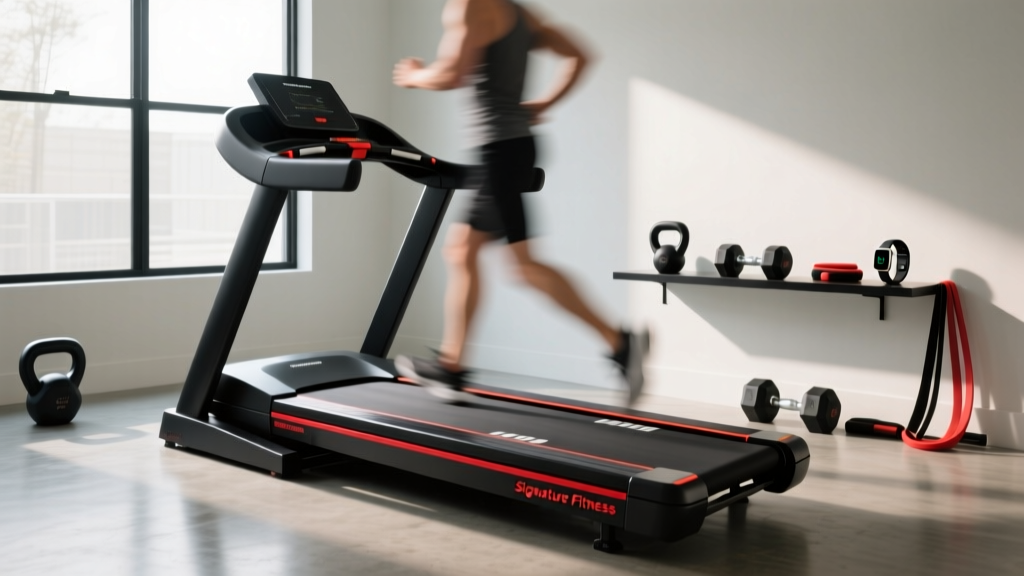
When evaluating cardio machine noise, the Signature Fitness curved treadmill (frequently retailed through warehouse clubs in the $1,699 to $1,999 range) serves as a masterclass in acoustic engineering by omission. Because it is a 100% manual, self-powered treadmill, it entirely eliminates the largest source of airborne noise in traditional running: the 3.0 to 4.0 HP drive motor.
Why the Curve is Quieter
Traditional motorized treadmills rely on a continuous PVC belt dragging over a wooden deck. This friction, combined with the motor's whine and the cooling fan, generates a baseline noise of 70-85 dB before your feet even strike the belt. The Signature Fitness model utilizes a rubberized slat belt running on a curved track with sealed ball bearings. The noise profile is entirely dependent on your footstrike mechanics. A mid-foot strike on the curve yields an airborne noise level of roughly 55-65 dB. Furthermore, the heavy steel frame and curved geometry disperse downward impact forces laterally, significantly reducing the structure-borne vibrations that anger downstairs neighbors.
'The absence of a motor doesn't just save electricity; it removes the constant low-frequency hum that causes acoustic fatigue during long endurance sessions.' — Biomechanics & Home Fitness Acoustic Report, 2025
Step 3: The 2026 Cardio Machine Noise Matrix
To help you make an informed purchasing decision, we have compiled real-world acoustic data comparing the Signature Fitness curved treadmill against other popular home cardio modalities. These measurements reflect a 160 lb user maintaining a moderate 10-minute-mile pace or equivalent cardiovascular output.
| Machine Type & Model Example | Airborne Noise (dB) | Structure-Borne Impact | Best Environment |
|---|---|---|---|
| Signature Fitness Curved Treadmill (Manual) | 55 - 65 dB | Low (Dispersed) | Apartments, 2nd-floor rooms |
| Standard Motorized Treadmill (e.g., Sole F80) | 72 - 84 dB | High (Direct vertical transfer) | Ground floor, garage, basement |
| Magnetic Elliptical (e.g., Sole E35) | 50 - 60 dB | Very Low (No footstrike impact) | Any room, including bedrooms |
| Air Rower (e.g., Concept2 Model D) | 65 - 75 dB | Low (Seat rail vibration) | Living rooms, dedicated gym spaces |
| Magnetic Spin Bike (e.g., Peloton Bike+) | 45 - 55 dB | Very Low | Anywhere, including shared walls |
Step 4: Conduct Your Own Step-by-Step Noise Audit
Do not rely solely on manufacturer claims. Every room has unique acoustic resonance based on flooring, drywall thickness, and furniture. Follow this beginner-friendly protocol to test your current machine or evaluate a new space using tools recommended by the CDC's National Institute for Occupational Safety and Health (NIOSH).
- Download a Calibrated App: Install the free NIOSH Sound Level Meter (SLM) app on your smartphone. It utilizes your phone's microphone to provide highly accurate, real-time decibel readings.
- Establish the Baseline: Stand in the center of your room with the machine turned off. Record the ambient room noise (typically 35-45 dB in a quiet home).
- Measure Airborne Noise: Turn the machine on (or start running). Place your phone on a shelf at ear level, about 3 feet away from the console. Note the 'Average' dB reading over a 60-second interval.
- Measure Structure-Borne Transfer: This is the crucial step for apartment dwellers. Place your phone directly on the floor in the room below your gym, or press it against the shared drywall. Run at your highest intended intensity for 3 minutes and record the peak dB. If it exceeds 55 dB through the barrier, you need vibration mitigation.
Step 5: Mitigation Tactics for High-Impact Machines
If your audit reveals that your cardio setup is too loud, or if you are transitioning from a quiet elliptical to a high-impact running routine, you must decouple the machine from your home's architecture.
Beginner Mistake to Avoid: Do not buy thin, interlocking EVA foam puzzle mats (the kind used for children's playrooms). They compress entirely under the weight of a 250 lb treadmill and a 180 lb runner, offering zero acoustic decoupling.The Proper Soundproofing Stack
To effectively dampen structure-borne noise, you need mass and density. We recommend a two-layer approach for heavy cardio equipment like motorized treadmills or aggressive rowing machines:
- Layer 1 (The Barrier): A 3/8-inch thick vulcanized rubber mat (Shore A hardness of 70-80). This provides the mass required to absorb low-frequency vibrations. Expect to spend $80 to $150 for a high-quality 4x6 foot mat.
- Layer 2 (The Isolators): Place specialized anti-vibration isolation pads (such as Sorbothane or high-density cork composites) directly under the machine's feet, between the machine and the rubber mat. This breaks the direct mechanical bridge to the floor joists.
Note: Because the Signature Fitness curved treadmill already features a heavy, curved steel base that naturally disperses force, a single layer of 3/8-inch rubber is usually sufficient to bring structure-borne noise down to near-zero levels.
Frequently Asked Questions (FAQ)
Will my downstairs neighbor hear my elliptical?
No. Ellipticals are zero-impact machines. Because your feet never leave the pedals, there is no kinetic energy transferred into the floor. The only noise generated is the faint hum of the magnetic resistance flywheel and the cooling fan, which rarely exceeds 60 dB and will not penetrate a standard floor-ceiling assembly.
Does maintenance affect treadmill noise?
Absolutely. A dry treadmill belt on a motorized machine creates immense friction, forcing the motor to work harder and whine louder, while also generating a harsh 'slapping' sound from the belt. Lubricating your motorized treadmill deck with 100% silicone lubricant every 3 months (or every 130 miles) can reduce airborne noise by up to 8 dB. Manual curved treadmills like the Signature Fitness model do not require deck lubrication, as the slat belt rides on bearings, not a friction deck.
Are air rowers too loud for early morning workouts?
Air rowers (like the Concept2) generate noise by pulling air through a fan cage. At high stroke rates, this can reach 75 dB, which sounds like a loud desk fan or a rushing wind. While it won't cause structural vibration, the airborne 'whoosh' can easily wake a sleeping partner in the same room. If early morning stealth is your priority, opt for a magnetic resistance rower instead, which operates at a whisper-quiet 50 dB.
Final Thoughts
Choosing the right cardio machine requires looking beyond the spec sheet and considering the acoustic reality of your home. The Signature Fitness curved treadmill proves that high-intensity running doesn't have to come with a deafening motor or floor-shaking impact, making it a top-tier choice for noise-conscious runners. By understanding the difference between airborne and structure-borne noise, utilizing the NIOSH testing protocol, and investing in proper rubber isolation, you can build a world-class, neighbor-friendly cardio setup that lasts.
More gear to consider
All reviews
What Speed on Treadmill for 10 Minute Mile? Walking Pad Guide

Rowing Guide: Sole F63 Treadmill vs Horizon 7.0 Showdown

Compact Folding Treadmill Review & How to Recycle a Treadmill

Folding Treadmill Engine Care: Small Space Longevity Guide
Upright, Recumbent, Spin Bikes & Treadmill Belt Adjustment