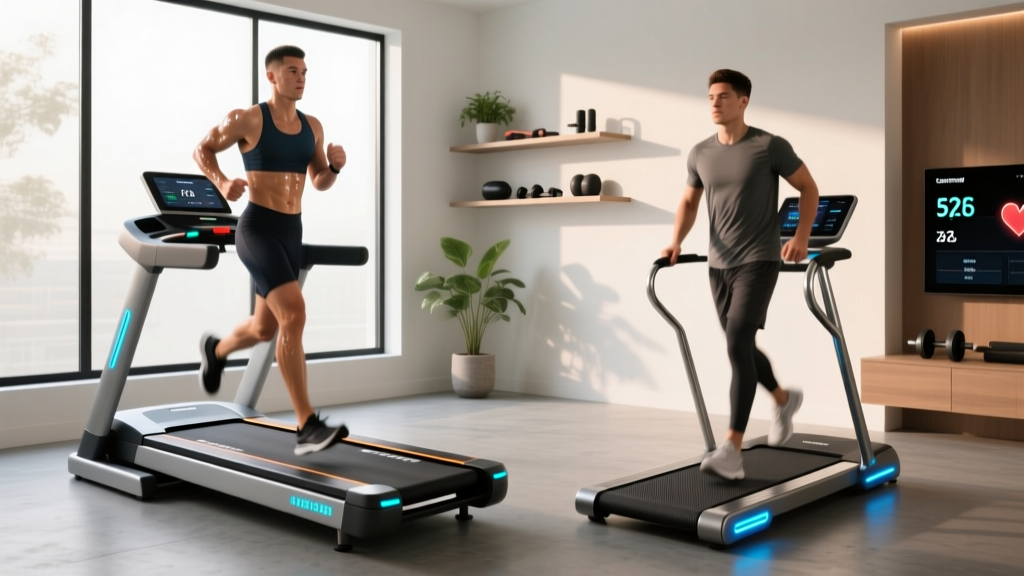
Cardio Exercises Treadmill vs Walking Pad: 2026 Guide
Discover the best cardio exercises: treadmill vs walking pad. Our 2026 beginner guide compares specs, routines, and setup for your home gym.

The Great Debate: Traditional Treadmills vs. Walking Pads
When planning your daily cardio exercises, treadmill and walking pad options present two very different paths to fitness. As we move through 2026, the home fitness market has seen a massive surge in compact under-desk walking pads, challenging the dominance of traditional folding treadmills. But which machine actually aligns with your biomechanics, space constraints, and cardiovascular goals?
The American Heart Association recommends at least 150 minutes of moderate-intensity aerobic activity per week for optimal heart health. Whether you are aiming to hit that baseline or train for a 5K, choosing the right hardware is your critical first step. This beginner-friendly, step-by-step guide will walk you through the exact specifications, spatial requirements, and training protocols to help you make an informed decision.
Step 1: Decode the Hardware Specifications
Before committing to a machine, you must understand the mechanical differences. In 2026, walking pad motors have become more efficient, but the physics of small flywheels still limit continuous high-speed running compared to traditional treadmills. Below is a direct comparison of three top-tier models representing different categories.
| Feature | Horizon Fitness 7.0 AT (Traditional) | UREVO Strol 2E (Budget Walking Pad) | King Smith WalkingPad R2 (Premium Pad) |
|---|---|---|---|
| Motor Type | 3.0 CHP (Continuous Horsepower) | 2.5 HP Peak (1.5 CHP) | 2.5 HP Peak (1.25 CHP) |
| Belt Dimensions | 22' x 60' | 16.5' x 45' | 17.3' x 47.2' |
| Max Speed | 12 MPH | 7.6 MPH (with handlebar) | 7.5 MPH (with handlebar) |
| Weight Capacity | 350 lbs | 240 lbs | 240 lbs |
| Average 2026 Price | $1,099 | $299 | $599 |
Expert Insight: Always look for CHP (Continuous Horsepower) rather than Peak HP. Peak HP only measures the motor's maximum output in short bursts, whereas CHP reflects what the motor can sustain during a 45-minute cardio session without overheating.
Step 2: Align Machine Choice With Your Cardio Goals
Your choice of equipment should dictate the type of cardio exercises you perform. Traditional treadmills are built for dynamic movement. The 60-inch belt length on the Horizon 7.0 AT allows for full stride extension, making it suitable for walking, jogging, and high-intensity interval training (HIIT). The 15% incline capability also allows for steep hill climbs, drastically increasing caloric expenditure and glute activation.
Conversely, walking pads are strictly designed for low-impact, steady-state walking. Because the belts max out around 47 inches in length, users taller than 5'8' will naturally shorten their stride to avoid stepping on the rear motor housing. According to the Mayo Clinic, maintaining proper walking posture and a natural arm swing is crucial for joint health and spinal alignment. If a walking pad forces you to hunch or chop your stride, it is not the right tool for vigorous cardio.
'If your primary goal is to increase your daily step count while working from home, a walking pad is unmatched. If your goal is to improve your VO2 max or train for outdoor races, you need the speed and incline range of a traditional treadmill.'
Step 3: Room Setup and Safety Clearances
One of the most common beginner mistakes is ignoring spatial requirements, leading to damaged drywall or severe injuries. Follow these exact measurements for your setup:
- Traditional Treadmill Clearance: You need a minimum footprint of 39 inches wide by 78 inches long. More importantly, the CDC and equipment manufacturers mandate a 6-foot (72-inch) clear safety zone directly behind the treadmill. If you fall off the back of a moving belt, this space prevents you from hitting a wall or furniture.
- Walking Pad Clearance: Walking pads require roughly 20 by 50 inches of floor space. Because they sit flush with the ground (usually under 5 inches high), they do not require a rear fall zone. However, you must ensure the power cord is routed away from the belt edges to prevent tripping.
- Electrical Requirements: Traditional treadmills with 3.0+ CHP motors draw significant current. Plug them directly into a dedicated 15-amp or 20-amp wall outlet. Never use an extension cord or a power strip, as voltage drops can burn out the motor control board.
Step 4: Your 7-Day Beginner Cardio Routine
Once your machine is assembled and calibrated, ease into your new habit. This 7-day protocol is designed for beginners using either a traditional treadmill or a walking pad (adjust speeds downward if your pad maxes out lower).
- Day 1: Acclimation (20 Minutes)
Speed: 2.5 MPH. Incline: 0%. Focus entirely on your posture. Keep your chest up, shoulders relaxed, and strike the belt with your midfoot. - Day 2: Brisk Base (30 Minutes)
Speed: 3.2 MPH. Incline: 1%. This slight elevation mimics outdoor wind resistance and reduces the braking force on your knees. - Day 3: Active Recovery (15 Minutes)
Speed: 2.0 MPH. Incline: 0%. A very light flush to promote blood flow to recovering leg muscles. - Day 4: Intro to Intervals (25 Minutes)
Warm-up: 5 mins at 2.5 MPH.
Work: 1 min at 3.8 MPH.
Recover: 2 mins at 2.5 MPH. Repeat 5 times.
Cool-down: 5 mins at 2.0 MPH. - Day 5: Endurance Builder (40 Minutes)
Speed: 3.0 MPH. Incline: 2%. Put on a podcast and maintain a steady, conversational pace. This builds your aerobic base. - Day 6: Incline Focus (30 Minutes - Treadmill Only)
Speed: 2.8 MPH. Incline: 8%. This targets the posterior chain (calves, hamstrings, glutes). Walking pad users should substitute this with a 45-minute flat walk at 3.5 MPH. - Day 7: Rest and Mobility
No machine work. Focus on static stretching and foam rolling.
Step 5: Maintenance and Edge-Case Troubleshooting
Cardio machines are mechanical devices that require routine upkeep. Ignoring maintenance is the leading cause of premature motor failure and voided warranties.
Belt Lubrication
Both traditional treadmills and walking pads require belt lubrication to reduce friction between the deck and the belt. Friction forces the motor to work harder, drawing excess amperage and generating heat. You must apply 100% pure silicone treadmill lubricant every 150 miles or every 3 months. Do not use WD-40 or petroleum-based products, as these will dissolve the belt backing.
Thermal Shutoff and Duty Cycles
A common edge case with walking pads is the 'thermal shutoff.' Because walking pads use smaller motors and lack the internal cooling fans found in traditional treadmills, they are typically rated for a 90-minute continuous duty cycle. If you attempt a 2-hour marathon training walk on a UREVO or King Smith pad, the internal thermal sensor will trip, and the machine will abruptly stop to prevent a fire hazard. If this happens, unplug the unit and let it cool for 45 minutes.
Belt Slipping
If you step heavily and the belt hesitates while the front roller continues to spin, your drive belt or walking belt is loose. Locate the two rear adjustment bolts at the back of the machine. Turn both bolts clockwise by exactly one-quarter turn. Test the machine. Never tighten one side more than the other, or the belt will track off-center and shred against the side rails.
Final Verdict: Which Should You Buy?
If you have a dedicated room, a budget over $800, and want to run, sprint, or climb steep hills, a traditional treadmill like the Horizon 7.0 AT is the undisputed champion of home cardio exercises. However, if you live in an apartment, work from home, and simply want to integrate 10,000 daily steps into your workday without dedicating 'gym time,' a high-quality walking pad is a life-changing investment. Assess your space, respect the safety clearances, and commit to the 7-day beginner plan to build a sustainable cardiovascular habit.
More gear to consider
All reviews
Assault Bike vs Air Bike: Budget & Life Fitness 95T Treadmill

Funmily Treadmill vs. Spin, Upright & Recumbent Bike Types (2026)
Space-Saving Layouts & UREVO Cyberpad Smart Treadmill Belt Care
NordicTrack EXP 7i Treadmill vs Walking Pads: Setup & Review

Compact Folding Treadmill Review & How to Recycle a Treadmill
