Cable Crossover vs Nautilus Chest Press Machine: 2026 Guide
Compare top cable crossover machines for chest training against the classic Nautilus chest press machine. 2026 specs, biomechanics, and buying advice.

The Biomechanical Showdown: Cables vs. Fixed Cams
When outfitting a high-end home gym or upgrading a commercial fitness facility in 2026, the debate over chest training equipment often narrows down to two distinct philosophies: the versatile, multi-vector cable crossover machine versus the highly engineered, fixed-path nautilus chest press machine. Both modalities are exceptional for pectoral hypertrophy, but they achieve muscle stimulation through fundamentally different biomechanical mechanisms.
The classic Nautilus philosophy relies on a precision-machined cam that matches the exact strength curve of the pectoralis major. As you press, the cam alters the resistance, making the weight feel heavier at the beginning of the movement (where you are mechanically stronger) and lighter at the peak contraction. This allows for absolute isolation without taxing the central nervous system with stabilizer demands. According to the National Strength and Conditioning Association (NSCA), fixed-path machines are unparalleled for safely pushing a muscle to absolute failure, as the user does not need to balance the load.
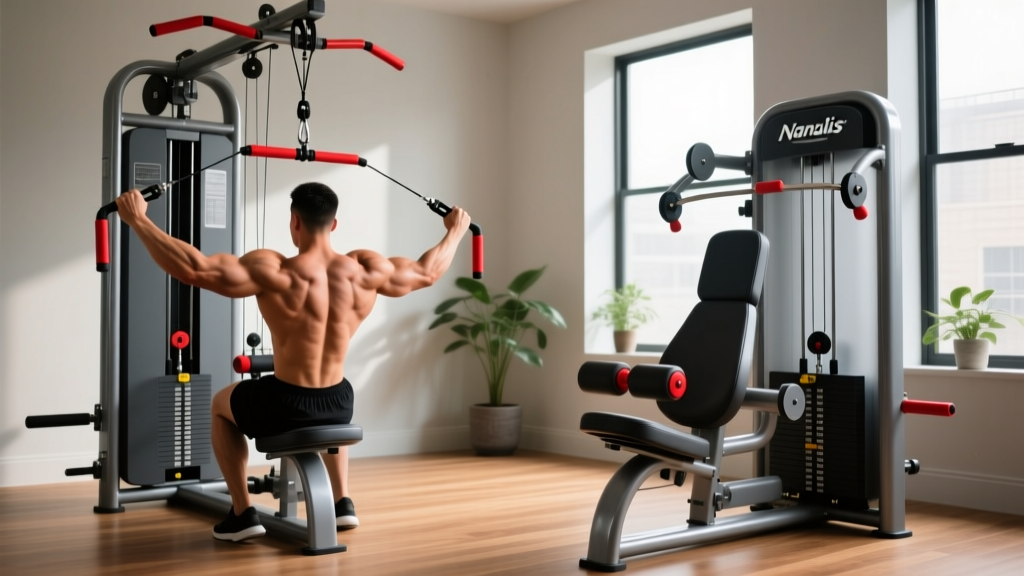
Conversely, a cable crossover machine for chest training provides constant, linear tension throughout the entire range of motion. Because the cables pull from a fixed point in space, the resistance vector remains horizontal regardless of your arm's position. This creates immense tension at the peak of the contraction (the squeeze) and a deep stretch at the bottom. As noted by ExRx, the adjustable pulley heights on a crossover allow lifters to target the clavicular (upper) or sternocostal (lower) heads of the pecs simply by altering the cable angle, a feat a standard seated chest press cannot replicate.
Quick Decision Framework
- Choose a Cable Crossover if: You want exercise variety (flyes, presses, pushdowns), need to train around shoulder injuries by adjusting angles, and have the floor space (40+ sq ft).
- Choose a Nautilus Chest Press if: Your primary goal is safe, heavy isolation to failure, you have limited space (15 sq ft), or you manage a commercial facility where user-friendly, fixed-path machines reduce liability and instruction time.
2026 Market Leaders: Top Cable Crossovers for Chest Training
If you have decided that the versatility of a cable system is necessary for your chest training arsenal, selecting the right machine is critical. The market in 2026 is dominated by three distinct tiers, each offering unique pulley ratios and build qualities.
1. Rogue Monster RM-43CC Cable Crossover
Price Range: $5,495 - $6,200 (depending on attachments)
Pulley Ratio: 1:1
Weight Stacks: Dual 250 lb selectorized stacks
The Rogue RM-43CC is the gold standard for commercial and elite garage gyms. Its 1:1 pulley ratio means that 100 lbs on the stack equals 100 lbs of resistance at the handle. For chest training, this is ideal for heavy cable presses and close-grip variations. However, for isolation flyes, the 10 lb weight increments can feel aggressive when the arms are fully extended and the lever arm is longest. The aircraft-grade aluminum pulleys and polyurethane belts ensure zero cable slip, even during explosive concentric movements.
2. Force USA G15 All-In-One Trainer
Price Range: $4,999
Pulley Ratio: 2:1 (Crossover) / 1:1 (Lat Row)
Weight Stacks: Dual 200 lb stacks
The G15 is a powerhouse for home gyms because it integrates a power rack, Smith machine, and cable crossover into a single footprint. For chest training, the 2:1 crossover ratio is a massive advantage. A 2:1 ratio means a 200 lb stack provides 100 lbs of actual resistance, but it moves twice as fast. This results in 5 lb effective weight increments, allowing for micro-loading during delicate chest flye movements. The 18 adjustable pulley positions allow for seamless transitions from decline crossovers to incline cable presses.
3. Rep Fitness FT-5000 2.0 Functional Trainer
Price Range: $2,299 - $2,599
Pulley Ratio: 2:1
Weight Stacks: Dual 160 lb stacks (upgradable to 200 lbs)
For budget-conscious buyers who refuse to compromise on smooth cable travel, the FT-5000 2.0 is the 2026 value champion. The 14-gauge steel frame is robust, and the 2:1 ratio makes the 160 lb stacks feel incredibly smooth for chest isolation work. While it lacks the integrated squat rack of the Force USA, its compact 50-inch width makes it viable for tighter spaces.
Head-to-Head Comparison Matrix
How do the top cable systems compare against a dedicated selectorized chest press? The table below breaks down the critical specifications for facility planners and home gym owners.
| Equipment Model | Modality | Approx. Price (2026) | Footprint | Best Chest Application |
|---|---|---|---|---|
| Rogue RM-43CC | Cable Crossover | $5,800 | 48 sq ft | Heavy Cable Presses, Athletic Power |
| Force USA G15 | All-In-One (2:1) | $4,999 | 32 sq ft | Micro-loaded Flyes, Incline Crossovers |
| Rep FT-5000 2.0 | Functional Trainer | $2,400 | 18 sq ft | Budget Isolation, Constant Tension |
| Nautilus Instinct Press | Fixed Cam Press | $4,200 | 14 sq ft | Heavy Isolation, Safe Failure Training |
Spatial, Installation, and Maintenance Realities
One of the most overlooked aspects of buying chest training equipment is the installation footprint and long-term maintenance. A dedicated nautilus chest press machine is a 'plug and play' unit. It requires roughly 4 feet by 3.5 feet of floor space, can be bolted directly to a concrete slab, and features enclosed weight stacks that keep dust and chalk out of the guide rods.
Cable crossovers, however, demand rigorous spatial planning. A commercial crossover like the Rogue RM-43CC spans nearly 9 feet wide and requires a minimum of 4 feet of clearance in front for the user's body and arm extension. Furthermore, maintenance on cable systems is inherently higher. According to ACE Fitness equipment maintenance guidelines, crossover cables must be inspected monthly for fraying, particularly at the pulley edge where the cable bends under load. If a user consistently performs crossovers with the cables rubbing against the plastic pulley guard, micro-abrasions will eventually lead to cable snapping. Selectorized pins on crossover stacks also require weekly silicone lubrication to prevent binding, a step not required on enclosed, cam-driven chest press machines.
Edge Case Warning: If your ceiling height is below 84 inches, standard commercial crossovers will not fit. You must look for low-profile models or opt for a compact chest press machine. Attempting to modify the top crossmember of a cable crossover voids the structural warranty and compromises the tensile integrity of the frame.Programming for Hypertrophy: Combining Modalities
For advanced lifters, the ultimate chest training setup does not force a choice between a cable crossover and a fixed press; it utilizes both to exploit different regions of the strength curve.
- Pre-Exhaustion with Cables: Begin the workout with high-rep (15-20) cable crossovers set at shoulder height. The 2:1 ratio allows for a deep stretch and a hard peak contraction without elbow joint strain. This pumps blood into the fascia and pre-fatigues the sternal pecs.
- Heavy Overload on the Nautilus: Move immediately to the Nautilus chest press machine. Because the stabilizers are already fatigued from the crossovers, the fixed cam allows you to safely push the prime movers to absolute mechanical failure without the risk of dropping a barbell or losing the cable path.
- Unilateral Finisher: Return to the crossover for single-arm, across-the-body sweeps to target the inner pec fibers and address any left-to-right strength imbalances that a bilateral fixed press might mask.
Frequently Asked Questions
Can a cable crossover fully replace a chest press machine?
For general fitness and athletic conditioning, yes. However, for pure bodybuilding and maximum hypertrophy, a cable crossover lacks the absolute stability required to safely push the pectorals to true failure with heavy loads. The core and shoulder stabilizers will often give out on a heavy cable press before the chest muscles are fully exhausted.
Why do some crossovers use a 2:1 ratio while others use 1:1?
A 1:1 ratio provides a direct 1-to-1 transfer of weight, which is excellent for heavy, athletic movements like cable rows and presses. A 2:1 ratio halves the resistance but doubles the cable travel speed. This creates a smoother, more fluid motion that is vastly superior for isolation exercises like chest flyes, where the lever arm changes dramatically and heavy weights can cause shoulder impingement.
What is the best cable attachment for chest flyes?
In 2026, the most effective attachment for crossover flyes is the ergonomic D-handle or a specialized cuff attachment that wraps around the wrist. Wrist cuffs eliminate grip fatigue, allowing the lifter to focus 100% of their neurological drive on squeezing the pectoral fibers without the forearms failing prematurely.
More gear to consider
All reviews
Push-Up Boards vs Chest Press Machines: 2026 Buying Guide

Incline Chest Press Machine Planet Fitness & Bench Comparison Care

Step vs. Boots: A Technical Comparison for Functional Footwear Selection

Pec Deck Guide: Space Layouts vs the Leg Bench Press Machine

Pec Deck vs Inclined Chest Press Machine: 2026 Review