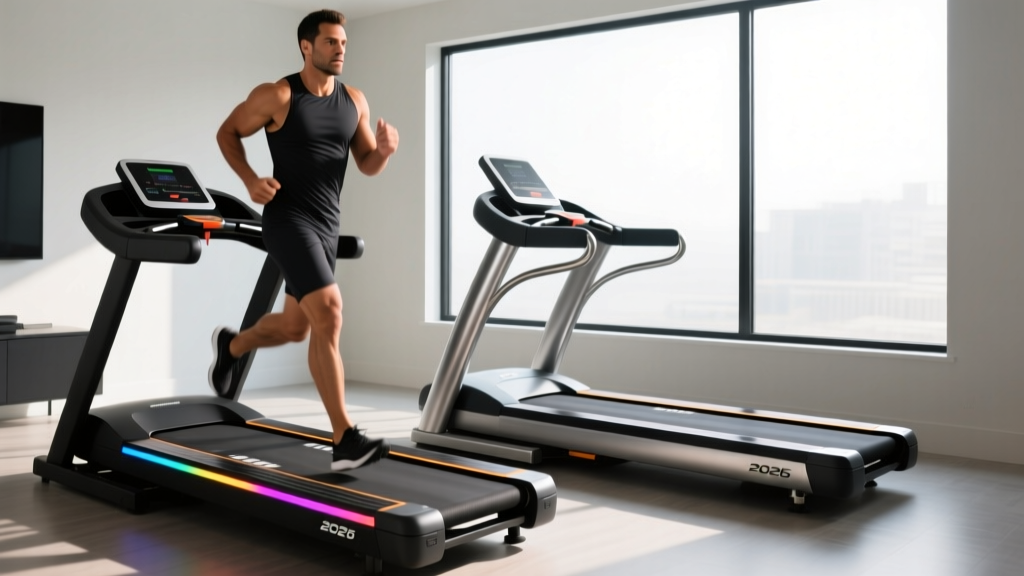
Best "Butt Treadmill" Showdown: Incline vs. Curved Manual (2026)
We compare high-incline motorized treadmills against curved manual models to find the ultimate butt treadmill for glute activation in 2026.

In the modern fitness community, the search for the ultimate 'butt treadmill'—a machine specifically optimized for maximum gluteus maximus and hamstring recruitment—has become a massive trend. Driven by viral 12-3-30 incline workouts and a growing emphasis on posterior chain development, consumers are no longer just looking for a basic cardio machine; they want a targeted glute-building tool. But as we navigate the 2026 fitness equipment market, a major debate has emerged: which style of treadmill actually delivers superior glute activation? Is it the steep, motorized incline trainer, or the self-powered curved manual treadmill?
To settle this, we are putting the two undisputed heavyweights of the category head-to-head: the NordicTrack Commercial X32i (the king of motorized inclines) and the AssaultRunner Elite (the premier curved manual treadmill). This guide goes beyond surface-level marketing, diving deep into biomechanics, real-world failure modes, spatial requirements, and exact pricing to help you make the right investment for your home gym.
The Motorized Incline King: NordicTrack Commercial X32i
When most people search for a 'butt treadmill,' they are thinking of the viral steep-incline walking workouts. The NordicTrack Commercial X32i dominates this space primarily because of its jaw-dropping 40% maximum incline. Priced at $3,999 (plus a mandatory $39/month iFIT subscription for full functionality), the X32i is a massive, luxury-class machine.
Key Specifications & Glute Mechanics
- Motor: 4.0 Continuous Horsepower (CHP) commercial-grade DC motor.
- Belt Size: 22 x 60 inches, providing ample room for long strides at high inclines.
- Incline/Decline: -6% to +40%.
- The Glute Factor: Walking at a 15% to 40% incline drastically alters your biomechanics. The severe upward angle forces the hip into deeper flexion during the swing phase, requiring a much more forceful concentric contraction of the gluteus maximus to extend the hip and propel your center of mass upward against gravity.
The Manual Posterior Powerhouse: AssaultRunner Elite
Curved manual treadmills represent a completely different philosophy. The AssaultRunner Elite (retailing at $3,299) features no motor, no incline dial, and no digital speed governor. Instead, it utilizes a 680-pound weight capacity frame and a vulcanized rubber slat belt that responds entirely to your foot strikes.
Key Specifications & Glute Mechanics
- Drive System: 100% user-powered curved deck.
- Belt Type: Vulcanized rubber slat belt (designed for 150,000+ miles of use).
- Footprint: 63 x 33 inches (significantly shorter than motorized models).
- The Glute Factor: According to kinesiology data cataloged by ExRx.net, the gluteus maximus and hamstrings act synergistically to extend the hip. On a curved treadmill, the user's foot strikes the front upslope of the curve. To pull the heavy slat belt down and backward, the user must actively 'paw' the ground, engaging the hamstrings and glutes far more aggressively than on a flat, motorized belt that simply pulls your foot backward for you.
Head-to-Head Feature Comparison Matrix
| Feature | NordicTrack X32i (Incline) | AssaultRunner Elite (Curved) |
|---|---|---|
| Retail Price (2026) | $3,999 + $39/mo sub | $3,299 (No sub required) |
| Max Incline | 40% | N/A (Fixed Curve) |
| Top Speed | 12 MPH | Unlimited (User-generated) |
| Glute Activation Style | Gravity resistance (Hip extension load) | Belt traction (Active hamstring/glute pull) |
| Weight Capacity | 350 lbs | 680 lbs |
| Deck Footprint | 76.5 x 40 inches | 63 x 33 inches |
| Power Requirement | Dedicated 120V/15A circuit | None (Self-powered) |
The Biomechanics of Glute Activation: What the Science Says
To truly understand which machine earns the title of the best butt treadmill, we have to look at electromyography (EMG) studies regarding muscle activation. Research indexed in PubMed consistently demonstrates that as treadmill incline increases past 15%, the metabolic demand shifts heavily away from the quadriceps and onto the posterior chain. At a 40% incline, the gluteus maximus is working near its maximum voluntary contraction (MVC) just to maintain a walking pace of 2.5 to 3.0 MPH.
However, curved manual treadmills offer a different stimulus. Studies highlighted by the American Council on Exercise (ACE) note that self-powered treadmills require the user to generate the horizontal propulsive force. On a motorized treadmill, the belt pulls your leg back, passively stretching the hip flexors. On a curved treadmill, you must actively pull the belt. This results in significantly higher hamstring and glute activation during the 'stance' and 'push-off' phases of the gait cycle, even at 0% incline.
The Expert Takeaway: If your goal is low-impact, high-tension time-under-tension (like the 12-3-30 workout), the motorized 40% incline wins. If your goal is explosive posterior chain development, sprint mechanics, and athletic conditioning, the curved manual treadmill is superior.
Real-World Edge Cases & Failure Modes
When spending over $3,000 on premium cardio equipment, you must consider the engineering limitations of both designs. Here are the non-obvious failure modes we see in home gyms:
1. The Incline Motor Burnout
Many budget 'incline' treadmills (priced under $1,200) advertise 15% inclines but utilize undersized 2.5 CHP DC motors. When a 200+ pound user walks at a 15% incline for 45 minutes, the motor amperage spikes, generating immense internal heat. Over time, this degrades the motor windings and warps the plastic drive gears. The NordicTrack X32i avoids this with a 4.0 CHP motor and an internal cooling fan, but it requires a dedicated 15-amp circuit. Plugging it into a shared bedroom outlet will trip the breaker mid-workout.
2. Slat Belt Degradation and Tensioning
Curved treadmills use thick vulcanized rubber slats bolted to a metal chain. While practically indestructible to foot strikes, the tensioning mechanism can drift over time if the treadmill is placed on an uneven garage or basement floor. If the AssaultRunner Elite is not leveled using its adjustable foot pads, the slat belt will track slightly to one side, causing a rhythmic 'clicking' noise and premature wear on the side rails.
Spatial Constraints: The Ceiling Height Trap
This is the most overlooked factor when buying a steep incline treadmill. When the NordicTrack X32i elevates to its maximum 40% incline, the front of the deck rises by over 26 inches. If you are 6 feet tall (72 inches), your head will be at roughly 98 inches (8 feet 2 inches) when standing on the elevated deck. If your home gym is in a basement with standard 8-foot ceilings, you will hit your head on the ceiling joists at maximum incline.
CRITICAL WARNING: Before purchasing a 40% incline treadmill, measure your ceiling height. You need a minimum clearance of 10 feet (120 inches) to safely use the X32i at its steepest settings without risking a head injury. The AssaultRunner Elite, having a fixed low-profile curve, only requires a standard 8-foot ceiling plus 6 inches of overhead clearance for arm movement.Final Verdict: Which 'Butt Treadmill' Should You Buy?
The choice between these two posterior-chain powerhouses ultimately comes down to your specific training style, spatial limitations, and budget.
Buy the NordicTrack X32i If:
- You exclusively do LISS (Low-Intensity Steady State) cardio, specifically high-incline walking routines.
- You want interactive, automated programming where the machine adjusts the incline for you.
- You have high ceilings (10+ feet) and a dedicated 15-amp electrical circuit.
- You prefer a traditional, guided workout experience with a massive 30-inch HD touchscreen.
Buy the AssaultRunner Elite If:
- You are an athlete looking to improve sprint mechanics, ground reaction forces, and explosive hip extension.
- You want to do HIIT (High-Intensity Interval Training) without waiting for a motor to spool up or a deck to mechanically elevate.
- You have low basement ceilings (8 feet) or limited floor depth.
- You despise mandatory monthly subscription fees and want a machine that functions perfectly without Wi-Fi.
Both machines are exceptional tools for building the posterior chain. By understanding the biomechanical differences and the real-world spatial requirements outlined above, you can confidently invest in the right equipment to reach your 2026 fitness goals.
More gear to consider
All reviews
Elliptical vs Treadmill: Home Cardio & Doggie Treadmills for Small Dogs

ProForm Pro 4500 Treadmill Setup & Motor Horsepower Guide

Stair Climber vs Beginner Treadmill Workout: Home Guide

Superfit Treadmill E07: Beginner's Guide to Treadmill Motors
Maintaining Stationary Bike Types & Sunny Health and Fitness Treadmill SF-T4400
