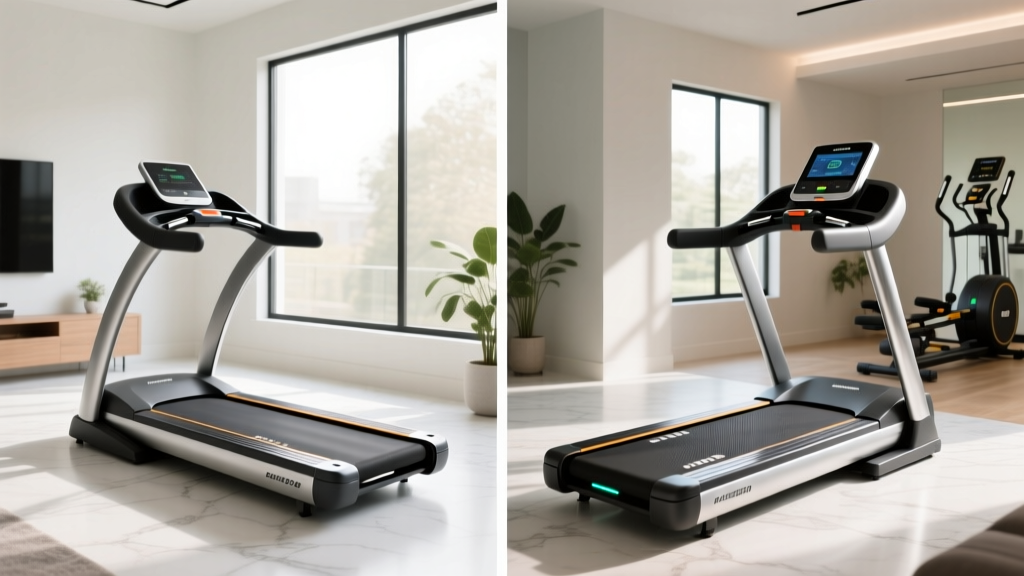
Curved vs Motorized: The Real Cost of a Treadmill (2026)
Discover the true cost of a treadmill in 2026. We compare curved manual vs. motorized models, covering upfront prices, maintenance, and long-term value.

When you begin your home gym journey, the cost of a treadmill is often the first metric you evaluate. However, as we navigate the fitness equipment market in 2026, the sticker price is only a fraction of the financial equation. The debate between curved manual treadmills and traditional motorized treadmills is no longer just about aesthetics or elite athletic training; it is fundamentally a question of long-term financial investment, biomechanical return, and spatial economics.
As a beginner, it is easy to be lured by a $599 motorized treadmill on sale, only to face hidden electrical costs, frequent maintenance, and premature motor failure. Conversely, a curved manual treadmill demands a steep upfront premium but offers a radically different ownership experience. This step-by-step guide will break down the true cost of a treadmill, comparing curved and motorized models across five critical financial and practical dimensions.
💡 Beginner Pro-Tip: Never base your purchasing decision solely on the Manufacturer's Suggested Retail Price (MSRP). The true cost of a treadmill includes electrical draw, replacement parts, deck resurfacing, and even the caloric efficiency of your workout.Step 1: Analyze the Baseline Sticker Price
The most obvious divergence between these two machine types is the initial capital required. In 2026, manufacturing efficiencies have slightly lowered the entry barrier for motorized units, while curved treadmills remain a premium, specialized category.
Motorized Treadmill Pricing Tiers
- Entry-Level ($500 - $899): Models like the Horizon Fitness T101 or ProForm City L6. These feature 2.0 to 2.5 Continuous Horsepower (CHP) motors, narrower 18-inch running belts, and basic LCD consoles. They are designed for walking to light jogging.
Curved Manual Treadmill Pricing Tiers
- Entry-Level / Budget Curved ($1,499 - $2,200): Models like the SB Fitness Equipment CURVE or entry-level AssaultRunner variants. These use basic rubber slat belts and heavier steel frames.
Step 2: Uncover the Hidden Operational Costs
Once the machine is in your home, the financial divergence begins. Motorized treadmills are essentially large appliances, while curved treadmills are purely mechanical devices.
The Electrical Draw
A standard motorized treadmill requires a dedicated 15-amp or 20-amp circuit. During a vigorous run, a 3.0 CHP motor can draw between 600 to 900 watts of continuous power. If you run for 45 minutes a day, five days a week, you are consuming roughly 150 kWh per month. Depending on your local 2026 utility rates, this adds $18 to $35 per month to your energy bill. Over a 5-year period, that is $1,080 to $2,100 in electricity alone.
Curved treadmills are 100% human-powered. The only electricity required is a negligible amount for the optional Bluetooth console or heart-rate telemetry, which runs on standard batteries or a low-voltage USB plug. Operational energy cost: $0.
Maintenance and Failure Modes
According to repair data analyzed by Consumer Reports, motorized treadmills are among the most frequently serviced home fitness appliances. Here is how the maintenance realities compare:
Maintenance Factor Motorized Treadmill Curved Manual Treadmill Belt Lubrication Required every 3 months or 150 miles using 100% silicone. Failure causes motor overheating. Zero lubrication required. The slat belt glides on sealed polyurethane wheels. Deck Wear MDF or phenolic decks warp or groove over time. Replacement costs $150-$300. No solid deck. The curved track is structural steel/aluminum and will outlast the user. Electronic Failures Motor control boards (MCBs) and console screens are prone to power surge damage ($250+ repairs). No MCB or incline motors to fry. Analog magnetic resistance systems are virtually fail-proof. ⚠️ Warning: The Folding Treadmill Trap
Many beginners buy folding motorized treadmills to save space. However, the hinges and hydraulic-assist lifts on sub-$1,000 folding models are notorious failure points. The repeated stress of folding and unfolding often leads to structural warping and broken locking pins within the first two years of ownership.Step 4: Evaluate the 'Biomechanical ROI'
When calculating the cost of a treadmill, you must also calculate the return on investment regarding your physical health and workout efficiency. Biomechanical analyses reviewed by institutions such as the American College of Sports Medicine (ACSM) highlight distinct differences in how these machines interact with the human body.
'Non-motorized curved treadmills demand greater activation of the posterior chain—specifically the glutes and hamstrings—because the user must actively pull the belt backward with each stride. This results in a higher metabolic demand and altered ground reaction forces compared to motorized belts.'
The Caloric and Joint Impact Equation
- Caloric Expenditure: Studies indicate that running on a curved manual treadmill can increase caloric burn by up to 30% at the same perceived rate of exertion compared to a motorized treadmill. If your goal is weight loss, the curved treadmill offers a higher 'time-to-result' ROI.
- Joint Kinematics: The curved geometry naturally encourages a forefoot or midfoot strike, reducing the harsh heel-strike impact associated with motorized treadmills. For beginners with knee or lower back sensitivities, this can mean fewer physical therapy bills and less downtime due to shin splints.
- Pace Control: Motorized treadmills dictate your pace, which is excellent for beginners learning to hold a steady heart rate zone. Curved treadmills require mental fortitude to maintain a steady pace, as any drop in effort immediately slows the belt.
Step 5: Make Your Final Decision
The true cost of a treadmill is a balance of your immediate budget, your long-term maintenance tolerance, and your biomechanical needs. Use this final decision matrix to guide your purchase.
Choose a Motorized Treadmill If:
- You are on a strict upfront budget of under $1,000.
- Your primary exercise is walking, incline hiking, or light jogging (under 6 MPH).
- You rely on interactive programming, automatic incline adjustments, and guided digital classes to stay motivated.
- You are recovering from an injury and need the belt to pull your leg through the range of motion.
Choose a Curved Manual Treadmill If:
- You have a higher upfront budget ($2,500+) but want to eliminate monthly electricity costs and electronic repair risks.
- You are a runner focused on sprint intervals, HIIT, and improving your natural running mechanics.
- You want a machine that will easily last 10 to 15 years with virtually zero mechanical maintenance.
- You live in an area with an ungrounded electrical system or frequent power surges that threaten sensitive electronics.
Ultimately, understanding the total cost of a treadmill empowers you to buy a machine that fits not just your living room, but your financial and fitness future. Whether you choose the automated convenience of a motorized belt or the raw, self-powered efficiency of a curved runner, making an informed choice ensures your investment pays dividends in health for years to come.
More gear to consider
All reviews Equipment
Under Desk Treadmill Review: Preventing a Workspace Treadmill Fail
Cardio Equipment
Stair Climber Setup Guide & Garmin Treadmill Calibration
Cardio Equipment
Rowing Guide: Better Than Treadmill Workout Routines for Weight Loss
Cardio Equipment
How to Take a NordicTrack Treadmill Apart to Fix Loud Noises
Cardio Equipment
40 Incline Treadmill vs Stationary Bikes: Budget Breakdown
Cardio Equipment
Stationary Bike Types & Treadmill Resistance Maintenance Guide
Cardio