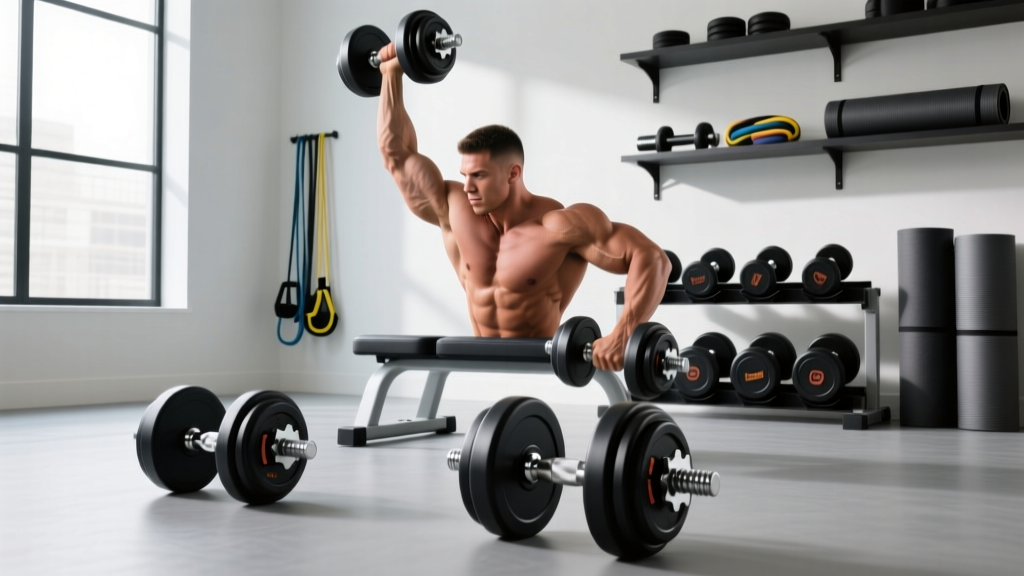
Overhead Shoulder Press Dumbbells vs Barbells: Collar Safety Guide
Troubleshoot your overhead press. Compare barbell collar types and learn why overhead shoulder press dumbbells offer distinct safety advantages.

The Hidden Danger of the Overhead Press: Bar Whip and Plate Shift
Transitioning from overhead shoulder press dumbbells to the barbell overhead press (OHP) is a milestone in any strength athlete's journey. While dumbbells demand immense unilateral stabilization, the barbell allows for absolute maximal loading. However, this transition introduces a critical, often overlooked variable: barbell sleeve dynamics. When you lock out a heavy barbell overhead, the kinetic energy doesn't just disappear. It reverberates through the steel shaft, creating a phenomenon known as 'bar whip.' If your barbell collars lack the necessary clamping force, this whip translates into lateral plate shift, compromising your center of gravity while a loaded bar is suspended directly over your cervical spine.
According to biomechanical analyses of the strict press outlined by Starting Strength, the deceleration phase at the apex of the lift generates significant horizontal shear force along the sleeves. Unlike overhead shoulder press dumbbells, where the mass is isolated in your hands and completely immune to lateral sleeve slippage, a barbell requires mechanical intervention to keep the load unified. This guide serves as your definitive troubleshooting manual for barbell collar and clamp types, ensuring your overhead pressing is as safe as it is strong.
Barbell Collar and Clamp Types Comparison
Not all collars are created equal. The market is flooded with options ranging from $10 spring clips to $95 machined aluminum competition locks. Understanding the mechanical failure points of each type is crucial for overhead pressing.
1. Standard Spring Collars (The Budget Trap)
Spring collars are the ubiquitous, cheap metal clips found in almost every commercial gym. They rely on the tension of bent steel wire to grip the 50mm Olympic sleeve. Troubleshooting Insight: Spring collars typically provide less than 20 lbs of lateral holding force. During a heavy push press or a high-rep strict press, the bar whip will easily overcome this tension. The collar will inch outward, and the plates will follow. Verdict: Never use standard spring collars for heavy overhead barbell work.
2. Polymer Lock-Jaw Clamps (The Gym Standard)
Clamps like the Lock-Jaw Lock-N-Load utilize a rigid polymer housing with an internal steel jaw and a lever-action closure. When snapped shut, they bite aggressively into the steel sleeve. Troubleshooting Insight: These provide roughly 120 lbs of lateral holding force. They are highly effective for strict pressing and general overhead work. However, the polymer housing can become brittle over years of exposure to UV light and extreme temperature fluctuations in a garage gym, leading to catastrophic hinge failure. Inspect the hinge pin annually.
3. Machined Aluminum Lever Collars (The Elite Choice)
High-end collars, such as the Rogue Monster Machined Collars or Eleiko Olympic Collars, are milled from solid aircraft-grade aluminum. They use a cam-lever mechanism that pulls a steel band or internal wedge flush against the sleeve. Troubleshooting Insight: These deliver upwards of 250 lbs of lateral clamping force. They completely eliminate plate rattle and shift, making them the only acceptable choice for elite-level overhead pressing, push jerks, and Olympic movements where bar whip is maximized.
4. Threaded Spinlock Collars (The Specialty Bar Niche)
Spinlock collars are heavy steel or cast-iron nuts that thread onto the grooved sleeves of standard (1-inch) or specialty Olympic bars. Troubleshooting Insight: While they offer absolute mechanical security (the plate cannot move unless the collar is unscrewed), they are incredibly slow to adjust. Furthermore, the threads can strip if cross-threaded under load, rendering the barbell sleeve useless.
Collar Performance Matrix: Overhead Pressing
| Collar Type | Avg. Price (Pair) | Lateral Holding Force | Overhead Safety Rating | Best Application |
|---|---|---|---|---|
| Standard Spring | $10 - $15 | < 20 lbs | 1/5 (Dangerous) | Light bench, floor work |
| Polymer Clamp (e.g., Lock-Jaw) | $25 - $35 | ~ 120 lbs | 4/5 (Very Good) | Strict OHP, Hypertrophy |
| Machined Aluminum Lever | $75 - $95 | 250+ lbs | 5/5 (Elite) | Heavy OHP, Push Jerks |
| Threaded Spinlock | $20 - $40 | Infinite (Mechanical) | 5/5 (Elite) | Standard 1" bars, Loadable dumbbells |
Troubleshooting Common Collar Mistakes During the OHP
Even with the right equipment, user error can lead to dangerous overhead shifts. Here are the most common mistakes lifters make when securing a barbell for the overhead press.
Mistake 1: Failing to Seat the Collar Flush
The most frequent cause of plate shift is leaving a 2mm to 5mm gap between the inner lip of the collar and the outer face of the bumper plate. When you initiate the press, the initial acceleration causes the plate to slam into the collar, creating a micro-impact that can weaken the clamp's grip or slowly walk the collar outward. The Fix: Always manually push the plates tightly together, then slide the collar completely flush against the plate before engaging the locking mechanism.
Mistake 2: Ignoring Sleeve Tolerance Variations
While the Olympic standard dictates a 50mm sleeve diameter, manufacturing tolerances vary. A budget barbell might have a 49.2mm sleeve, while a premium power bar sits at exactly 50mm. If you use a rigid aluminum collar calibrated for 50mm on a 49.2mm sleeve, the cam-lever will close without achieving maximum friction. The Fix: Test your collar's tension on your specific barbell. If the lever closes too easily without resistance, the collar is too wide for the sleeve and will slip overhead.
Mistake 3: Using Collars as a Substitute for Proper Loading
Some lifters attempt to press with unbalanced loads (e.g., a 45lb plate on one side and a 25lb + 10lb on the other) and rely on heavy-duty collars to keep the center of gravity stable. The Fix: Collars prevent lateral movement; they do not fix rotational torque. Always load the barbell symmetrically for overhead pressing to avoid severe rotator cuff strain.
Expert Insight: 'The bar is a spring. When you press heavy weight overhead, the bar bends and snaps back. If your collars are loose, that snap acts like a hammer driving the plates outward.' — Strength Equipment Biomechanics Review, Garage Gym Reviews.
When to Revert to Overhead Shoulder Press Dumbbells
There are specific training scenarios where the mechanical vulnerabilities of barbell collars make overhead shoulder press dumbbells the vastly superior and safer choice.
Safety Callout: High-Fatigue and Drop-Set Protocols
If you are performing overhead drop sets, AMRAP (As Many Reps As Possible) sets to absolute failure, or complex supersets where you must rapidly change loads, the barbell is a liability. The time required to safely unclamp, strip, and re-clamp barbell collars ruins the metabolic stimulus of a drop set. Furthermore, as fatigue sets in, your bar path deviates, increasing erratic bar whip and the risk of collar failure. In these scenarios, overhead shoulder press dumbbells or a dedicated selectorized dumbbell system (like Nuobell or PowerBlock) eliminate the collar variable entirely, allowing you to train to failure with zero risk of lateral plate shift.
Frequently Asked Questions (FAQ)
Do I need collars if I'm only using the barbell for strict pressing?
Yes. Even during a slow, controlled strict press, the lockout phase requires rapid deceleration. This deceleration transfers kinetic energy into the sleeves. Without collars, the plates will rattle and slowly migrate outward over the course of a 5x5 working set, altering your balance and grip mechanics.
Can I use hose clamps as a cheap barbell collar alternative?
While heavy-duty stainless steel hose clamps (specifically the T-bolt variety) can provide immense clamping force on a 50mm sleeve, they are highly discouraged. The sharp metal edges can tear the knurling on your barbell sleeves, and they require a screwdriver or wrench to adjust, making them entirely impractical for a live gym environment.
Why do my polymer clamps slip when I use them on a stainless steel sleeve?
Stainless steel sleeves (common on high-end Olympic weightlifting bars) are significantly smoother and harder than standard chrome or black oxide sleeves. Polymer clamps rely on micro-abrasions to grip the metal. On polished stainless steel, polymer jaws will slide. You must upgrade to machined aluminum collars with steel internal bands to achieve a secure lock on stainless sleeves.
More gear to consider
All reviews
Bumper vs Iron Plates: Trends in Trapezius Muscle Dumbbell Exercises

Power Rack vs Squat Rack: Best for Barbell or Dumbbell Bent Over Rows?

500 Pound Dumbbell Set Guide: Best Adjustable Options (2026)

Cable Flyes vs Dumbbell Flys: Adjustable Dumbbell Guide

How to Use Dumbbells Correctly: Top Neoprene Sets Compared