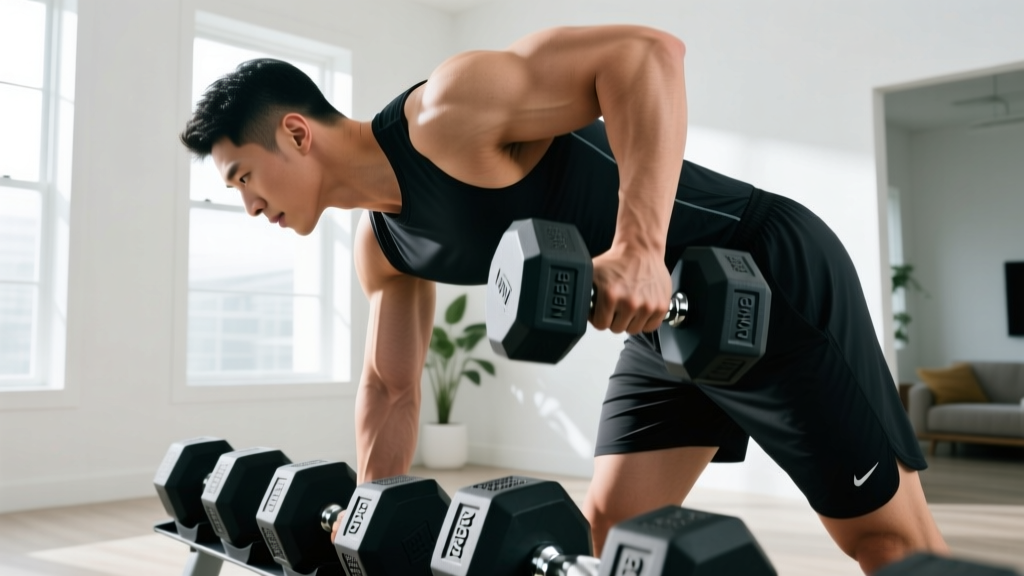
Bumper vs Iron Plates & A Landmine Rotation Alternative with Dumbbells
Optimize your home gym layout. We compare bumper vs iron plates for small spaces and reveal the best landmine rotation alternative with dumbbells.

The Spatial Dilemma: Designing the Compact 2026 Home Gym
As residential real estate footprints shrink and garage conversions become the norm in 2026, spatial efficiency is no longer a luxury—it is the defining constraint of home gym design. When building out a sub-150-square-foot training space, every inch of floor clearance, wall storage, and active swing radius matters. Two of the most common spatial bottlenecks lifters face are the physical storage footprint of weight plates and the massive active clearance required for functional barbell movements.
This guide tackles both challenges through the lens of layout optimization. First, we break down the exact dimensional differences between bumper plates and cast iron plates, revealing how your choice dictates your storage infrastructure. Second, we address the "landmine space tax" and provide a highly effective landmine rotation alternative with dumbbells that preserves your gym's usable floor plan without sacrificing transverse plane power development.
The Storage Footprint: Bumper Plates vs. Cast Iron
The choice between rubber bumper plates and machined iron plates is often framed around noise or drop-safety. However, from a layout design perspective, the critical differentiator is volumetric density. Bumper plates maintain a uniform 17.7-inch diameter regardless of weight, while iron plates scale in both diameter and thickness. This fundamentally changes how you must design your plate storage zones.
| Feature | Rogue Echo Bumper Plates | Rogue Machined Iron Plates | Layout Impact |
|---|---|---|---|
| Diameter | 17.72 inches | 14.5 inches | Iron plates allow for lower wall-mounted racks without hitting the floor. |
| Thickness (Width) | 3.25 inches | 1.3 inches | Iron pairs take up 60% less horizontal sleeve or tree-peg space. |
| 300lb Set Storage | Requires heavy-duty 6-peg vertical tree | Fits on compact 3-peg tree or wall cradle | Iron saves approx. 4-6 sq ft of floor space in the storage zone. |
| Approx. 2026 Cost | ~$3.50 / lb ($525 for 150lb pair) | ~$2.00 / lb ($300 for 150lb pair) | Iron frees up budget for space-saving adjustable dumbbells. |
According to equipment testing by Garage Gym Labs, storing a standard 300lb set of bumper plates requires a vertical plate tree with a wide, reinforced base to prevent tipping due to the extended center of gravity. In a tight layout, this tree becomes a tripping hazard. Conversely, a 300lb set of iron plates can be stored flush against the wall on a horizontal plate cradle, keeping your primary walkways completely clear.
The "Drop Zone" Layout Constraint
If your programming requires dropping weights from overhead (e.g., Olympic lifts), bumper plates are mandatory. However, this forces you to dedicate a permanent 4x8 foot "drop zone" lined with 3/4-inch vulcanized rubber horse stall mats. If you train in a multi-use space where you must park a car or store equipment, iron plates paired with a strict "no-drop" policy and controlled eccentric lowering allow you to use thinner, interlocking rubber tiles that can be rolled up or walked on without damaging the subfloor.
The Landmine Space Tax in Compact Gyms
The landmine attachment is a staple for rotational power, core stability, and unilateral pressing. But spatially, it is a nightmare for small gyms. A standard landmine setup requires:
- The Equipment: A 7-foot Olympic barbell (86 inches) sleeved into a floor-mounted or rack-mounted pivot base.
- The Swing Radius: To perform rotational sweeps or landmine twists, the lifter needs a semi-circular clearance zone of at least 5 feet from the pivot point.
- Total Active Footprint: Over 35 square feet of dedicated, unobstructed floor space.
In a 10x10 garage gym, dedicating 35 square feet to a single movement pattern severely limits layout flexibility. Furthermore, leaving a barbell permanently anchored in a landmine base creates a massive tripping hazard and blocks access to adjacent squat racks or dumbbell shelves.
The Ultimate Landmine Rotation Alternative with Dumbbells
To replicate the biomechanical benefits of the landmine rotation without the spatial tax, we must target the transverse plane while mimicking the landmine's unique resistance vector. A landmine provides a diagonal resistance vector (up and away from the pivot). Standard dumbbell rotations only provide a vertical gravity vector.
To bridge this gap, we use the Banded Dumbbell Rotational Scoop. This movement requires only a single adjustable dumbbell and a resistance band anchored to the bottom of your power rack or a heavy kettlebell, reducing the active footprint to a mere 4x4 foot square.
Biomechanical Insight: Why This Works
Rotational power is generated from the ground up, transferring through the hips and torso. As noted by ACE Fitness, rotational exercises require the core to resist and produce torque simultaneously. By combining a dumbbell (vertical load) with a low-anchored band (horizontal load), you recreate the exact diagonal lever-arm tension of a landmine barbell, forcing the obliques and serratus anterior to work through the full range of motion.
Execution: The Banded Dumbbell Rotational Scoop
- The Setup: Anchor a heavy resistance band (e.g., 1/2 inch loop band) to the base of your squat rack. Hold a single adjustable dumbbell (35-50 lbs) in your outside hand, and grab the band with your inside hand.
- The Stance: Stand perpendicular to the anchor point, feet shoulder-width apart, knees slightly bent. Start with the dumbbell near your outside hip.
- The Drive: Initiate the movement by aggressively pivoting your back foot and driving your hips forward. Use your core to "scoop" the dumbbell up and across your body in a diagonal arc, mimicking the path of a landmine sweep.
- The Lockout: Finish with the dumbbell at eye level on the opposite side of your body, fully extending the arms and rotating the torso. Slowly reverse the path back to the hip.
- Programming: 3 sets of 8-10 reps per side. Focus on hip-driven torque, not just arm movement.
Space-Saving Dumbbell Recommendations for 2026
To execute this alternative effectively, you need dumbbells that offer incremental weight jumps without requiring a 15-pair wall rack.
- Nuobell 80lb Adjustable Dumbbells (~$429/pair): Their traditional handle design and knurling are superior for rotational flows where grip security and wrist alignment are critical. The compact cradle footprint takes up less than 2 square feet.
- PowerBlock Elite EXP (~$399/pair): The rectangular cage design prevents the dumbbell from rolling away when placed on the floor during complex transitions, a crucial safety feature in tight spaces where a rolling dumbbell could damage drywall or trip a user.
Decision Matrix: Optimizing Your Floorplan
Use this quick framework to finalize your free weight layout based on your available square footage:
| Gym Size | Plate Recommendation | Storage Layout | Rotational Training Tool |
|---|---|---|---|
| Under 100 Sq Ft | Cast Iron Plates | Horizontal Wall Cradle (keeps floor clear) | Banded Dumbbell Scoop (Adjustable DBs) |
| 100 - 150 Sq Ft | Hybrid (Iron for heavy, Bumpers for light) | Vertical 4-Peg Tree in dead corner space | Dumbbell Halos & Landmine (if rack mounted) |
| 150+ Sq Ft | Full Bumper Plate Set | Vertical 6-Peg Tree near drop zone | Dedicated Floor Landmine Base |
Final Layout Takeaways
Designing a highly functional home gym in 2026 requires ruthless prioritization of space. By opting for machined iron plates, you reclaim critical floor space and simplify your storage infrastructure, allowing for safer, more open training lanes. Furthermore, by recognizing the spatial inefficiencies of permanent landmine setups and adopting a landmine rotation alternative with dumbbells, you maintain elite-level rotational power development without sacrificing the usable footprint of your gym. Train smart, optimize your layout, and let the physics of your equipment work in harmony with your architecture.
More gear to consider
All reviews
Olympic vs Standard Plates: Home Gym & HIIT Workout with Dumbbells

Kettlebell Care: Cast Iron vs Competition & Dumbbell Good Mornings
2026 Budget Breakdown: Bumper vs Iron Plates & Dumbbell Lat Raises
Optimize Your Dumbbell Schedule Workout: 2026 Rack & Storage Trends

Rack Storage and Longevity Care for a 5 100 Pound Dumbbell Set