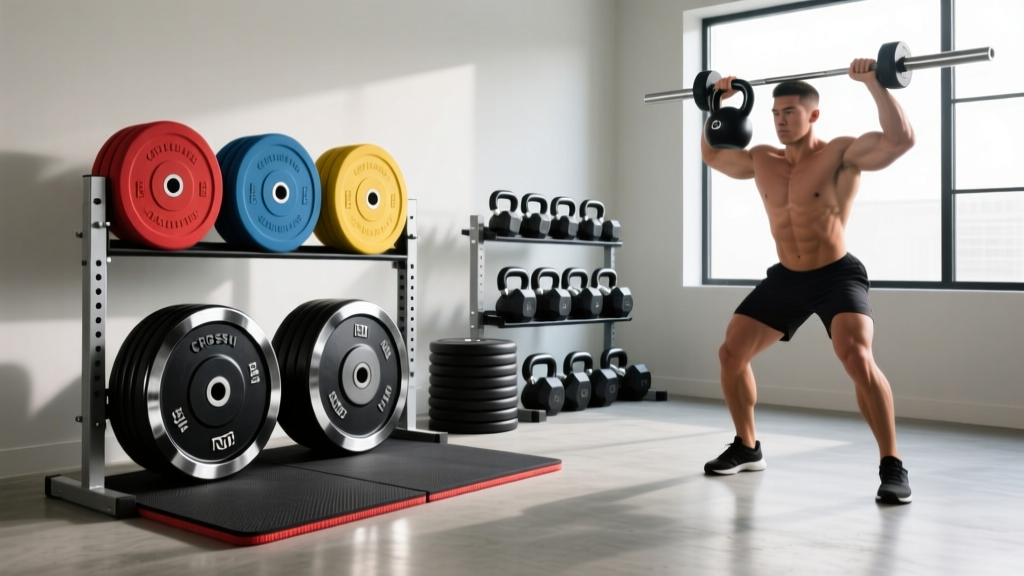
Bumper vs Iron Plates: Layouts & CrossFit Exercises with Dumbbells
Optimize your garage gym layout with our bumper vs iron plate comparison. Plus, discover space-saving storage and top CrossFit exercises with dumbbells.

As urban density increases and residential square footage shrinks in 2026, the modern home gym is no longer a sprawling warehouse setup. It is a highly engineered, multi-modal micro-facility. When you are building a functional fitness space in a standard two-car garage (roughly 400 square feet, minus the space for your vehicle and water heater), every single inch of floor and vertical clearance matters. The foundational decision that dictates your entire floor plan comes down to your weight plates: the classic bumper plate vs iron plate debate. This choice doesn't just affect your wallet; it fundamentally alters your storage footprint, your flooring requirements, and your programming options.
In this comprehensive layout guide, we will dissect the spatial geometry of bumper versus iron plates, reveal a zero-footprint storage hack for iron, and explore how to maximize your remaining floor space using highly efficient crossfit exercises with dumbbells.
The Spatial Reality: Bumper Plates vs. Iron Plates
To optimize a small gym, you must first understand the physical dimensions of your equipment. While both plate types share a standardized 17.7-inch outer diameter (to meet International Weightlifting Federation specs for barbell clearance), their thickness and material density create drastically different spatial footprints on the barbell sleeve and in your storage racks.
Quick Spec Snapshot: 45lb Plates
Rogue Echo Bumpers: 3.46 inches thick | ~$415 per 230lb set
Rogue Machined Iron: 1.37 inches thick | ~$235 per 230lb set
Source: Rogue Fitness Echo Bumper specifications
When you load a barbell for a heavy deadlift or a high-volume CrossFit WOD, sleeve space is premium real estate. A standard Olympic barbell sleeve is 16.3 inches long. If you load four 45lb bumper plates per side, you are consuming roughly 14 inches of sleeve space, leaving barely enough room for a spring collar. Conversely, four 45lb machined iron plates consume only about 5.5 inches of sleeve space, allowing you to load well over 500 lbs on a standard bar while maintaining safe collar clearance.
| Feature | Virgin Rubber Bumpers | Cast Iron Plates | Layout & Space Impact |
|---|---|---|---|
| Sleeve Footprint (per 45lb plate) | ~3.5 inches | ~1.4 inches | Iron allows heavier loads on standard bars |
| Drop Safety | High (Absorbs impact) | Zero (Will crack concrete) | Bumpers require a dedicated 4x8ft drop zone |
| Storage Rack Compatibility | Floor Trees / A-Frames | Wall-Mounts / Trees | Iron enables zero-floor-space wall storage |
| Noise & Vibration | Low (Dead bounce) | High (Loud clatter) | Iron is problematic for attached/shared garages |
For a deeper dive into the material longevity and manufacturing differences between these two plate types, Garage Gym Reviews' comprehensive plate breakdown highlights how urethane-coated irons and virgin rubber bumpers age differently in unclimate-controlled environments.
Storage Footprints: The Wall-Mount Advantage
The most critical space optimization strategy in a small gym is eliminating floor-standing storage. A standard vertical plate tree (like the Rogue A-Frame) requires a 29" x 29" footprint. While that is only about 6 square feet, it creates a "dead zone" where you cannot stand, swing a kettlebell, or perform lateral movements.
The Iron Plate Zero-Footprint Hack
Because iron plates are incredibly dense and relatively thin (typically under 1.5 inches for a 45lb plate), they can be safely stored on heavy-duty wall-mounted peg racks. A rack like the Titan Fitness Wall Mount Plate Rack protrudes only 6.5 inches from the wall and holds up to 500 lbs. By mounting your iron plates on a structural stud wall, you reclaim 100% of your floor space. Bumper plates, due to their 3.5-inch thickness and wider center hubs, are generally incompatible with standard wall pegs and will permanently consume floor space on a tree or A-frame.
The "Drop Zone" Flooring Penalty
If your programming includes Olympic weightlifting (snatches, clean and jerks) or high-rep barbell cycling, you must use bumper plates. However, this mandates a dedicated "drop zone." You will need to lay down a 4x8-foot platform of 3/4-inch horse stall mats over plywood. In a 200-square-foot usable gym space, a 32-square-foot drop zone consumes 16% of your total facility. If you strictly do powerlifting, bodybuilding, or metabolic conditioning, switching to iron plates eliminates the need for a massive drop platform, allowing you to use thinner, interlocking rubber tiles that cover the entire floor uniformly.
Reclaiming the Micro-Zone: CrossFit Exercises with Dumbbells
When you eliminate the 4x8-foot barbell drop zone to save space, you still need a way to achieve high-intensity, functional metabolic conditioning. This is where crossfit exercises with dumbbells become the ultimate spatial hack. Dumbbells allow you to perform unilateral and bilateral movements in a confined "micro-zone" (typically just a 3x5-foot area, the size of a standard yoga mat).
To maximize this, invest in space-saving adjustable dumbbells (such as the Nuobell 80lb adjustable sets, which measure just 15.5 inches in length and replace 15 pairs of fixed hex dumbbells) or a compact vertical hex dumbbell rack.
Top Space-Efficient Dumbbell Movements
- Dumbbell Snatches: Unlike barbell snatches, which require a 4x8-foot clearance to account for the 7-foot barbell swinging forward or backward, DB snatches are strictly vertical. You can perform high-rep alternating snatches in a 2x4-foot lane without risking drywall damage.
- Dumbbell Thrusters: Many garage gyms suffer from low 8-foot ceilings, making barbell overhead squats or thrusters dangerous. Dumbbell thrusters allow for a slightly wider, more natural overhead lockout that easily clears low ceilings while delivering the same cardiovascular stimulus.
- Dumbbell Devil Presses: A staple in the CrossFit Open, the devil press combines a burpee with a double dumbbell snatch. Because the dumbbells stay planted on the floor during the burpee phase, your entire spatial footprint remains confined to a single 2x6-foot mat.
- Single-Arm Dumbbell Rows & Renegade Rows: These eliminate the need for a bulky adjustable bench. You can use your plyo box or even your wall-mounted plate rack as a bracing surface, keeping the center of the gym entirely open.
Expert Layout Tip: According to ACE Fitness guidelines on home gym safety, you should always maintain a minimum 36-inch clearance around any moving equipment or lifting zone to prevent tripping hazards. By utilizing dumbbells for metabolic conditioning instead of wide-swinging kettlebells or barbells, you can safely reduce your primary workout zone from a 6x8-foot rectangle down to a 4x4-foot square, easily maintaining that 36-inch safety buffer.
The 200-Square-Foot Blueprint: Putting It Together
How do we synthesize the bumper vs iron plate debate with dumbbell conditioning into a cohesive, space-optimized layout? Here is a proven blueprint for a 20x20-foot (400 sq ft) garage where one bay must remain open for a vehicle, leaving a 10x20-foot (200 sq ft) workout strip.
- The Perimeter (Wall Space): Install a wall-mounted rig (like the Rogue RML-390F fold-back rack, which protrudes only 4 inches when folded) on the back wall. Mount your iron plate peg rack directly adjacent to it. This keeps 100% of the floor clear.
- The Barbell Zone (Corner): If you must include bumper plates for occasional Olympic lifting, store them on a compact vertical post attached to the rig itself, rather than a freestanding tree. Lay down a single 4x6-foot rubber mat in the corner for your drop zone.
- The Conditioning Zone (Center): Keep the center of the 10x20 strip completely empty. Store your adjustable dumbbells on a small, 2-tier floor stand tucked under the fold-back rig. When it is time for crossfit exercises with dumbbells, pull the DBs into the center of the room. You now have a 10x15-foot open turf or rubber-matted area for high-heart-rate WODs.
Final Verdict on Equipment Density
The choice between bumper and iron plates is not merely about aesthetics or lifting style; it is a strict geometric equation. If your programming demands dropping weight from overhead, bumpers are non-negotiable, but you must accept the spatial penalty of floor trees and thick drop platforms. If your goal is raw strength, hypertrophy, and high-intensity metabolic conditioning, machined iron plates paired with wall-mount storage and a robust set of adjustable dumbbells will yield the highest equipment-to-square-foot ratio possible. By understanding the exact dimensions and failure modes of your gear, you can engineer a 2026 garage gym that feels twice as large as its physical footprint.
More gear to consider
All reviews
From Seated Dumbbell Hammer Curls to Deadlifts: Bumper vs Iron Plates

EZ Curl vs Straight Bar: Bowflex SelectTech 560 Dumbbells Value

Spotting Dumbbell Bench Press: Best Adjustable Dumbbells Compared

Barbell Collar Types & Incline Dumbbell Press Weight Setup
Rubber Hex vs Urethane: Good Dumbbell Workouts at Home Gear Trends
