Bumper vs Iron Plates: Space Layouts & 10 lb Dumbbell Workout Zones
Compare bumper vs iron plates for space optimization. Learn layout strategies for plate storage and integrating a 10 lb dumbbell workout zone.

The Spatial Footprint: Bumper Plates vs. Cast Iron
Designing a high-functioning home gym in 2026 requires more than just buying equipment; it demands a meticulous approach to spatial geometry. The foundational decision that dictates your floor plan, storage requirements, and traffic flow is the choice between bumper plates and traditional cast iron plates. While both serve the purpose of loading a barbell, their physical dimensions drastically alter how you optimize your layout.
Bumper plates, engineered for Olympic lifting and high-impact drops, maintain a uniform diameter regardless of weight. According to Rogue Fitness specifications, a standard 45 lb Echo Bumper measures exactly 450mm (17.72 inches) in diameter. Conversely, cast iron plates scale in both weight and physical size. A 45 lb iron plate typically spans about 368mm (14.5 inches), while a 10 lb iron plate shrinks to roughly 228mm (9 inches). This variance in diameter and thickness directly impacts your storage footprint and the spatial boundaries of your lifting zones.
| Feature | Standard 45lb Bumper Plate | Standard 45lb Cast Iron Plate | Spatial Impact |
|---|---|---|---|
| Diameter | 450mm (17.72') | ~368mm (14.5') | Bumpers require wider vertical storage pegs and broader floor clearance. |
| Thickness | ~3.25 inches | ~1.3 inches | Iron plates allow for high-density wall mounting; bumpers require deep A-frames. |
| Drop Tolerance | High (Deadlifts, Cleans) | Low (Controlled eccentrics only) | Bumpers require 3/4' vulcanized rubber matting; iron requires a dedicated platform or strict control. |
Storage Layouts: Maximizing Vertical and Wall Space
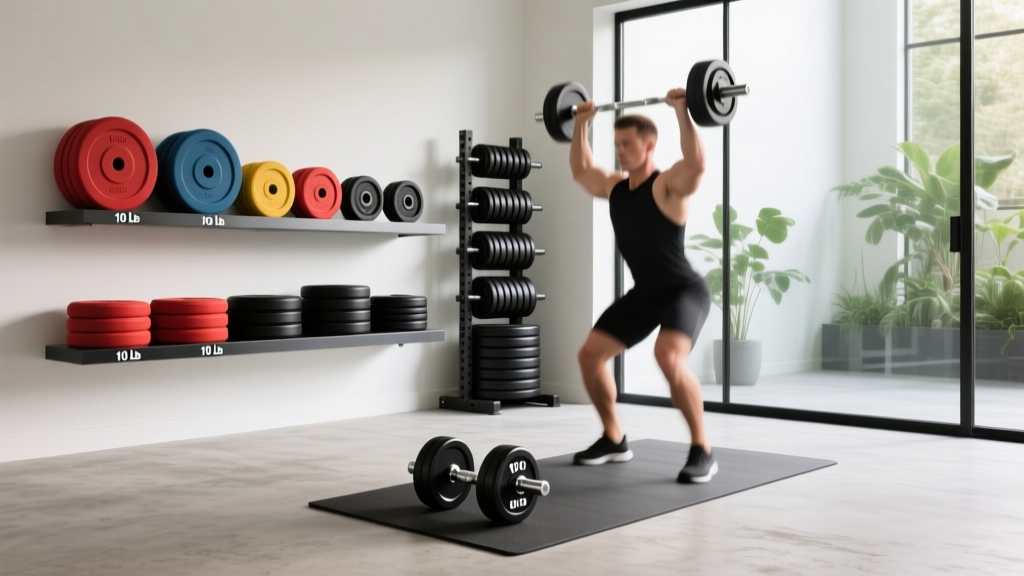
When optimizing a compact garage or basement gym, floor space is your most valuable asset. The thickness of your plates dictates your storage strategy. Because cast iron plates are remarkably thin, they are the undisputed champions of wall-mounted storage. A heavy-duty wall plate holder (like those offered in Rogue's weight storage lineup) protrudes merely 6 to 8 inches from the wall, holding hundreds of pounds while leaving the floor completely clear for movement.
Bumper plates, however, present a spatial challenge. Their 3+ inch thickness means a standard wall-mounted peg will only hold two or three plates before the stack becomes unstable or bows under the leverage. Therefore, bumper plates usually necessitate floor-standing A-frame racks or vertical weight trees. A standard vertical tree occupies a 2.5 square foot footprint but requires a 360-degree clearance radius for safe loading and unloading, effectively consuming 9 to 12 square feet of usable gym space.
Layout Pro-Tip: If your gym is narrower than 12 feet wide, prioritize cast iron or urethane plates paired with wall-mounted storage. This reclaims the floor perimeter, preventing the 'clutter choke' that makes navigating around a squat rack feel hazardous.
Drop Zones, Flooring, and Spatial Boundaries
Your plate choice defines your 'drop zone'—the area where heavy loads meet the floor. Bumper plates allow for dynamic, uncontrolled eccentrics (like dropping a deadlift from the lockout). This means your spatial layout must account for impact dispersion. You will need to cover the primary lifting area with 3/4-inch vulcanized rubber horse stall mats, extending at least 4 feet outward from the barbell's center line to catch glancing bounces.
Iron plates, conversely, demand controlled lowering. Because you cannot drop them without risking catastrophic damage to your concrete slab or the plates themselves, the spatial boundary of your lifting zone is defined by your body's biomechanics rather than impact radius. However, this means you cannot position your squat rack or deadlift platform directly adjacent to fragile walls or mirrored surfaces, as a failed rep with iron plates could result in the barbell tipping and shattering the glass.
Carving Out the Accessory Zone: The 10 lb Dumbbell Workout
A common mistake in home gym layout design is dedicating 100% of the floor plan to heavy barbell movements while ignoring the spatial requirements for accessory, rehab, and mobility work. A well-rounded routine heavily features a 10 lb dumbbell workout targeting the rotator cuff, lateral deltoids, and spinal stabilizers. Exercises like dumbbell halos, high-rep lateral raises, and overhead tricep extensions require specific spatial clearances that are frequently overlooked until you scrape your knuckles against the drywall.
The Biomechanical Clearance Rule
When mapping out your accessory zone for a 10 lb dumbbell workout, you must calculate the 'wingspan clearance'. An average adult male performing a strict lateral raise with a 10 lb dumbbell requires a minimum lateral wingspan of 6.5 feet. If your squat rack or plate tree is positioned just 2 feet from the wall, you have no room to execute these movements safely.
- Vertical Clearance: Minimum 8 feet for overhead halos and tricep extensions.
- Lateral Clearance: Minimum 3.5 feet from any wall, mirror, or rig upright per side.
- Flooring: Standard interlocking EVA foam tiles are sufficient here; heavy rubber matting is unnecessary for 10 lb loads.
Integrating this zone means pushing your heavy plate storage to the rear corners of the room, leaving the center and at least one long wall completely open. This open perimeter serves as your dedicated accessory corridor, allowing you to transition seamlessly from heavy barbell squats to your 10 lb dumbbell mobility circuit without having to step over weight trees or navigate around loaded barbells.
Cost vs. Space ROI in 2026
As we evaluate the home gym market in 2026, the financial and spatial ROI of your plate selection is clearer than ever. According to comprehensive testing by Garage Gym Reviews, bumper plates remain a premium investment, typically costing between $3.00 and $4.50 per pound for high-quality virgin rubber or urethane models. Cast iron, especially on the secondary market, remains the budget king, often averaging $1.00 to $1.50 per pound.
However, the 'Space ROI' must factor into your budget. If you opt for cheap, bulky cast iron plates but lack the wall space to mount them, you will be forced to buy a $250+ weight tree, negating your initial savings. Conversely, if you invest in premium, thin-profile urethane iron plates, you can mount them flush to the wall, eliminating the need for a weight tree entirely and freeing up 10 square feet of floor space—a massive ROI for a cramped 200-square-foot garage gym.
Decision Matrix: Which Plate Fits Your Floorplan?
Use this step-by-step framework to finalize your layout and equipment choices based on your specific spatial constraints:
- Assess Your Ceiling Height and Drop Needs: If you are in a low-ceiling basement (under 8 feet) and cannot perform Olympic lifts, skip the bumpers. The uniform 450mm diameter of light bumper plates (like 10lb or 15lb bumpers) makes them prone to 'tacoing' (bending and breaking) if dropped alone. Choose iron.
- Measure Your Wall Studs: If you have solid wood studs and at least one clear 4-foot wall span, invest in cast iron or urethane plates and wall-mounted storage. This is the ultimate space-saving hack.
- Map the Accessory Corridor: Before buying a weight tree, tape out a 6x6 foot square on the floor near your mirrors. This is your dedicated zone for the 10 lb dumbbell workout and mobility flows. If a proposed A-frame plate rack encroaches on this tape line, reject the rack and opt for wall storage or under-bench plate cradles.
- Finalize the Flooring Boundary: If you choose bumpers, your rubber matting must extend to the edges of your drop zone. If you choose iron, you can confine the heavy matting strictly to the footprint of your squat rack and deadlift platform, saving money and reducing the trip-hazard transition between mat and concrete.
Ultimately, optimizing your free weight layout is an exercise in compromise. By understanding the exact millimeter differences between bumper and iron plates, and respecting the spatial boundaries required for essential accessory movements, you can engineer a home gym in 2026 that feels twice as large as its actual square footage.
More gear to consider
All reviews
Dumbbell Squat Clean Mistakes & 2026 Adjustable Dumbbell Guide

Bumper vs Iron Plates & Best Middle Back Workout Dumbbells
EZ Curl vs Straight Bar: Space Design & Dumbbell Shaped Water Bottle
Mastering Glute Bridges With Dumbbells: Best Loadable Picks 2026

Glutes Workout With Dumbbells Limits: Olympic Barbell Knurl & Weight