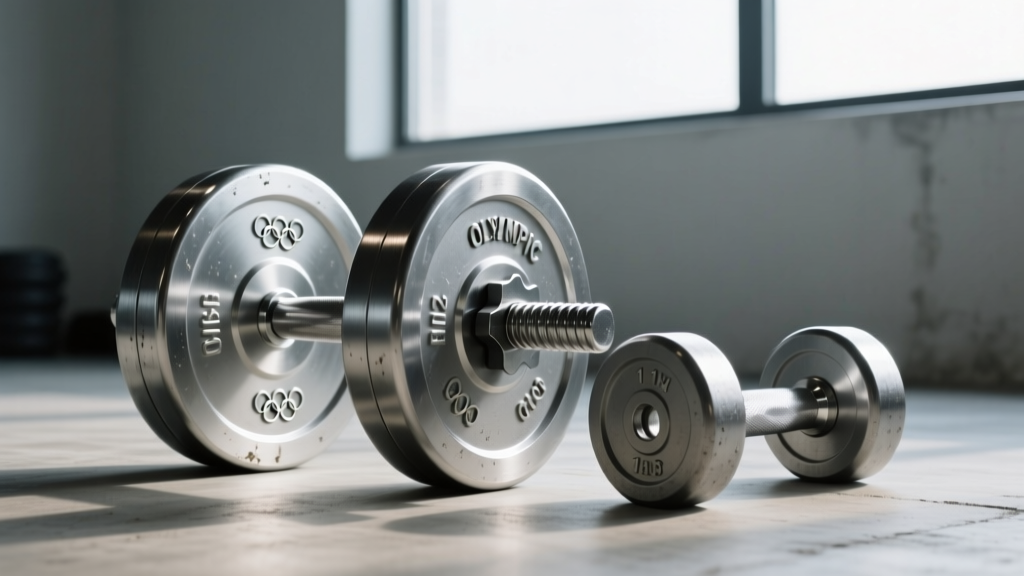
Bumper vs Iron Plate Value and the Standing Dumbbell Shoulder Press
Compare bumper plate vs iron plate costs. Learn how saving on cast iron funds adjustable dumbbells for the standing dumbbell shoulder press.

The $1,000 Home Gym Dilemma: Where Should Your Capital Go?
When outfitting a home gym, lifters are immediately confronted with a brutal budgetary bottleneck: the weight plates. A standard 250-pound plate package can cost anywhere from $250 to over $800 depending on the material. For years, the fitness industry has pushed the narrative that bumper plates are a mandatory upgrade for any serious garage gym. But from a strict value analysis and budget breakdown perspective, is that actually true?
In 2026, the smartest home gym builders are looking at opportunity cost. Every dollar spent on premium virgin rubber bumpers is a dollar stripped from your dumbbell arsenal. By choosing high-quality cast iron plates over bumpers, you can unlock the capital required to purchase premium adjustable dumbbells. This pivot fundamentally changes your training capabilities, specifically allowing you to properly execute and progress the standing dumbbell shoulder press—a movement that offers superior biomechanical benefits for hypertrophy and joint health compared to the barbell overhead press.
Below, we break down the exact math, material failure modes, and the strategic budget allocation framework to help you decide between bumper plate vs iron plate investments.
Cost-Per-Pound Analysis: 2026 Market Pricing
To understand the value proposition, we must look beyond the sticker price and analyze the cost-per-pound, shipping realities, and density. Bumper plates are incredibly bulky, often triggering freight shipping fees or oversized UPS charges, whereas cast iron is dense and cheaper to ship per unit of weight.
| Plate Type | Example Model | Avg. Cost Per Pound | 250lb Set Price | Shipping / Hidden Costs |
|---|---|---|---|---|
| Premium Virgin Bumper | Rogue Echo Bumper | $3.15 - $3.40 | $790 - $850 | Often free over $500, but bulky storage required. |
| Crumb Rubber Bumper | REP Fitness Crumb | $2.10 - $2.30 | $525 - $575 | Heavy dead-bounce; high odor off-gassing. |
| Premium Cast Iron | Rogue Deep Dish / Machined | $1.80 - $2.20 | $450 - $550 | Standard freight; requires rust maintenance. |
| Economy Cast Iron | Amazon Basics / CAP Barbell | $1.10 - $1.40 | $275 - $350 | High variance in center hole diameter (calibration issues). |
As highlighted in BarBend's comprehensive plate breakdown, the price gap between premium bumpers and reliable cast iron is roughly $350 to $400 for a standard 250lb set. In a vacuum, spending less seems like an easy win. But the true value of that $400 delta is realized when we reallocate it to unilateral free weight movements.
The Opportunity Cost: Funding the Standing Dumbbell Shoulder Press
If you opt for the economy or premium cast iron route, you instantly free up $350+ in your equipment budget. This is the exact price point of a top-tier adjustable dumbbell set, such as the Nuobell 80lb pair ($349) or the PowerBlock Elite USA ($389). According to extensive testing by Garage Gym Reviews' adjustable dumbbell guides, these models offer commercial-grade durability and rapid weight changes.
Why is this reallocation critical? Because the barbell overhead press, while excellent for raw strength, locks your wrists and shoulders into a fixed, bilateral path. The standing dumbbell shoulder press allows for independent joint tracking, unilateral core stabilization, and movement within the scapular plane. As noted in BarBend's guide to the standing dumbbell shoulder press, utilizing dumbbells reduces the risk of shoulder impingement and corrects left-to-right strength imbalances that a barbell simply masks.
Biomechanics & Budget Synergy
The Iron + Dumbbell Combo: By spending $400 on cast iron plates for your heavy squats and deadlifts, and $350 on adjustable dumbbells, you gain the ability to perform the standing dumbbell shoulder press with up to 80lbs per hand. This provides a vastly superior hypertrophic stimulus for the anterior and medial deltoids compared to being forced to use a barbell exclusively because you blew your entire budget on bumper plates.
Material Science, Failure Modes, and Hidden Costs
To make a mathematically sound decision, you must account for how these plates fail over a 5-to-10-year lifecycle. Bumper plates and iron plates degrade in entirely different ways.
- Bumper Plate Failure Modes: Cheap bumpers suffer from 'dead bounce' degradation, where the rubber hardens and eventually cracks around the steel hub insert. Furthermore, low-durometer (Shore A scale below 85) bumpers will warp if stored vertically on a tree for long periods, causing them to wobble on the barbell sleeve.
- Cast Iron Failure Modes: Iron does not warp, crack, or degrade from UV exposure. Its primary failure mode is cosmetic and environmental: oxidation (rust). However, a $20 can of Rust-Oleum and a wire brush every three years completely mitigates this issue.
- The Flooring Tax: Bumper plates are designed to be dropped. If you buy cast iron, you must factor in the cost of proper flooring. A 4x6 foot, 3/4-inch thick horse stall mat costs roughly $50-$60. You will need at least two ($120 total) to create a safe drop zone for iron plates, slightly eating into your dumbbell budget.
The Budget Allocation Decision Matrix
Use this step-by-step framework to determine which plate type yields the highest ROI for your specific training goals in 2026.
- Audit Your Lift Repertoire: Do you perform Olympic weightlifting (snatches, clean and jerks) where dropping the bar from overhead is mandatory? If yes, bumpers are a non-negotiable safety requirement. If your overhead pressing consists primarily of strict presses, push presses, and the standing dumbbell shoulder press, cast iron is perfectly adequate.
- Calculate the Delta: Price out a 250lb set of REP Fitness Cast Iron plates versus Rogue Echo Bumpers. Note the exact dollar difference (usually ~$350).
- Reinvest in Unilateral Tools: Take that $350 delta and purchase a high-quality adjustable dumbbell set. This immediately unlocks the standing dumbbell shoulder press, lateral raises, and unilateral goblet squats.
- Protect the Asset: Allocate $100 of your remaining budget to high-density EVA foam or rubber stall mats to dampen the acoustic shock and protect your concrete slab from cast iron impacts.
Frequently Asked Questions
Can I drop cast iron plates on rubber mats during deadlifts?
Yes, but with strict limitations. Dropping iron plates from the hip (deadlift lockout) onto 3/4-inch vulcanized rubber stall mats is generally safe for the plates and your floor. However, dropping them from shoulder height or overhead will shatter the iron, damage the barbell sleeves, and crack concrete. For high-rep touch-and-go deadlifts, iron is fine; for explosive drops, you need bumpers.
Are crumb rubber bumpers a good budget alternative to virgin rubber?
Crumb rubber bumpers (made from recycled tires) bridge the gap between iron and premium bumpers, usually costing around $2.20/lb. However, they are significantly thicker than virgin rubber, meaning you can fit less weight on the barbell sleeve. They also produce a massive amount of 'dead bounce' which can be dangerous during cleans, and they off-gas a strong tire odor that can take months to dissipate in an enclosed garage gym.
Why is the standing dumbbell shoulder press better for joint longevity?
When using a barbell, your hands are fixed, forcing the humerus to track in a single, rigid plane that can impinge the rotator cuff at the top of the movement. The standing dumbbell shoulder press allows you to press slightly forward in the scapular plane (about 30 degrees anterior to the frontal plane). This natural arc reduces stress on the AC joint and rotator cuff, making it a vastly superior choice for lifters over 30 or those with a history of shoulder impingement.
More gear to consider
All reviews
EZ Curl Bar vs Straight Bar & PowerBlock Dumbbells Space Guide
Hamstring Curls with Dumbbells: Beginner Neoprene Guide

Cast Iron vs Competition Kettlebells & 60lbs Dumbbell Space Layouts
Single Leg Romanian Deadlift One Dumbbell: Adjustable Comparison

1 Dumbbell Workout Guide: Rubber Hex vs Urethane Dumbbells