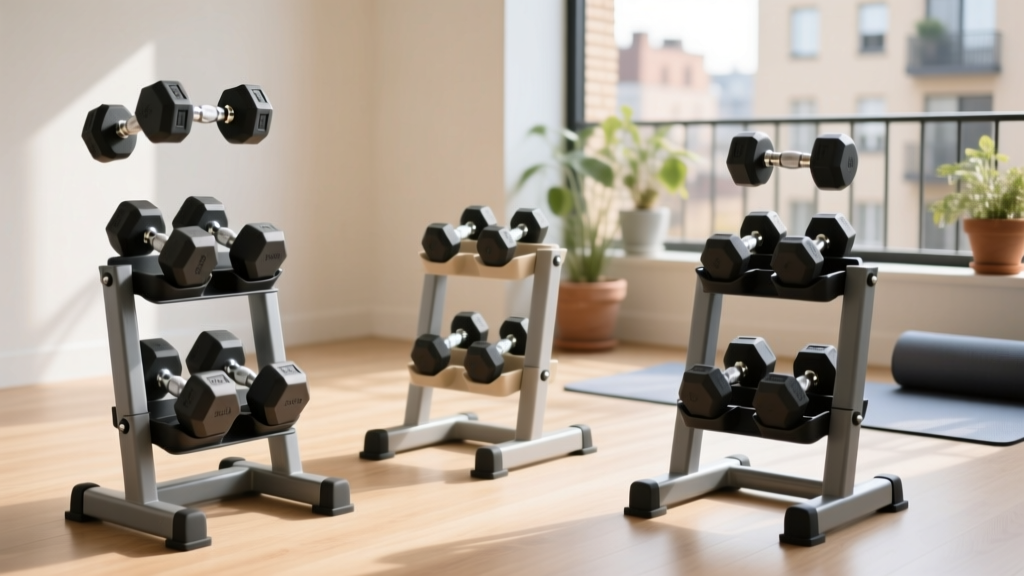
Budget Racks for Triceps Extension Dumbbell Storage: Value Guide
Analyze the best budget dumbbell racks for 2026. We break down storage value, footprint costs, and solutions for your triceps extension dumbbell sets.

The True Cost of Home Gym Clutter
When building a home gym, lifters typically allocate 85% of their budget to the iron itself—barbells, bumper plates, and adjustable benches. Storage is often treated as an afterthought, leading to a dangerous and disorganized workout space. As we navigate the 2026 home gym equipment market, the price of commercial-grade steel has stabilized, making high-quality storage solutions more accessible than ever. However, the definition of 'value' extends far beyond the initial purchase price.
Proper weight storage is a matter of safety, equipment longevity, and workout efficiency. Whether you are racking heavy 100-pound hex bells for floor presses or reaching for a 15-pound triceps extension dumbbell for high-rep isolation work, your storage solution dictates your workflow. Dropping a $300 set of urethane dumbbells onto a concrete floor because you lacked adequate rack space will instantly destroy the rubber casing and compromise the internal steel core. In this guide, we break down the budget storage landscape, analyzing cost-per-square-foot, structural integrity, and specific solutions for lightweight isolation bells.
A-Frame vs. Tiered Racks: A Value Analysis
The two dominant designs in the budget storage category are the A-Frame rack and the horizontal 3-Tier rack. Each serves a distinct purpose and offers a different value proposition depending on your available floor space and the weight range of your dumbbell set.
A-Frame Racks utilize a vertical footprint, storing dumbbells on angled shelves. They are generally cheaper to manufacture and ship, making them the go-to for budgets under $150. However, they suffer from a critical flaw: weight distribution. Loading an A-frame unevenly can create a tipping hazard, and the angled shelves often cause round dumbbells to roll off if they lack proper end-stops.
Horizontal 3-Tier Racks require more horizontal wall space but offer superior ergonomics. You can read the weight markings on the side of the bells without bending over, and the flat shelves provide a much safer resting place for both heavy compound bells and lighter isolation weights. According to extensive testing by Garage Gym Reviews, horizontal racks consistently outscore A-frames in long-term user satisfaction due to ease of access and structural stability.
💡 The Ergonomic Advantage: The average lifter performs 12 to 15 weight changes per workout. Bending down to the bottom tier of an A-frame or squinting at angled bells adds micro-frustrations to your routine. A horizontal 3-tier rack keeps the most frequently used weights (the 20 lb to 50 lb range) precisely at waist height, optimizing your gym's workflow.2026 Budget Rack Comparison Matrix
Below is a data-driven breakdown of the top three budget-friendly dumbbell racks currently dominating the market. Pricing reflects early 2026 averages, including standard shipping estimates.
| Model | Approx. Price | Steel Gauge | Footprint | Value Score |
|---|---|---|---|---|
| Titan Fitness A-Frame | $149.99 | 14-Gauge | 31" x 24" | 7.5 / 10 |
| Rep Fitness 3-Tier (36") | $179.00 | 11-Gauge | 36" x 22" | 9.2 / 10 |
| Rogue 3-Tier (48") | $345.00 | 11-Gauge | 48" x 23" | 8.8 / 10 |
Note: For a complete look at commercial-grade storage options, the Rogue Fitness storage catalog remains the industry benchmark for 11-gauge steel construction and laser-cut precision.
The Triceps Extension Dumbbell Problem
Most budget rack reviews focus entirely on heavy hex dumbbells (50 lbs and above). But what happens to the lighter weights in your set? This is where many lifters encounter a massive design flaw in standard 3-tier racks.
Why Standard Racks Fail Light Weights
Standard horizontal racks feature shelf depths ranging from 8 to 10 inches, designed to cradle the wide heads of a 70-pound hex bell. However, a 10-pound or 15-pound triceps extension dumbbell has a significantly smaller head diameter and a shorter handle. When placed on a deep bottom or middle tier, these small bells often slip through the gaps, roll off the edges, or get buried behind heavier pairs. Isolation exercises require precise weight jumps—moving from a 12 lb to a 15 lb triceps extension dumbbell to achieve progressive overload. If your light bells are scattered on the floor, your workout flow is broken, and the urethane coating is subjected to concrete abrasion.
The $40 Top-Tray Solution
The most cost-effective solution to this problem is the add-on top tray. Brands like Rep Fitness and Titan offer specialized lightweight trays that bolt onto the top tier or the uprights of the rack. For roughly $40 to $60, you gain a dedicated 4-inch deep shelf specifically angled to hold 5 lb to 25 lb dumbbells. This single upgrade increases the functional capacity of your rack by 30% and completely eliminates the 'lost light bell' phenomenon.
Cost-Per-Square-Foot Breakdown
In a standard 2-car garage gym (approx. 400 square feet), every square foot of floor space costs you money in both real estate value and usable workout area. Let's analyze the spatial economics of your rack choice.
- A-Frame Rack: Occupies roughly 5.2 square feet. Stores up to 10 pairs. Cost per sq ft of footprint: ~$28.84 (based on Titan A-Frame).
- 36" 3-Tier Rack: Occupies roughly 5.5 square feet. Stores up to 10 pairs + top tray. Cost per sq ft of footprint: ~$32.54 (based on Rep 3-Tier).
- 48" 3-Tier Rack: Occupies roughly 7.6 square feet. Stores up to 15 pairs. Cost per sq ft of footprint: ~$45.39 (based on Rogue 48").
While the A-Frame wins on pure spatial economy, the 36" 3-Tier rack offers the highest functional value when you factor in the addition of a top tray for your triceps extension dumbbell sets and the ergonomic time saved during supersets.
"A well-organized gym is a safe gym. The leading cause of home gym ankle injuries isn't missed lifts; it's tripping over a 15-pound dumbbell left on the floor because the rack was full or poorly designed for lighter weights."
— Home Gym Safety Standards Report, 2025
Edge Cases and Failure Modes to Avoid
When shopping for budget racks on Amazon or discount fitness sites, beware of these specific structural failure modes that compromise long-term value:
- The 14-Gauge Bend: Racks made from 14-gauge or 16-gauge steel tubing will visibly bow when loaded with more than 400 lbs of total weight. Over a 3-year period, this metal fatigue leads to warped shelves and misaligned welds. Always insist on 11-gauge or 12-gauge steel.
- Plastic End-Stops: Many budget A-frames use injection-molded plastic lips to keep dumbbells from rolling off. Urethane and rubber dumbbells will eventually degrade and shear these plastic stops off, especially in unclimate-controlled garages where temperature fluctuations make the plastic brittle.
- Flimsy Powder Coating: If the rack's paint chips easily during assembly, it will rust rapidly where the metal dumbbell heads scrape against the shelf. Look for racks that advertise a 'textured' or 'matte' powder coat finish, which is applied electrostatically and baked for durability.
Final Decision Framework
To maximize your budget and protect your equipment, use this quick decision matrix based on your current dumbbell inventory:
Scenario A: You own a light set (5 lbs - 25 lbs) primarily for physical therapy, yoga, or isolation work like the triceps extension dumbbell routine.
Recommendation: Skip the heavy-duty 3-tier racks. Invest in a dedicated, compact 'neoprene/urethane tree' or a 2-tier lightweight rack. Cost: $70 - $110.
Scenario B: You own a standard hex set (10 lbs - 50 lbs) for general fitness.
Recommendation: The 36" 3-Tier rack (like the Rep Fitness model) with an add-on top tray. This provides the perfect waist-level access for your 30s and 40s, while keeping your lighter triceps extension dumbbell pairs secure and visible. Cost: $220 - $240 total.
Scenario C: You are a heavy lifter with a set ranging from 15 lbs to 100+ lbs.
Recommendation: The 48" 3-Tier rack. You need the reinforced 11-gauge steel and the wider shelf spacing to accommodate the massive heads of heavy hex bells. Cost: $345+.
Ultimately, treating your storage solutions with the same analytical rigor as your barbells and benches will yield a safer, more efficient, and highly optimized training environment for years to come.
More gear to consider
All reviews
Olympic vs Standard Plates: Alternating Dumbbell Pullover Setup Guide

Bumper vs Iron Plate Cost Analysis: Deadlifts to Dumbbell Chest Row

Olympic vs Standard Plates & the Pullover Exercise with Dumbbells

High Intensity Interval Training with Dumbbells: Best Loadable Gear
Hex vs Urethane for the Dumbbell Rear Foot Elevated Split Squat
