Budget Storage for Leg Workouts with Dumbbells: Female Guide
Discover the best budget dumbbell racks for female leg workouts. We break down cost, safety, and storage value for heavy home gym weights in 2026.

The Storage Paradox of Lower Body Training
When building a home gym optimized for lower-body hypertrophy, equipment logistics quickly become a bottleneck. While online searches for leg workouts with dumbbells female routines dominate fitness forums, the practical reality of storing the required heavy weights is rarely discussed. Female lifters focusing on progressive overload for glutes, hamstrings, and quads require a wider range of heavy dumbbells than upper-body routines demand. Exercises like Romanian Deadlifts (RDLs), Bulgarian split squats, and heavy goblet squats necessitate dumbbell pairs ranging from 20 to 50+ pounds.
This creates a unique storage paradox: you need a rack robust enough to hold 400+ pounds of iron, yet ergonomic enough to allow safe racking and retrieval without risking lumbar or shoulder strain. In 2026, the home fitness equipment market has stabilized, offering excellent budget-friendly storage solutions that do not compromise on structural integrity. This guide breaks down the true value, cost-per-pound metrics, and ergonomic edge cases of budget dumbbell racks tailored for heavy lower-body training.
💡 The 50-Pound Racking Rule: If your leg day includes 50-pound dumbbell RDLs, your rack’s bottom tier must be no higher than 12 inches from the floor. Lifting a 50-pound bell from the ground to a 24-inch high tier places dangerous sheer force on the shoulder capsule and lower back.Weight Requirements for Female Leg Workouts
To accurately assess the value of a dumbbell rack, we must first define the inventory it needs to hold. According to principles outlined by the National Strength and Conditioning Association (NSCA), effective hypertrophy requires progressive overload, typically in the 8-12 rep range. For an intermediate female lifter, a comprehensive leg day requires the following dumbbell pairs:
- Goblet Squats: 1 x 30lb to 45lb dumbbell
- Bulgarian Split Squats: 2 x 20lb to 35lb dumbbells
- Romanian Deadlifts (RDLs): 2 x 35lb to 50lb+ dumbbells
- Weighted Glute Bridges: 1 x 40lb to 50lb dumbbell
- Calf Raises: 2 x 15lb to 25lb dumbbells
This inventory represents roughly 5 to 7 pairs of hex or urethane dumbbells, totaling between 350 and 500 pounds. A standard 2-tier rack will not suffice; a 3-tier A-frame or a heavy-duty horizontal wall mount is mandatory. Furthermore, research published in the Journal of Strength and Conditioning Research highlights that lower-body resistance training in women yields significant strength adaptations when volume and load are adequately scaled, meaning your weight collection—and your storage solution—will only grow heavier over time.
Budget vs. Value: Cost-Per-Pound Analysis
When evaluating budget racks (defined here as the $60 to $160 range), the most critical metric is the Cost-Per-Pound of Capacity (CPPC). Cheap racks often advertise a 500lb capacity but utilize 14-gauge steel with narrow base footprints, leading to severe wobbling when racking heavy bells.
The Hidden Cost of "Cheap" A-Frames
Many entry-level A-frames found on big-box retail sites use thin steel and plastic end-caps. When you drop a 45-pound hex dumbbell onto a 14-gauge steel tier from even a few inches high, the kinetic energy transfers directly into the welds. Over a year of heavy leg workouts, this micro-trauma leads to weld fatigue, tier sagging, and eventual failure. A $70 rack that breaks after 14 months has a terrible long-term value proposition compared to a $140 rack built from 11-gauge steel that lasts a lifetime.
2026 Dumbbell Rack Comparison Matrix
Below is a data-driven comparison of three popular budget-to-mid-tier racks available in 2026, specifically evaluated for heavy lower-body training loads.
| Feature | Amazon Basics 3-Tier Hex Rack | Yes4All Heavy Duty A-Frame | REP Fitness DB-5000 3-Tier |
|---|---|---|---|
| Approx. Price (2026) | $75.00 | $99.00 | $159.00 |
| Steel Gauge | 14-Gauge | 12-Gauge | 11-Gauge |
| Max Weight Capacity | ~400 lbs | ~600 lbs | 1,000+ lbs |
| Bottom Tier Height | 14.5 inches | 11.0 inches | 10.5 inches |
| Wobble Factor (Heavy Load) | High (Requires wall anchoring) | Moderate | Negligible |
| Tier Spacing | 8.5 inches | 9.5 inches | 10.2 inches |
| Value Verdict | Poor for heavy leg days | Best Budget Compromise | Best Long-Term Investment |
"The spacing between tiers is just as important as the weight capacity. Many budget racks fail to account for the larger head diameter of modern urethane dumbbells, causing 40lb and 45lb bells to scrape against the tier above them." — Garage Gym Reviews Equipment Analysis
Edge Cases: Sizing, Ergonomics, and Failure Modes
When optimizing your setup for leg workouts with dumbbells, female lifters must pay special attention to the ergonomics of retrieval. Picking up two 40-pound dumbbells for RDLs requires a hip-hinge mechanic. If your rack’s bottom tier is too high, or if the footprint is too wide, you are forced to round your lower back to grip the weights.
The Urethane vs. Rubber Head Width Problem
A common failure mode in budget storage is buying a rack before measuring your dumbbells. Standard rubber hex dumbbells (like CAP Barbell) have relatively compact heads. However, premium urethane dumbbells (like Rogue or REP) feature wider, rounded heads to protect floors. If you buy the Amazon Basics 3-Tier rack (8.5-inch tier spacing) but own urethane bells, your 35lb, 40lb, and 45lb pairs will not fit on the same tier, rendering the rack useless for your heaviest leg day weights.
⚠️ Safety Warning: The Pendulum EffectNever store heavy dumbbells (35lbs+) on the top tier of an A-frame rack. When you remove a heavy bell from the top, the center of gravity shifts violently. If the base footprint is less than 24 inches deep, the rack can tip forward, causing catastrophic injury.
Space Optimization for Small Home Gyms
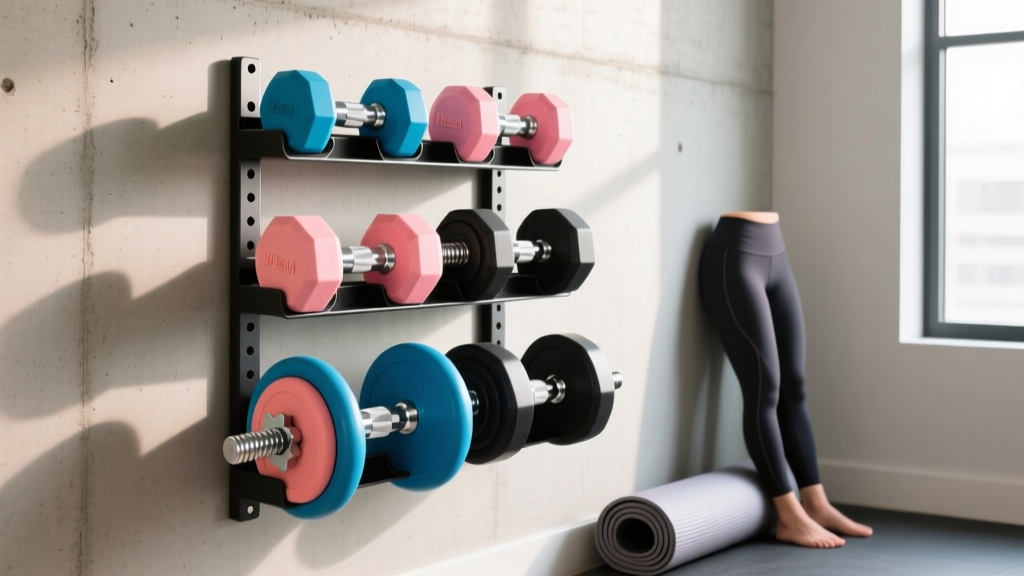
Not every home gym has the 4-foot clearance required for an A-frame. If you are working out in a spare bedroom or apartment, wall-mounted horizontal racks offer a superior spatial footprint. While slightly more expensive ($120-$180 for heavy-duty wall brackets), they eliminate the trip hazard of A-frame legs and allow you to mount the bottom tier exactly 10 inches off the floor, perfectly aligning with the ergonomic hip-hinge retrieval needed for heavy split squats and lunges.
DIY vs. Commercial Storage
Some budget-conscious lifters attempt to build DIY wooden dumbbell racks. While a DIY wooden rack built from 2x4 lumber and lined with horse-stall mat rubber can hold the weight, wood is susceptible to warping from humidity and lacks the sheer-strength of steel welds. For the $99 you would spend on materials and hardware, you are better served by purchasing the Yes4All 12-gauge A-frame, which offers verified load-bearing safety and a much smaller physical footprint.
Final Verdict: Maximizing Your Equipment Budget
Designing a home gym for intensive leg workouts with dumbbells requires treating your storage equipment with the same respect as the weights themselves. The repetitive impact of racking 40-pound and 50-pound dumbbells will quickly expose the weaknesses of ultra-cheap, 14-gauge steel racks.
For lifters on a strict budget, the Yes4All Heavy Duty A-Frame ($99) provides the best compromise of low-tier height (11 inches) and adequate tier spacing for most rubber hex dumbbells. However, if your leg day routinely pushes past 45-pound dumbbells, bypassing the budget tier to invest in the REP Fitness DB-5000 ($159) is a non-negotiable safety and longevity upgrade. By prioritizing 11-gauge steel, low bottom-tier heights, and adequate tier spacing, you ensure that your storage solution supports your progressive overload journey safely and efficiently.
More gear to consider
All reviews
Olympic Barbell Setup: Knurling & Incline Dumbbell Chest Press Form

Bumper vs Iron Plates & Dumbbell Curl Bench Care
Put Down the Dumbbell Mug: Beginner Guide to Barbell Collars

Brachialis Dumbbell Workout: Dumbbell Rack Budget Guide

Prone Y Raise Dumbbell Trends 2026: Rubber Hex vs Urethane
