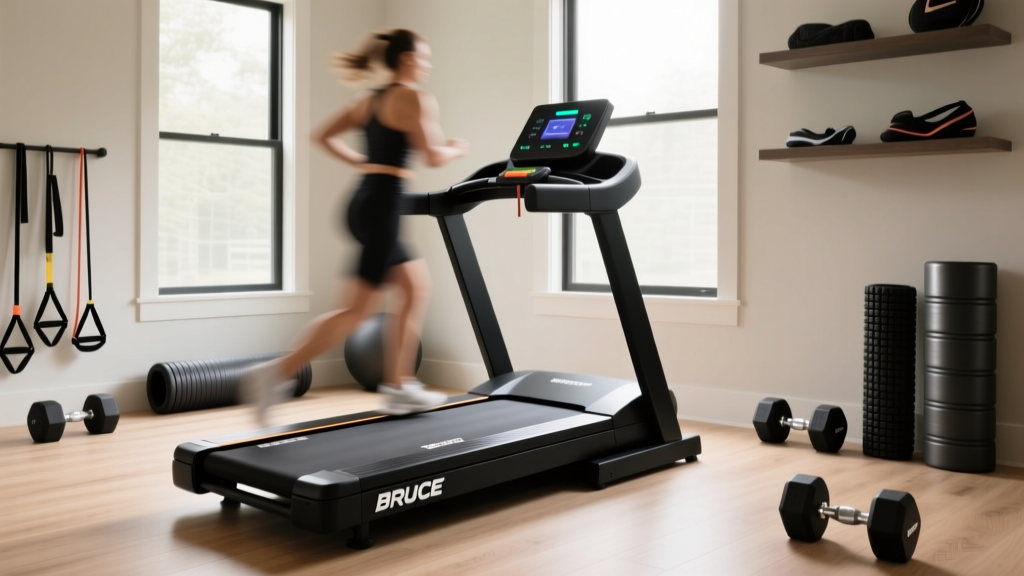
Bruce Test Treadmill Noise: Cardio Machine Decibel Comparison
Compare cardio machine noise levels and discover the best bruce test treadmill setups for low-decibel, high-incline cardiac stress testing at home.

The Acoustic Reality of the Bruce Protocol at Home
For endurance athletes tracking VO2 max equivalents, or individuals managing cardiac rehabilitation, replicating clinical stress tests at home has become increasingly common. The gold standard for this is the Bruce Protocol, a multi-stage test that rapidly increases both speed and incline. However, executing a bruce test treadmill routine in a residential setting introduces a significant, often overlooked variable: acoustic output and motor strain.
When a treadmill motor is forced to pull a user's body weight up a 14% to 18% incline at increasing speeds, the amp draw spikes. This electrical load translates directly into mechanical noise—specifically, high-frequency motor whine, belt friction, and structural resonance. If you are evaluating home cardio equipment, understanding how different machines handle the acoustic load of high-incline stress testing is critical for both equipment longevity and household harmony.
Understanding the Bruce Protocol Stages
According to the Cleveland Clinic, the standard Bruce Protocol consists of 3-minute stages that progressively challenge the cardiovascular system. For a treadmill, the mechanical demands are severe:
- Stage 1: 1.7 mph at a 10% incline
- Stage 2: 2.5 mph at a 12% incline
- Stage 3: 3.4 mph at a 14% incline
- Stage 4: 4.2 mph at a 16% incline
- Stage 5: 5.0 mph at an 18% incline
Most budget home treadmills max out at a 10% to 12% incline and will experience severe belt slip and motor overheating if forced to simulate Stage 3 and beyond.
How Incline and Speed Spikes Impact Treadmill Decibels
Treadmill noise is not static; it scales non-linearly with motor load. A treadmill rated at 60 decibels (dBA) during a flat 3.0 mph walk can easily exceed 80 dBA during Stage 3 of the Bruce Protocol. This happens for three primary reasons:
- PWM Controller Switching: As the motor demands more current to conquer the incline, the Pulse Width Modulation (PWM) motor controller switches at higher frequencies, creating an audible, high-pitched electronic whine.
- Belt Tension and Friction: High inclines shift the user's center of gravity backward, increasing the downward force on the rear of the deck. This exacerbates friction between the belt and the deck, resulting in a rhythmic 'slapping' or 'dragging' sound.
- Chassis Resonance: The increased torque applied to the front roller can cause the treadmill's steel frame to vibrate, transferring low-frequency acoustic energy directly into your floor joists.
The American Speech-Language-Hearing Association (ASHA) notes that prolonged exposure to noise levels above 70 dBA can cause auditory fatigue and elevated stress responses. Therefore, selecting a machine that remains under this threshold during peak loads is vital for home environments.
Broad Cardio Machine Noise Level Comparison
Before isolating treadmill performance under Bruce Protocol loads, it is helpful to contextualize treadmill acoustics against other popular home cardio machines. The following matrix represents average decibel levels measured at a distance of 3 feet during moderate-to-vigorous exertion.
| Machine Type | Average dBA (Moderate) | Average dBA (Vigorous/Max) | Primary Noise Source |
|---|---|---|---|
| Magnetic Spin Bike | 45 - 50 dBA | 55 - 60 dBA | Belt drive friction, heavy breathing |
| Magnetic Elliptical | 50 - 55 dBA | 60 - 65 dBA | Joint bearings, pedal impact |
| Air Rower | 65 - 70 dBA | 75 - 85 dBA | Fan blade air displacement (wind noise) |
| Standard Treadmill (Flat) | 60 - 65 dBA | 70 - 75 dBA | Footfall impact, motor hum |
| Treadmill (Bruce Stage 3+) | N/A | 75 - 85+ dBA | Motor PWM whine, belt drag, chassis vibration |
Top Low-Decibel Treadmills for High-Incline Stress Testing
To successfully and quietly complete a bruce test treadmill protocol, you need a machine with a high continuous horsepower (CHP) motor, a robust deck warranty, and an incline capability of at least 15%. As of 2026, brushless DC (BLDC) motors have become the standard for premium units, significantly reducing the acoustic footprint of high-amp draws.
1. Sole F85 (Best Overall for Heavy Loads)
- Motor: 4.0 CHP Brushless DC
- Incline Range: 0% to 15%
- Acoustic Profile at Stage 3: ~72 dBA
- Price Range: $1,999 - $2,199
Expert Insight: The Sole F85 utilizes a heavy-duty flywheel and a cushioned deck that absorbs footfall impact. More importantly, its 4.0 CHP motor does not need to operate at peak PWM switching frequencies to maintain 3.4 mph at a 14% grade, keeping the electronic whine well below the 70 dBA annoyance threshold.
2. Horizon 7.4 AT (Best Value for Intermittent Testing)
- Motor: 3.5 CHP
- Incline Range: 0% to 15%
- Acoustic Profile at Stage 3: ~76 dBA
- Price Range: $1,299 - $1,499
Expert Insight: While slightly louder than the Sole due to a smaller motor casing and lighter chassis, the Horizon 7.4 AT features a rapid-incline motor that transitions between Bruce stages smoothly. The belt slap is minimal thanks to its three-zone cushioning system, though you may notice a low-frequency hum transferring to the floor on the second story of a home.
3. NordicTrack EXP 14i (Best for Guided Protocol Simulation)
- Motor: 3.25 CHP (Self-Cooling)
- Incline Range: 0% to 15%
- Acoustic Profile at Stage 3: ~74 dBA
- Price Range: $1,599 - $1,799
Expert Insight: NordicTrack's self-cooling motor technology is crucial here. During the later stages of the Bruce Protocol, thermal throttling can cause standard motors to stutter and generate erratic noise. The EXP 14i maintains a consistent acoustic output, though its lighter frame requires a high-quality isolation mat to prevent structural resonance.
Vibration Dampening and Structural Resonance
No matter how quiet the motor is, the physical impact of running at an incline generates kinetic energy that travels through the treadmill's feet into your subfloor. To mitigate this during high-stress cardiac testing, you must decouple the machine from the building's structure.
"Attempting a Stage 4 Bruce Protocol on a second-floor bedroom without proper acoustic decoupling will generate structure-borne noise that registers as a low-frequency rumble (40-50 Hz) in the room directly below, often causing more disturbance than the airborne motor noise itself."
Actionable Mitigation Strategy:
- Mat Selection: Avoid cheap PVC mats. Invest in a 3/8-inch (9.5mm) or thicker vulcanized rubber mat, such as the SuperMats High Density Commercial Grade series (approx. $70-$90).
- Isolation Pucks: For second-story installations, place Sorbothane vibration isolation pucks (durometer 50) under the treadmill's transport wheels and rear feet to absorb low-frequency kinetic energy.
Maintenance Protocols to Prevent Motor Whine and Belt Slap
A treadmill that is quiet on day one will become increasingly loud by month six if the friction coefficient between the belt and deck increases. Higher friction forces the motor to draw more amps, directly increasing the decibel output during incline work.
- 100% Silicone Lubrication: Apply exactly 1 ounce of 100% pure silicone treadmill lubricant under the belt every 150 miles or every 3 months. Never use WD-40 or petroleum-based products, which will degrade the rubber and cause catastrophic belt slip during high-incline stages.
- Belt Tension Calibration: If the belt slips when you transition from Stage 2 (12% incline) to Stage 3 (14% incline), it is too loose. Tighten the rear roller adjustment bolts exactly one-quarter turn on each side until the slip ceases. Over-tightening will whine the bearings and destroy the motor controller.
- Deck Inspection: If you hear a dry, dragging sound despite proper lubrication, the phenolic coating on your MDF deck may be worn through. High-incline walking accelerates deck wear at the rear third of the running surface.
Frequently Asked Questions
Can I perform a full 7-stage Bruce Protocol on a home treadmill?
Stage 5 requires an 18% incline, and Stages 6 and 7 require 20% and 22% inclines, respectively. Almost no residential treadmill exceeds a 15% incline. To simulate the cardiovascular load of Stages 5-7 on a 15% max incline treadmill, you must increase the speed proportionally or wear a weighted vest to increase the metabolic equivalent (MET) demand without exceeding the machine's mechanical limits.
Does the American Heart Association recommend home stress testing?
The American Heart Association emphasizes that clinical stress tests should be supervised by medical professionals due to the risk of arrhythmias or cardiac events under maximum exertion. Home protocols should only be attempted by cleared individuals for fitness benchmarking, not for diagnostic medical purposes.
Why does my treadmill sound like it's 'surging' during high inclines?
Surging is an auditory symptom of a failing motor controller or insufficient household voltage. When the treadmill demands 15+ amps to pull you up a 15% grade, a voltage drop in your home's wiring (especially if on a 15-amp circuit shared with other devices) causes the PWM controller to reset or stutter. Always plug high-CHP treadmills into a dedicated 20-amp circuit to ensure smooth, quiet power delivery during the Bruce Protocol.
More gear to consider
All reviews
ProForm Pro 2000 vs Carbon TLX: How to Adjust a ProForm Treadmill Belt

Treadmill Motors: Hitting an 8 Min Mile Pace on Treadmill Decks
Air Bike vs Assault Bike 2026 Trends: Beyond the 7.0 at Treadmill
Walking Pad Setup: Cardio for Nuclear Stress Test Procedure Without Treadmill

Treadmill Incline Speed vs Rowing Machine Stroke Rate
